Thermodynamics cycles quick question

Click For Summary
SUMMARY

The discussion focuses on the analysis of thermodynamic processes involving a piston and gas within a vertical cylinder. The initial confusion arises from the understanding of heat transfer and pressure changes during isobaric and isochoric processes. It is clarified that during the first stage, heat is added at constant volume, leading to an increase in pressure until the piston lifts. The second stage involves the piston rising while maintaining constant pressure, requiring a specific temperature increase to achieve the desired volume change.

PREREQUISITES
  • Understanding of thermodynamic processes, specifically isobaric and isochoric processes.
  • Familiarity with pressure-volume (PV) diagrams and their interpretation.
  • Knowledge of gas behavior under varying temperature and pressure conditions.
  • Basic principles of mechanics related to pistons and cylinders.
NEXT STEPS
  • Study the principles of isobaric and isochoric processes in thermodynamics.
  • Learn how to construct and interpret PV diagrams for different thermodynamic cycles.
  • Research the ideal gas law and its applications in thermodynamic calculations.
  • Explore real-world applications of piston-cylinder systems in engines and refrigeration cycles.
USEFUL FOR

Students and professionals in physics and engineering, particularly those studying thermodynamics, mechanical engineering, or anyone involved in designing and analyzing piston-cylinder systems.

Jaydude
Messages
3
Reaction score
0
I'm unsure of part b of the question 7 below;
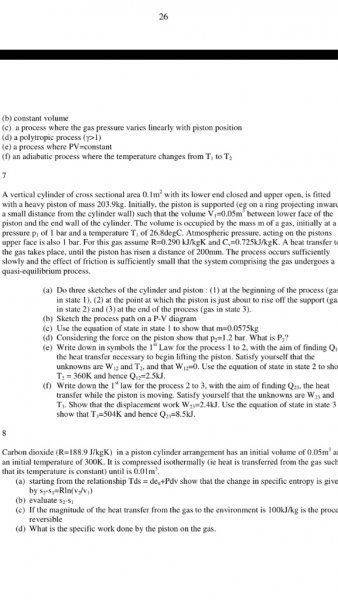
ImageUploadedByPhysics Forums1423230802.914015.jpg


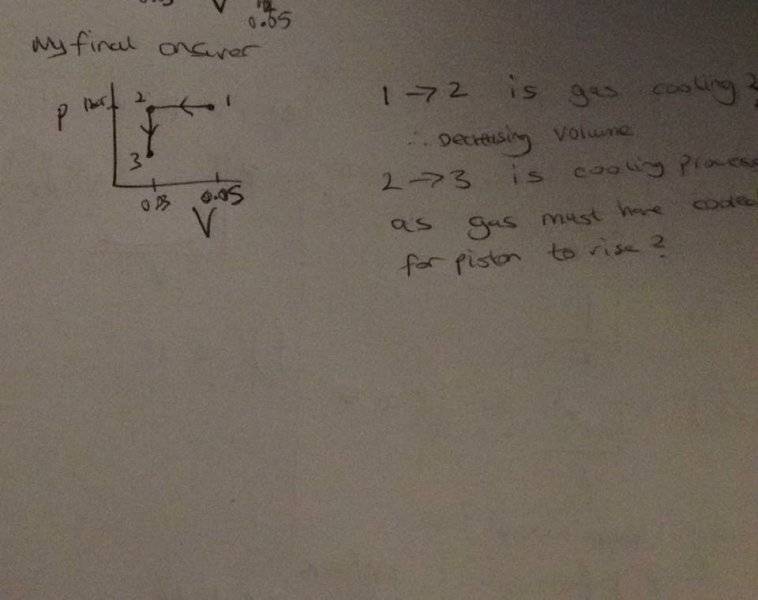
My attempt:
ImageUploadedByPhysics Forums1423230835.870688.jpg


I'm confused as to what direction the arrows are meant to go.
If heat transfer occurs to the gas, and the piston rises, the volume must have decreased in the cylinder.

So from state 1 - 2, the gas is cooling or heating up? This is a isobaric process right?
And from states 2- 3 the piston moves up, known as isochoric?

Finally therefore is my process path correct?

Thanks, kind regards,
Jay
 
Physics news on Phys.org
Hi Jay. Welcome to Physics Forums.

I have bad news for you. Sorry. Your analysis is completely incorrect.

The weight of the piston is supported on the ridge inside the cylinder, until the pressure within the cylinder is high enough to start lifting the piston. So when heat is being added to the gas in the first stage of the process, the pressure of the gas is increasing at constant volume. How high does the temperature of the gas have to get before the pressure is high enough to start lifting the piston? In the second stage of the process, heat continues to be added to the gas, but now the piston is rising, so that its pressure stays constant. How high does the temperature of the gas have to get in this stage of the process to bring about the desired increase in volume?

Now, re-evaluate the PV diagram and see what you come up with.

Chet
 
Still slightly confused;

So the gas is actually under the piston in the cylinder? Can you provide pictures as I can't visualise what you mean.
What about the gas above the piston?

Although if the gas is under the piston, I guess heating it up, doing work on it would increase pressure, which would produce force up on piston which makes sense, or am I completely wrong again?

Thanks
 
The cylinder is vertical, and the gas is within the cylinder. The piston sits on top of the gas, and there is air outside. The bore of the cylinder has two sections: (1) drilled from the top all the way down the length of the cylinder, at a diameter slightly less than that of the piston (2) drilled half way down the length of the cylinder from the top, with a diameter essentially equal to that of the piston (so that the piston slides freely). Initially, the piston sits on the ridge between the two sections, half way down the length.

Chet
 

Similar threads

  • · Replies 3 ·
Replies
3
Views
1K
  • · Replies 1 ·
Replies
1
Views
3K
Replies
49
Views
3K
  • · Replies 1 ·
Replies
1
Views
2K
Replies
2
Views
2K
Replies
8
Views
2K
Replies
2
Views
1K
Replies
14
Views
2K
  • · Replies 5 ·
Replies
5
Views
1K
  • · Replies 8 ·
Replies
8
Views
4K