Thermodynamics - engines question

Join the discussion
Registration is free. Ask a follow-up in this thread, or start your own.
11 replies · 2K views
Jaydude
Messages
3
Reaction score
0
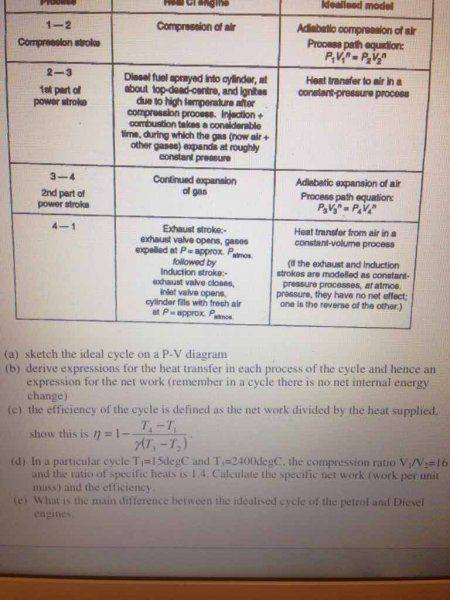
I'm stuck on a question, part d below:
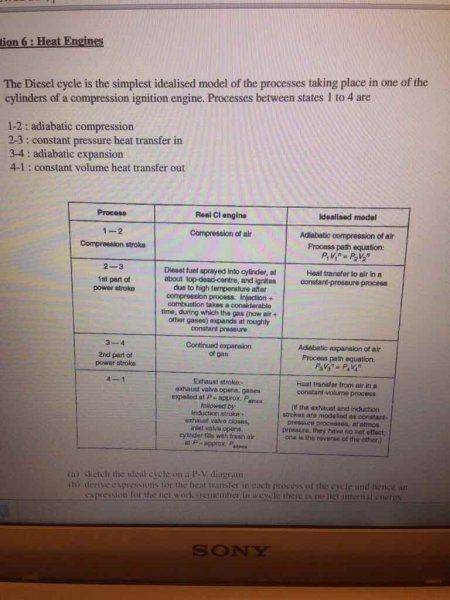
ImageUploadedByPhysics Forums1426372078.640984.jpg
ImageUploadedByPhysics Forums1426372110.374401.jpg


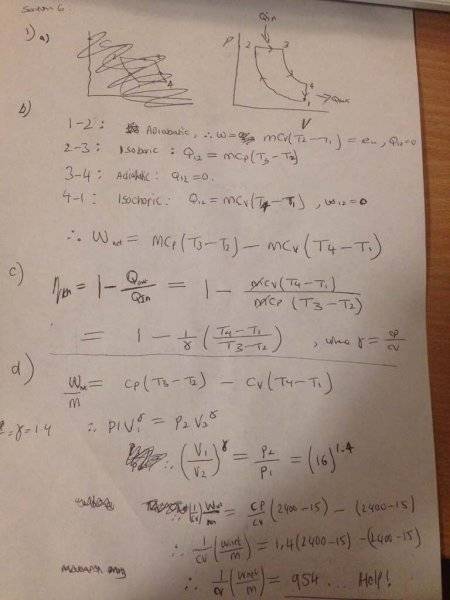
My attempt:
ImageUploadedByPhysics Forums1426372492.452289.jpg


I reckon that T4 = T3 and T2 = T1, otherwise I don't know how else you can get T4 and T2...?

Once I got first part of d, I reckon I could do efficiency using part c that I derived.

I don't see where I'm supposed to use compression ratios in this question, if someone can direct me to the right path please!

(If this is supposed to be in advanced physics section, please let me know for next time!)

Kind regards,

Jay
 
Physics news on Phys.org
Hello Jay. Welcome to PF!

Jaydude said:
I reckon that T4 = T3 and T2 = T1, otherwise I don't know how else you can get T4 and T2...?
You are given that ##P_2V_2^\gamma = P_1V_1^\gamma##. See if you can use that along with the ideal gas law to express T2 in terms of T1, V1 and V2.
 
ImageUploadedByPhysics Forums1426442178.074818.jpg


Sweet! But now I'm not sure how to get t4? And how do I apply that to get work done?

I could use my equation (correct) in part b but I don't know what Cp and Cv are, how do I apply the constant 1.4 there?

(I'm going to assume t2 is correct here...)

Thanks!
 
Try a similar calculation to find T4 in terms of T3.
 
TSny said:
Hello Jay. Welcome to PF!You are given that ##P_2V_2^\gamma = P_1V_1^\gamma##. See if you can use that along with the ideal gas law to express T2 in terms of T1, V1 and V2.
TSny said:
Try a similar calculation to find T4 in terms of T3.

But I don't have V3/V4 compression ratio :(
 
Jaydude said:
But I don't have V3/V4 compression ratio :(
How is V4 related to V1? How is V3 related to V2?
 
ImageUploadedByPhysics Forums1426446649.608185.jpg


I see what you did there, but I get the incorrect answer, T4 should be 1379k

What have I done wrong ?
 
How do you justify taking V4 / V3 to be 16?
 
TSny said:
How is V4 related to V1? How is V3 related to V2?
TSny said:
How do you justify taking V4 / V3 to be 16?

If V4 = V1 and V3 = V2, and we know V1/V2 = 16, then V4/V3 = 16 too...?
 
I see my problem.

V2 does not equal V3!

Can't solve this, its getting annoying as I've spent hours ripping my hair out on this!
 
Last edited:
Bump. Can Someone point me in the right direction here/helpout with the solution? This is only for my practise and is not part of any H/W or Cwk and all of my friends are struggling with this Q too.

Kind regards,
Jay
 
V2 does not equal V3, but you can express V3 in terms of V2 using the ideal gas law.