Academic First Law Of Thermodynamics Problem

Kolin101
Messages
4
Reaction score
0
Homework Statement
An insulated tank of volume 12 m3 and with a valve was filled with perfect triatomic gas at pressure 10 bar. Initially the valve was closed. A paddle wheel was mounted inside the tank and was run by 20 kW engine. The paddle wheel was turn on and at the same time the exit valve was opened. The gas temperature was constant trough the whole process (due to very slow flow) and equal to 300 K.
Calculate the time needed to decrease the pressure in the tank to 5 bar.
Relevant Equations
dU=dQ-dW-dmh
Hi there. I have a problem solving above problem. How can I move on with my solution? It seems to me that I have proper approach but I'm just stuck with the energy equation ;/

Part of solution below:
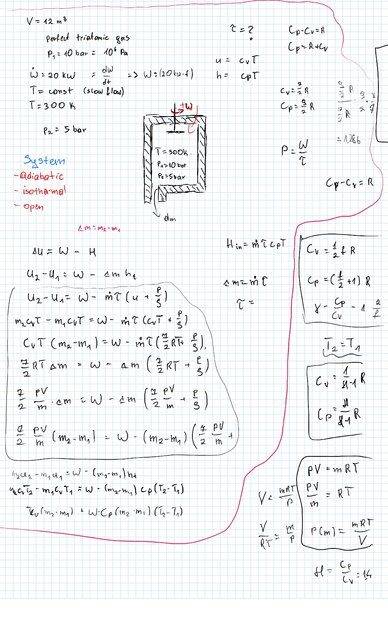
Exam Questions Test 1 - Strona 1.jpg
 
This involves application of the open-system version of the 1st law of thermodynamics, and, for this particular problem, should be formulated as a time-dependent differential equation (rather than using finite differences): $$\frac{d(nu)}{dt}=-\dot{W}+h\frac{dn}{dt}=-\dot{W}+u\frac{dn}{dt}+RT\frac{dn}{dt}$$For constant temperature, this reduces to: $$0=-\dot{W}+V\frac{dP}{dt}$$
 
  • Like
Likes   Reactions: Kolin101
Thank You a lot, I've tried also this way but with no results. But to be sure, what for does the "n" stands for in your first equation?
 
Kolin101 said:
Thank You a lot, I've tried also this way but with no results. But to be sure, what for does the "n" stands for in your first equation?
Number of moles in tank at time t.
 
  • Like
Likes   Reactions: Kolin101
ok I've figured out how would it look like in "my style solution" but I still have some questions. Why does the $$ u\frac{dn}{dt} $$
term disappears? when i rewrote it using mass instead of moles, the term
$$\frac{dm}{dt}CvT$$ seems to have a non zero value (there is a mass flowing out, that caries out internal energy at T=300K) and unfortunately Cv is not known either ;/

(new solution attached below the quote)
Chestermiller said:
This involves application of the open-system version of the 1st law of thermodynamics, and, for this particular problem, should be formulated as a time-dependent differential equation (rather than using finite differences): $$\frac{d(nu)}{dt}=-\dot{W}+h\frac{dn}{dt}=-\dot{W}+u\frac{dn}{dt}+RT\frac{dn}{dt}$$For constant temperature, this reduces to: $$0=-\dot{W}+V\frac{dP}{dt}$$

tank discharge.jpg
 
Kolin101 said:
ok I've figured out how would it look like in "my style solution" but I still have some questions. Why does the $$ u\frac{dn}{dt} $$
term disappears?
It cancels from both sides of the equation. What is the derivative of un with respect to t? On the rhs, h=u+Pv.
 

Similar threads

Replies
5
Views
3K
Replies
28
Views
2K
  • · Replies 3 ·
Replies
3
Views
2K
  • · Replies 2 ·
Replies
2
Views
838
  • · Replies 2 ·
Replies
2
Views
2K
Replies
12
Views
3K
  • · Replies 37 ·
2
Replies
37
Views
5K
  • · Replies 1 ·
Replies
1
Views
2K
Replies
25
Views
2K
  • · Replies 1 ·
Replies
1
Views
3K