Thermodynamics Pathria Eq.4.5.9

Click For Summary
SUMMARY

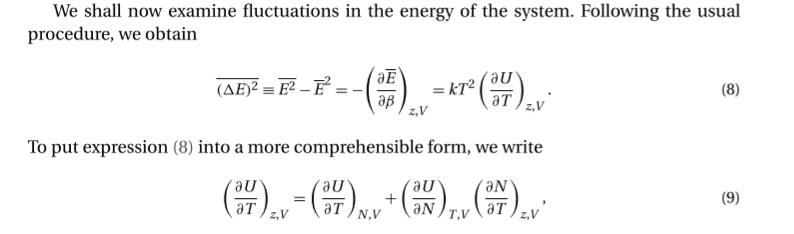
The discussion centers on the derivation of Equation 4.5.9 from Pathria's thermodynamics textbook, specifically addressing the variables that define the average internal energy U. The key variables include temperature T, chemical potential (expressed through fugacity z), volume V, and particle number N. The participants clarify that only three of these four parameters are necessary to specify U, and they detail the differentiation process required to arrive at Equation 4.5.9. The final expression for dU is derived by equating two forms of the differential and applying the appropriate conditions.

PREREQUISITES
  • Understanding of thermodynamic concepts, particularly internal energy U
  • Familiarity with partial derivatives in multivariable calculus
  • Knowledge of chemical potential and fugacity in thermodynamics
  • Experience with LaTeX for mathematical expressions
NEXT STEPS
  • Study the derivation of thermodynamic equations in Pathria's "Statistical Mechanics"
  • Learn about the relationship between chemical potential and fugacity in thermodynamic systems
  • Practice calculating partial derivatives of thermodynamic functions
  • Explore applications of Equation 4.5.9 in real-world thermodynamic problems
USEFUL FOR

Students and professionals in physics and engineering, particularly those specializing in thermodynamics and statistical mechanics, will benefit from this discussion.

IcedCoffee
Messages
20
Reaction score
4
I'm confused about the mathematics that led to the equation 4.5.9.
upload_2018-10-9_16-19-51.png


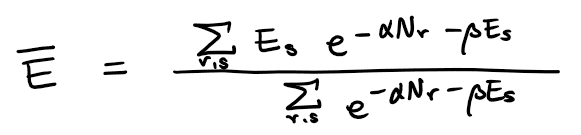
Specifically, I'm confused about what the variables that describe U are.

From the equation
upload_2018-10-9_16-26-44.png


I think temperature T(through beta), chemical potential (through alpha), V (through E_s) and N (through... restriction on the summation?) defines the (average) internal energy U,

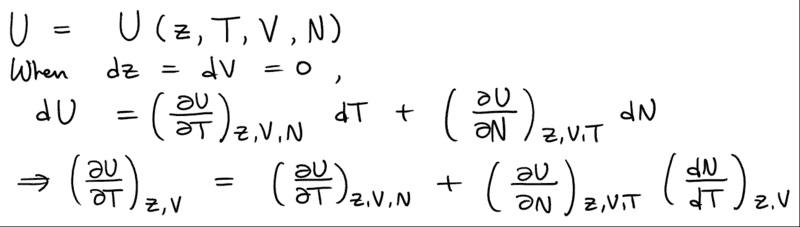
but how should I do the differentiation? What I ended up was that the chemical potential dependence can be changed to the dependence on the fugacity z so that
upload_2018-10-9_16-29-42.png


but it doesn't seem to be exactly eq.4.5.9 to me.
 

Attachments

  • upload_2018-10-9_16-19-51.png
    upload_2018-10-9_16-19-51.png
    13.9 KB · Views: 852
  • upload_2018-10-9_16-26-44.png
    upload_2018-10-9_16-26-44.png
    3.7 KB · Views: 822
  • upload_2018-10-9_16-29-42.png
    upload_2018-10-9_16-29-42.png
    11.2 KB · Views: 552
Science news on Phys.org
I have the answer. It's going to take me a few minutes to write out the partial derivatives in Latex... ## \\ ## ## z=z(T, N,V) ##, so that ## U(T,z,V)=U(T,N,V) ## . ## \\ ## Three parameters are need to specify ## U ##, not 4 . Any 3 of the 4, (##z,T,N,V ##), can be chosen.## \\ ## Now using the first expression for ## U ##, ## \\ ## ## dU=(\frac{\partial{U}}{\partial{T}})_{z,V} \, dT+(\frac{\partial{U}}{\partial{z}})_{V,T} \, dz+(\frac{\partial{U}}{\partial{V}})_{z,T} \, dV ##. ## \\ ## Taking the second expression: ## \\ ## ## dU=(\frac{\partial{U}}{\partial{T}})_{N,V} \, dT+(\frac{\partial{U}}{\partial{N}})_{V,T} \, dN+(\frac{\partial{U}}{\partial{V}})_{N,T} \, dV ##. ## \\ ## Now, set ## dz=0 ## and ## dV=0 ##, and set the two ## dU's ## equal. Take a partial w.r.t. ## T ## at constant ## z,V ##, (we set ## dz ## and ## dV=0 ## ), =divide through by ## dT ## everywhere, and the result is the equation 4.5.9. ## \\ ## @Chestermiller This is a good thermodynamics problem that the OP has. Might you have anything to add?
 
Last edited:
@IcedCoffee You have a very interesting question, but so far you haven't returned to see the answer.
 

Similar threads

Replies
5
Views
1K
  • · Replies 1 ·
Replies
1
Views
1K
  • · Replies 4 ·
Replies
4
Views
3K
  • · Replies 1 ·
Replies
1
Views
1K
  • · Replies 1 ·
Replies
1
Views
2K
  • · Replies 9 ·
Replies
9
Views
3K
  • · Replies 3 ·
Replies
3
Views
2K
  • · Replies 6 ·
Replies
6
Views
4K
  • · Replies 8 ·
Replies
8
Views
2K
  • · Replies 22 ·
Replies
22
Views
20K