Thermodynamics - Second Law: 2 Heat Engines Connected Between 3 Metal Blocks

Click For Summary
SUMMARY

The forum discussion centers on solving a thermodynamics problem involving two heat engines connected between three metal blocks. Key insights include the application of the Second Law of Thermodynamics, where the total change in entropy must equal zero, and the equations for heat transfer (Q) and work (W) between the blocks. The participants derive equations for heat transfer, such as Q1, Q2, and Q3, and discuss the integration of entropy changes using the formula ds = dq/T. The final results yield temperatures T1 = 1.34730T and T2 = 3.3054T, with alternative roots also identified.

PREREQUISITES
  • Understanding of the Second Law of Thermodynamics
  • Familiarity with heat transfer equations (Q = mcΔT)
  • Knowledge of entropy and its calculation (ds = dq/T)
  • Basic skills in solving simultaneous equations
NEXT STEPS
  • Explore the implications of the Second Law of Thermodynamics in practical applications
  • Learn about the integration of thermodynamic equations for entropy calculations
  • Investigate the physical significance of multiple solutions in thermodynamic problems
  • Study the behavior of heat engines and their efficiency in thermodynamic cycles
USEFUL FOR

Students and professionals in physics and engineering, particularly those focusing on thermodynamics, heat transfer, and energy systems. This discussion is beneficial for anyone looking to deepen their understanding of heat engines and entropy calculations.

Master1022
Messages
590
Reaction score
116
Homework Statement
Three blocks of metal have the same mass and specific heat. Their initial temperatures are T, 2T, and 3T. Reversible heat engines are connected between these blocks, but no net work is produced or used. No heat is exchanged with the surroundings. Finally two of the blocks reach the same temperature T1, and the third block reaches T2. Find these temperatures.
Relevant Equations
First law of thermodynamics
Second law of thermodynamics
Hi,

I posted a similar question recently and gained some insight on these types of problems. However, I am slightly stumped on how to approach this variation of the problem.

So I know that:
- there is no net change in enthalpy of the blocks and the engine as the processes are reversible
- \Delta S_{surroundings} = 0 as no heat is exchanged with surroundings
- the internal energy of the system should not change as it is a cycle

I have made a quick sketch of what I envision system to look like - but perhaps I am wrong. I have assumed that the work extracted from a certain turbine connecting block i to j is used to power the pump between those same blocks.
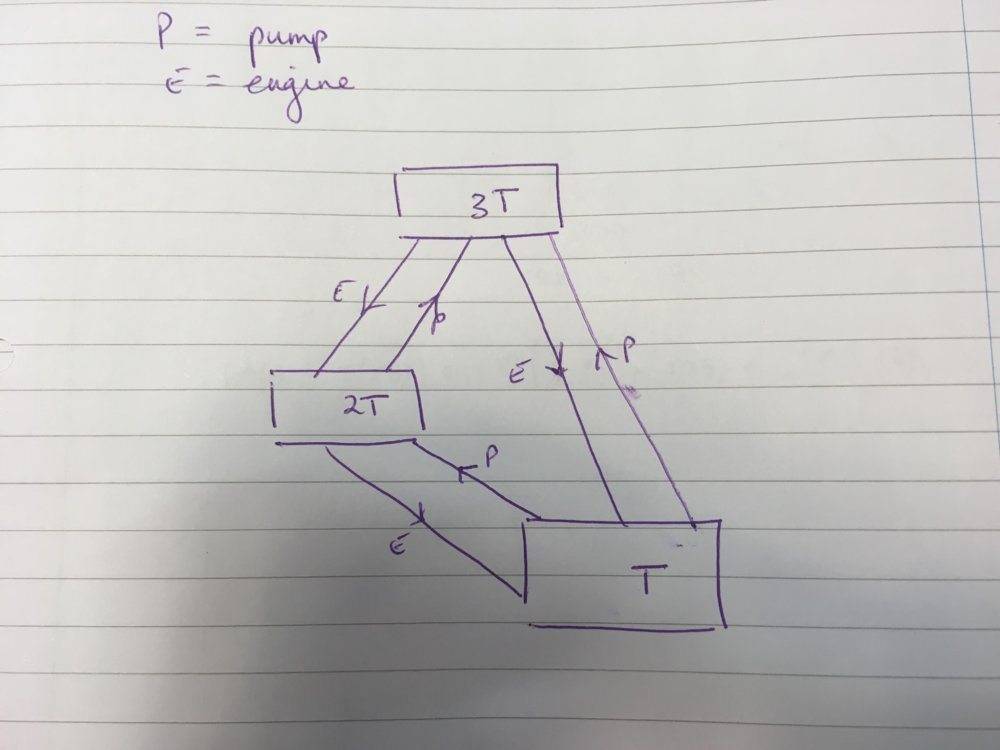
IMG_8748.jpg

(have left out work terms for simplicity in the drawing)

I tried to start writing equations for dQ_i for each block, but am ending up with lots of big equations (am thinking that surely there is a more elegant way of solving this). For example, if we number the blocks 1, 2, and 3 (with the numbering corresponding to the blocks with the initial termperature as nT), then I am getting the following equation for dQ_1:
dQ_1 = mcdT_2 - dW_{21} - mcdT_1 - mcdT_1 + mcdT_3 + dW_{31}

doing the same for dQ_2 and dQ_3, I get:
dQ_2 = mcdT_3 - dW_{23} - 2mcdT_2 + mcdT_1 + dW_{21}
dQ_3 = mcdT_2 + dW_{23} - 2mcdT_3 + mcdT_1 + dW_{31}

Then, given that we know that dS = \frac{dQ}{T} = 0, then combining those equations, I get:
\frac{dQ_1}{T_1} + \frac{dQ_2}{T_2} + \frac{dQ_3}{T_3} = 0
rearranging gives:
mcdT_1 \left( \frac{1}{T_2} + \frac{1}{T_3} + \frac{-2}{T_1} \right) + mcdT_2 \left( \frac{1}{T_3} + \frac{1}{T_1} + \frac{-2}{T_2} \right) + mcdT_3 \left( \frac{1}{T_2} + \frac{1}{T_1} + \frac{-2}{T_3} \right) + dW_{13} \left( \frac{1}{T_3} - \frac{1}{T_1} \right) + dW_{12} \left( \frac{1}{T_2} - \frac{1}{T_1} \right) + dW_{23} \left( \frac{1}{T_3} - \frac{1}{T_2} \right) = 0

I am not really sure if what to do from here (or if this was the right path to follow). I could integrate, but then I am not sure what to do with all the work terms that I have.

Any help would be greatly appreciated.
 
Last edited by a moderator:
Physics news on Phys.org
It seems to me you are getting bogged down in the details. The key to this problem, in my judgment, is to guess which block reaches T2, subject to the constraints that
1. Since there is no work done and no change in internal energy, so Q1+Q2+Q3=0
2. The sum of the three entropy changes is zero.

Apparently, there is only one choice for the block that reaches T2 that satisfies these constraints. So first assume that the correct block is #1. So, it goes from T to T2, while blocks 2 and 3 go from 2T and 3T to T1, respectively. Determine if this can satisfy the two constraints. If there is no real solution to the equations for T1 and T2, discard this choice and move on to block #2.

Actually, it doesn't matter which block you choose for T2. Any choice gives you the same answers for T1 and T2.
 
Last edited:
  • Like
Likes   Reactions: Master1022 and Lnewqban
Chestermiller said:
Apparently, there is only one choice for the block that reaches T2 that satisfies these constraints. So first assume that the correct block is #1. So, it goes from T to T2, while blocks 2 and 3 go from 2T and 3T to T1, respectively. Determine if this can satisfy the two constraints. If there is no real solution to the equations for T1 and T2, discard this choice and move on to block #2.

Actually, it doesn't matter which block you choose for T2. Any choice gives you the same answers for T1 and T2.

Thank you very much for your reply. Is this a correct way of proceeding?
We can instead write equations for Q_1, Q_2, Q_3:
Q_1 = mc \left( T_{final} - T_{initial} \right) = mc \left( T_2 - T \right)
Q_2 = mc \left( T_1 - 2T \right)
Q_3 = mc \left( T_1 - 3T \right)

then, evaluating Q_1 + Q_2 + Q_3 = 0, we get 6T = 2 T_1 + T_2. Does that look correct?

Then I was wondering: how do we know which temperature to divide by when we are dealing with changes in entropy ds = \frac{dq}{T} ?

Then I could set up another equation and solve those simultaneously - I am just stuck as to whether I should divide by the initial or the final temperature.

Thanks for the help.
 
  • Like
Likes   Reactions: Chestermiller
Master1022 said:
Thank you very much for your reply. Is this a correct way of proceeding?
We can instead write equations for Q_1, Q_2, Q_3:
Q_1 = mc \left( T_{final} - T_{initial} \right) = mc \left( T_2 - T \right)
Q_2 = mc \left( T_1 - 2T \right)
Q_3 = mc \left( T_1 - 3T \right)

then, evaluating Q_1 + Q_2 + Q_3 = 0, we get 6T = 2 T_1 + T_2. Does that look correct?

Then I was wondering: how do we know which temperature to divide by when we are dealing with changes in entropy ds = \frac{dq}{T} ?

Then I could set up another equation and solve those simultaneously - I am just stuck as to whether I should divide by the initial or the final temperature.

Thanks for the help.
What you do is you integrate: $$dS=\frac{dq}{T}=\frac{mCdT}{T}$$for each block.
 
  • Like
Likes   Reactions: Master1022
Chestermiller said:
What you do is you integrate: $$dS=\frac{dq}{T}=\frac{mCdT}{T}$$for each block.

Okay, so does that mean that my entropy equation would look like: ?
\int_T^{T_2} \frac{1}{T} \, dT + \int_{2T}^{T_1} \frac{1}{T} \, dT + \int_{3T}^{T_1} \frac{1}{T} \, dT = 0
which I would then go on to solve.

Thanks in advance
 
Master1022 said:
Okay, so does that mean that my entropy equation would look like: ?
\int_T^{T_2} \frac{1}{T} \, dT + \int_{2T}^{T_1} \frac{1}{T} \, dT + \int_{3T}^{T_1} \frac{1}{T} \, dT = 0
which I would then go on to solve.

Thanks in advance
Yes. That is the next step.
 
Chestermiller said:
Yes. That is the next step.
Thank you for the help. Just to finish the thread for anyone else who may ever read it, solving those two equations simultaneously yields the following (according to Wolfram Alpha): T_1 = 1.34730 T and T_2 = 3.3054 T
 
Master1022 said:
Thank you for the help. Just to finish the thread for anyone else who may ever read it, solving those two equations simultaneously yields the following (according to Wolfram Alpha): T_1 = 1.34730 T and T_2 = 3.3054 T
Your 2nd equation was $$T_1^2T_2=6T^3$$, correct?

I also found a 2nd pair of roots at about T1=2.53T and T2=0.94T
 
Chestermiller said:
Your 2nd equation was $$T_1^2T_2=6T^3$$, correct?

I also found a 2nd pair of roots at about T1=2.53T and T2=0.94T
Sorry for my late reply. Yes, that was my second equation. That is true actually, there were also those other roots - I just chose mine because those were what the answers were.

However, I have not yet developed an intuition as to why the roots I quoted are the the answers and not this other pair. I will continue to think about it and post on here when I have come up with a satisfactory reason.

I wonder if it has to do with the fact that this alternative set of roots has a temperature which is less than T?
 
  • #10
Master1022 said:
Sorry for my late reply. Yes, that was my second equation. That is true actually, there were also those other roots - I just chose mine because those were what the answers were.

However, I have not yet developed an intuition as to why the roots I quoted are the the answers and not this other pair. I will continue to think about it and post on here when I have come up with a satisfactory reason.

I wonder if it has to do with the fact that this alternative set of roots has a temperature which is less than T?
In my judgment, the second set of roots is a valid solution also, just as valid as the first. The third set of roots has a negative T1, so it is not physically realistic.
 

Similar threads

  • · Replies 4 ·
Replies
4
Views
2K
  • · Replies 6 ·
Replies
6
Views
2K
  • · Replies 2 ·
Replies
2
Views
3K
Replies
2
Views
2K
  • · Replies 3 ·
Replies
3
Views
1K
  • · Replies 3 ·
Replies
3
Views
2K
  • · Replies 18 ·
Replies
18
Views
949
Replies
1
Views
2K
  • · Replies 2 ·
Replies
2
Views
2K