Discussion Overview
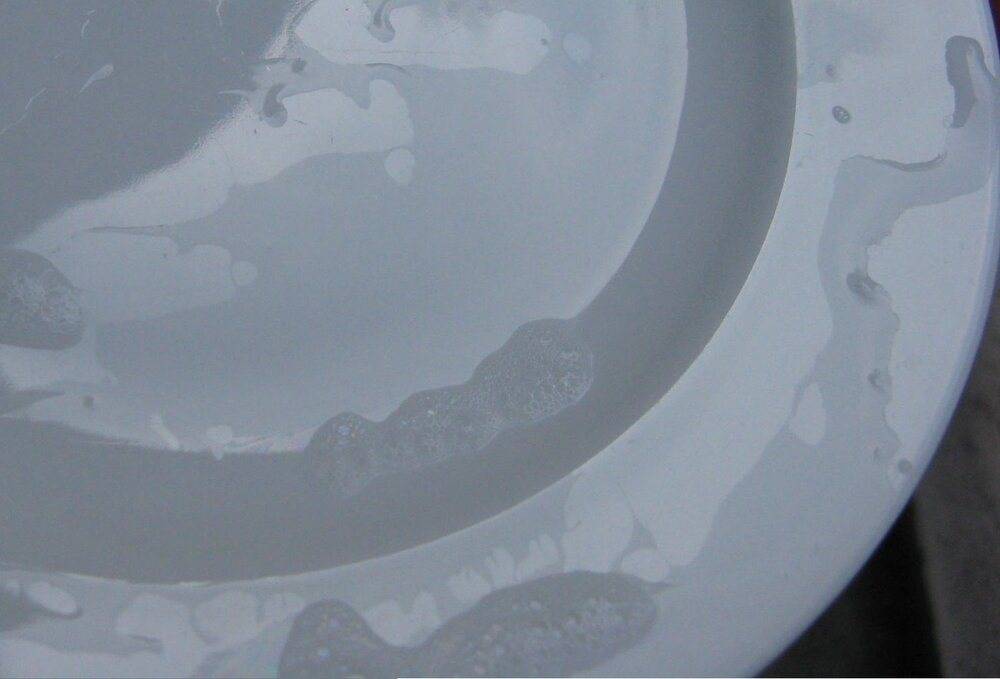
The discussion revolves around the optical properties of wet and dry surfaces, specifically focusing on the thickness of water films on dishes and how this affects their appearance. Participants explore the relationship between the thickness of the water layer, light reflection, and the resulting visual differences observed on various surfaces, including glass and ceramics.
Discussion Character
- Exploratory
- Technical explanation
- Debate/contested
- Conceptual clarification
Main Points Raised
- Some participants note that the appearance of wet spots can vary based on background lighting, angle of observation, and the material properties of the dish.
- One participant suggests that the reflectivity of a water film changes significantly as its thickness approaches several wavelengths of visible light.
- Another participant observes that wet surfaces consistently appear darker than dry surfaces, regardless of the material, and questions the possibility of a one-molecule thick water film affecting reflectivity.
- There is a discussion about the differences between diffuse and specular reflection, with some arguing that wet surfaces exhibit more specular reflection.
- Concerns are raised about the specific types of crockery being discussed, with references to how different materials (like terracotta versus glass) influence the visibility of reflections.
- Participants propose that a very thin layer of water (e.g., one molecule thick) would have minimal impact on reflectivity, especially under certain conditions like cryogenic temperatures or specific surface chemistries.
- One participant emphasizes the importance of surface roughness and how it interacts with the presence of water to alter optical effects.
Areas of Agreement / Disagreement
Participants do not reach a consensus on the exact effects of water film thickness on reflectivity, with multiple competing views on how thickness influences appearance and the nature of reflections on different surfaces.
Contextual Notes
There are limitations regarding the assumptions made about surface conditions, the influence of environmental factors (like temperature and soap content), and the specific definitions of reflectivity being used in the discussion.