What mistake did I make in finding the reaction at hinge A?

Click For Summary
The discussion centers on finding the reaction at hinge A, where the user calculated the vertical and horizontal components of the reaction forces. The user arrived at a resultant force of approximately 1118 N, which differs from the book's answer of 112 N at an angle of 26.6° below the horizontal. It was clarified that the book's error was likely due to a decimal place mistake. Additionally, the direction of the resultant force can be interpreted in multiple ways, complicating the definition of "above" or "below" horizontal. The user expressed relief upon realizing their calculations were correct.
gnits
Messages
137
Reaction score
46
Homework Statement
To find forces in a framework
Relevant Equations
Equating of forces
Moments
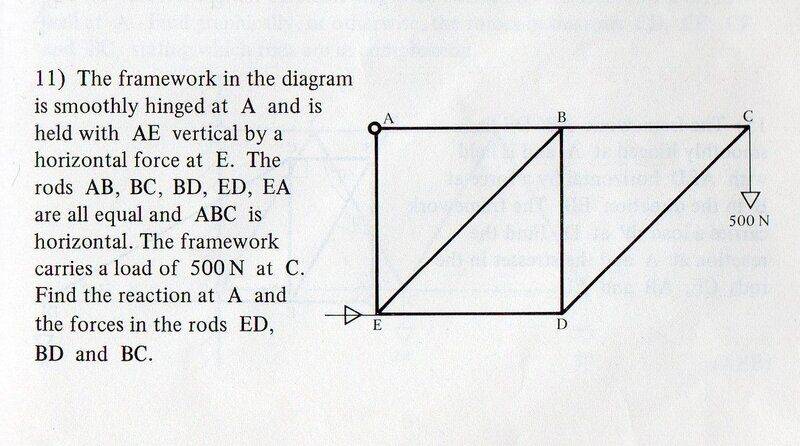
A very simple (I thought!) question:
img096.jpg


I'm just looking at the first part, finding the reaction at the hinge A.

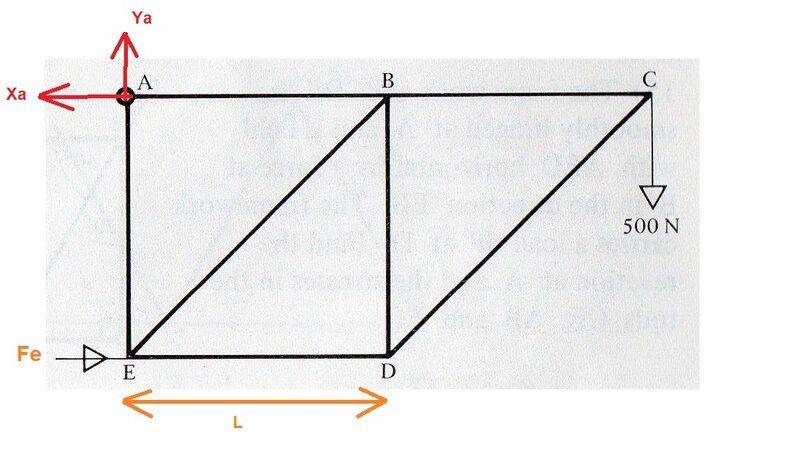
Here is my annotated diagram, with the reaction and A resolved into it's X and Y components, the force at E labelled as Fe and the length of ED labelled as L.
img096_ann.jpg


Considering the body as a whole:

Resolving vertically:

Ya = 500

Taking moments about E:

Xa * L = 2 * L * 500

which gives Xa = 1000

So the resultant at A will have size sqrt(1000^2 + 500^2) = 1118 (approx.)

Answer given in book is 112 N at 26.6⁰ below the horizontal.

My answer is very different and also above the horizontal.

What simple mistake have I made in my reasoning?

Thanks.
 
Physics news on Phys.org
The answer given in the book is not correct, yours is.
 
Thanks, that's a relief. The book has rarely been wrong and so I was all too ready to doubt myself. Much appreciated.
 
gnits said:
Thanks, that's a relief. The book has rarely been wrong and so I was all too ready to doubt myself. Much appreciated.
The book's error in the magnitude is clearly just a decimal place blunder.
Above or below horizontal is inadequate to define the direction. Given the angle it makes to the horizontal, there are four possible directions. Up and to the left can be thought of as above horizontal, viewing it as a motion in that direction from A. But it can be viewed as below horizontal when considering the diagonal line through A that it lies on: first and third quarters = above horizontal, second and fourth quarters = below horizontal.
 
The book claims the answer is that all the magnitudes are the same because "the gravitational force on the penguin is the same". I'm having trouble understanding this. I thought the buoyant force was equal to the weight of the fluid displaced. Weight depends on mass which depends on density. Therefore, due to the differing densities the buoyant force will be different in each case? Is this incorrect?

Similar threads

  • · Replies 5 ·
Replies
5
Views
1K
Replies
11
Views
2K
  • · Replies 7 ·
Replies
7
Views
2K
Replies
5
Views
2K
Replies
2
Views
3K
Replies
5
Views
2K
Replies
3
Views
1K
Replies
1
Views
2K
  • · Replies 4 ·
Replies
4
Views
7K
  • · Replies 5 ·
Replies
5
Views
3K