Help Solving 2 Qs: Tan(Ɵ) & Sign Direction Error

Click For Summary
SUMMARY

The discussion revolves around solving two questions related to the forces acting on a system involving friction and moments. The first part establishes the relationship between the tangent of the angle (tan(Ɵ)) and the coefficient of friction (u') with the equation tan(Ɵ) <= 2/(3u'). The second part addresses the error in sign direction when calculating the friction force (F1) and the normal force (S), ultimately leading to the correct conclusion that F1 <= uS. The confusion arises from the interpretation of the equations and the signs used in the calculations.

PREREQUISITES
  • Understanding of static equilibrium and forces in a system
  • Knowledge of friction coefficients (u and u') in mechanics
  • Familiarity with calculating moments and torques in physics
  • Ability to manipulate trigonometric functions in equations
NEXT STEPS
  • Study the principles of static equilibrium in mechanics
  • Learn about the role of friction in preventing slipping in mechanical systems
  • Explore the derivation of equations involving moments and forces
  • Investigate common mistakes in sign conventions in physics problems
USEFUL FOR

Students and professionals in physics, engineering, and mechanics who are working on problems involving forces, friction, and equilibrium analysis.

gnits
Messages
137
Reaction score
46
Homework Statement
To find possible angle of two leaning rods
Relevant Equations
moments
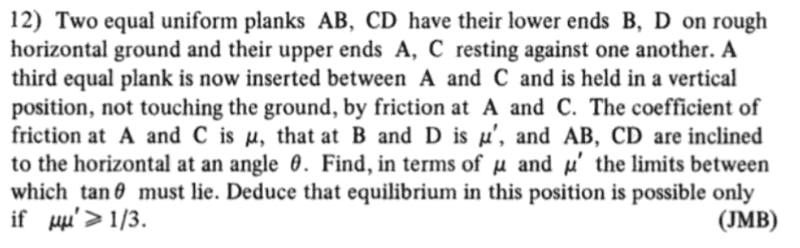
Could I please ask for help with the following question:
1642514927301.png


The last part follows easily from the first part.

Answer from back of book for first part is:

2/(3u') <= tan(Ɵ) <= 2u

What I have done is the following:

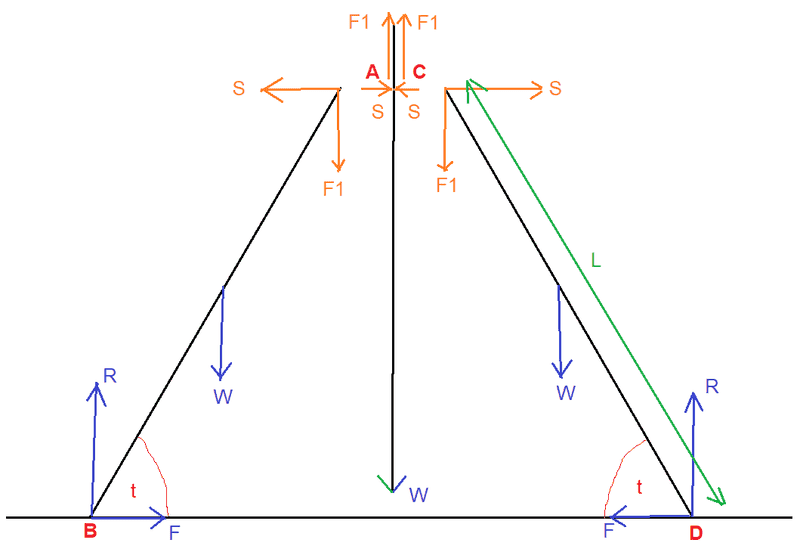
Here's my diagram (I have separated the components to show the internal forces in the system. I have used t instead of Ɵ) :
leaning.png


Orange forces are internal forces.

If I equate forces for the whole system vertically I get:

R = (3/2)W

If I equate forces vertically for the vertical rod only I get:

F1 = W/2

If I take clockwise moments about C for rod CD only I get:

F * L sin(t) + W * (L/2) cos(t) = R * L cos(t)

Substituting for R and rearranging gives: F = W / tan(t)

Now for no slipping at D we need F <= u' R so this gives:

W/tan(t) <= u' * (3/2)W

Which leads to tan(t) <= 2/(3u') which is the answer asked for but with the sign reversed.

1) How have I gotten the sign mixed up?

Taking clockwise moments about D for rod CD only I get:

S * L sin(t) = F1 * L cos(t) + W * (L/2) * cos*(t)

Substituting for F1and rearranging gives:

S = W/tan(t) and for no slipping at C we need S <= u * F1

So gives W/tan(t) <= u * W/2 which leads to tan(t) >= 2/u

Again wrong direction of sign and also wrong answer as we need tan(t) <= 2u

2) Where have a erred?

Thanks for any help.
 
Physics news on Phys.org
Thank you very much kuruman for your reply.

So, notwithstanding the signs, would you (or others) think my analysis of taking moments for CD only about D looks correct? I ask because here I differ in the actual form of the answer. The given answer is 2u but I arrive at 2/u. If you\others agree that 2/u is correct then I would put it down to a typo in the book.

Thanks again.
 
Last edited:
gnits said:
Now for no slipping at D we need F <= u' R so this gives:

W/tan(t) <= u' * (3/2)W

Which leads to tan(t) <= 2/(3u') which is the answer asked for but with the sign reversed.
I agree with the first equation here, but that implies that ##\mu' \tan \theta \ge \dfrac 2 3##.
 
PeroK said:
I agree with the first equation here, but that implies that ##\mu' \tan \theta \ge \dfrac 2 3##.
Yes indeed, I agree. I had fallen at the last there. Thanks for that. So only the second part is now causing me issues.
 
gnits said:
S = W/tan(t) and for no slipping at C we need S <= u * F1
For no slipping we need ##\mu S \ge F_1 = \dfrac{mg}{2}##.

##S## is the normal force and ##F_1## is the required friction force.
 
PeroK said:
For no slipping we need ##\mu S \ge F_1 = \dfrac{mg}{2}##.

##S## is the normal force and ##F_1## is the required friction force.
Thanks very much indeed. I had swapped S and F1. I had written S <= u * F1 whereas, as you say, I should have written F1 <= u S. And indeed this leads to the book's answer. Thank you very much.
 
gnits said:
Thank you very much kuruman for your reply.

So, notwithstanding the signs, would you (or others) think my analysis of taking moments for CD only about D looks correct? I ask because here I differ in the actual form of the answer. The given answer is 2u but I arrive at 2/u. If you\others agree that 2/u is correct then I would put it down to a typo in the book.

Thanks again.
Sorry, I deleted my reply to write a better one, but then I had an emergency that kept me away from the task. You must have read my post soon after I posted it but before I deleted it. Anyway, it looks like your issue has been resolved so there is nothing more for me to say. I apologize for the confusion.
 

Similar threads

Replies
5
Views
2K
  • · Replies 7 ·
Replies
7
Views
3K
  • · Replies 5 ·
Replies
5
Views
1K
  • · Replies 1 ·
Replies
1
Views
1K
  • · Replies 5 ·
Replies
5
Views
1K
  • · Replies 6 ·
Replies
6
Views
2K
  • · Replies 2 ·
Replies
2
Views
2K
  • · Replies 2 ·
Replies
2
Views
2K
Replies
6
Views
4K
Replies
3
Views
1K