Top quark mass mt at energy scales μ<mt?

Click For Summary
SUMMARY

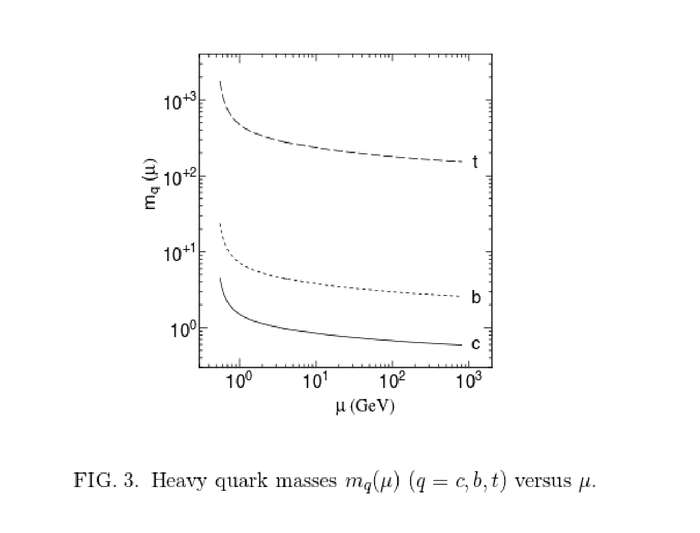
The discussion centers on the behavior of the top quark mass (mt) at energy scales below mt, emphasizing its decoupling in effective field theory. Despite this decoupling, the top quark influences various processes, particularly rare B decays, where its mass running is significant. The top mass is computed at different energy scales, with estimates showing it to be around 84 GeV at 10^15 GeV and 360 GeV at 2 GeV. The conversation highlights the importance of the top quark in loop-mediated processes, which remain relevant even at energies below its rest mass.

PREREQUISITES
  • Effective Field Theory concepts
  • Running Gauge Coupling Constants
  • Top Quark Mass Measurements
  • Rare B Decay Processes
NEXT STEPS
  • Study the implications of Effective Field Theory in particle physics
  • Research the running of gauge coupling constants in Quantum Field Theory
  • Examine the role of top quark mass in rare B decays and their branching ratios
  • Explore the msbar scheme for running mass calculations in Quantum Chromodynamics
USEFUL FOR

Particle physicists, researchers in quantum field theory, and anyone studying the implications of the top quark in high-energy physics and its effects on low-energy processes.

unknown1111
Messages
7
Reaction score
3
Does it make sense to talk about the top mass at energies below mt, although in all processes the corresponding energy scale is above mt because of the rest mass energy of the top quark?

Using an effective field theory approach, the top quark decouples at energies below the top quark mass and therefore has no influence on the mass running of the other fermions. Nevertheless, it is possible to compute how the top quark mass mt changes at energies below mt, for example, because of the energy dependence of the gauge coupling constants. For example, in Updated Estimate of Running Quark Masses the authors compute
8KWbX.png

Imagine, for example, the top would be stable for some reason and we could determine its mass somehow using a "scale" at low energies. Would we get the top mass at "room temperature", i.e. a few milli-GeV or only always its mass at around 200 GeV, because of the rest mass energy of the top quark?
 
Physics news on Phys.org
unknown1111 said:
Does it make sense to talk about the top mass at energies below mt

How would you ever measure this?
 
Unfortunately, I have no good idea. Maybe, assuming it's metastable, i.e. with a long but not infinity lifetime, we could bring it to "rest" (cool it to a given temperature) and then sum the energy of the decay products?
 
The decay process would still happen at the top mass. Unless your top is completely off-shell, but then the result is not the top mass anyway.
 
Thanks for your answer. My question is motivated by the result that, assuming a fixed standard model vev, one has in SU(5) GUTs at high energies m_bottom=m_tau. However through the RGE running of the Yukawas one gets at low energies m_bottom=3 m_tau. The top mass in the article I cite above is computed at 10^15 GeV to be around 84 GeV and at 2 GeV to be 360 GeV. Assuming the mass of another particle is around 200 GeV at all energy scales, i.e. the corresponding Yukawa coupling runs much slower. Would the top be able to decay into this new particle at low energies where m_new<m_top, but not at high energies where m_new>m_top?
 
Actually, I think the running of the top mass at scales well below mt has actually been indirectly measured by several processes.

Essentially, all rare B decays (fcnc for example) are mediated by top penguins and boxes. In the predictions of these branching ratios, the top is ran from the top quark pole mass down to mU=mb and used as an input. In some cases, the uncertainty in the top mass as mt, leads to large uncertainties for the process in question. For example, the calculation of B_s-> mU mU at NNLO.

If the top mass were very different to that expected in the SM, it would have also been seen at lep through Z->bb observables too!
 
I thought that the SM forbade fcnc interactions
 
Only at tree level, they appear in higher orders.
 
Yes, sorry if my post wasn't clear.

In summary, the top quark plays an effect on many observables at scales well below mt. The reason being that these processes are only loop mediated, or the loop mediated contribution is large.

In many cases (like rare Bhadron decays or Z->bb B0 mixing etc.) the effects from the top are very significant. In fact, maybe first estimates of the top mass (before direct observation) came from theory predictions of these observable s compared to data, where they extract the top mass.

To do this, generally the msbar (running top mass is used). In the case of B decays, an appropriate scale choice of mu is around the b quark mass.

Hope this helps
 

Similar threads

  • · Replies 9 ·
Replies
9
Views
1K
  • · Replies 4 ·
Replies
4
Views
3K
  • · Replies 4 ·
Replies
4
Views
2K
  • · Replies 1 ·
Replies
1
Views
2K
  • · Replies 2 ·
Replies
2
Views
3K
  • · Replies 2 ·
Replies
2
Views
2K
  • · Replies 4 ·
Replies
4
Views
2K
  • · Replies 0 ·
Replies
0
Views
2K
  • · Replies 16 ·
Replies
16
Views
6K
  • · Replies 62 ·
3
Replies
62
Views
11K