Torque Balance of Motor and Transmission

Click For Summary
SUMMARY

The discussion focuses on the torque balance in a gearbox, specifically in the context of an auger machine. The relationship between input torque (10 in-lbs) and output torque (50 in-lbs) is analyzed, revealing that the internal reaction torque from the motor (10 in-lbs) and the external torque required by the operator (50 in-lbs) must balance out. The participants clarify that while the gearbox experiences a total reaction torque of 60 in-lbs, the effective torque felt by the operator remains at 50 in-lbs due to the opposing motor torque. This confirms that the principle of RT-T (Ratio x Torque - Torque) holds true when considering the direction of torques.

PREREQUISITES
  • Understanding of torque concepts and calculations
  • Familiarity with gear ratios and their impact on torque
  • Knowledge of internal vs. external forces in mechanical systems
  • Basic principles of mechanical equilibrium and reaction forces
NEXT STEPS
  • Study the principles of torque transmission in gear systems
  • Learn about the mechanics of auger machines and their operational dynamics
  • Explore the concept of mechanical advantage in gear ratios
  • Investigate the effects of reaction forces in various mechanical assemblies
USEFUL FOR

Mechanical engineers, automotive designers, and anyone involved in the design and analysis of gear systems and torque applications will benefit from this discussion.

alkaspeltzar
Messages
354
Reaction score
37
TL;DR
Trying to determine how the torques balance in a gearbox below
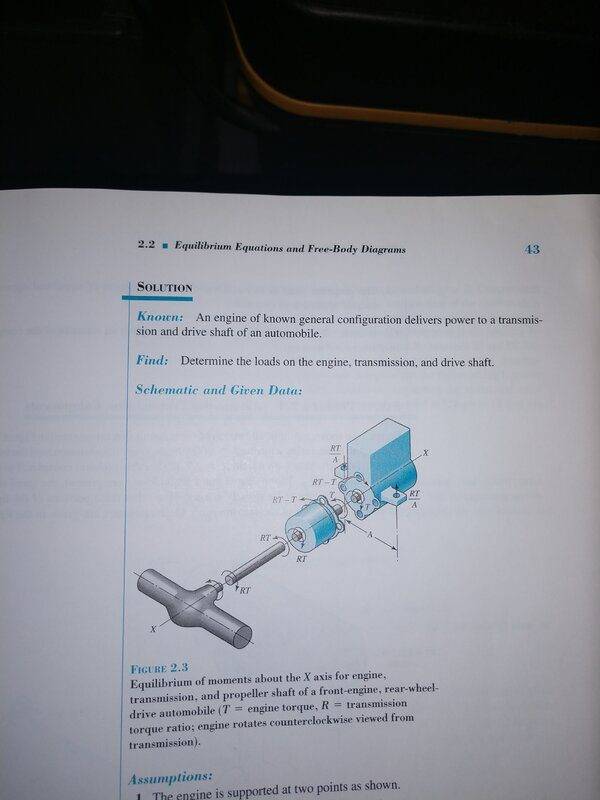
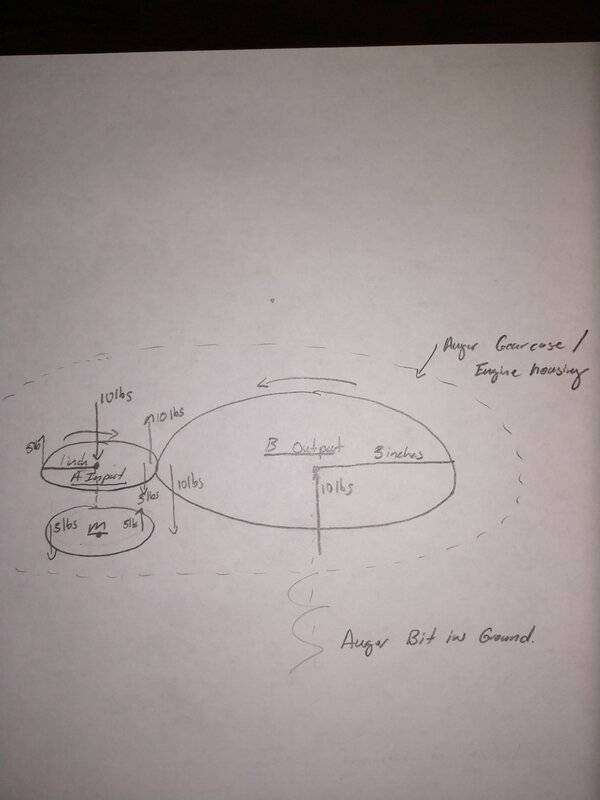
I read this in my college design book, that for a car transmission, if the engine provide T, and the output is RT(ratio x Torque), the difference of (RT-T) must be back on the engine mounting. This example makes sense, I am not questioning that.However, if i have an offset gear drive, like that below, where input gear is 2" diameter, has input torque of 10in-lbs, and outputs to gear of 10" diameter, output torque of 50in-lbs, when i do the math, i don't find the relation above to hold. What i find is the entire housing reacts with 60 in-lbs, but due to reaction of the motor, 10in lbs, the whole unit (gearcase and motor) have 50 in lbs, which is equal to the torque on the output.

Please see attached images. am I missing something? Or does this relationship not apply to this setup of gearbox
img_20201222_095333161-jpg.jpg
IMG_20201223_190249533.jpg
 
Engineering news on Phys.org
If I understand correctly, you're getting 60 in-lbs from the 10lb couple from A to B so 6in (1in radius drive gear + 5in radius driven gear)? If so, you're mixing up torques along different axes. RT-T still applies in the axis of the auger bit, 60in-lbs applies in the axis coming out of the page. Both torques are felt by the auger frame, and both torques are balanced by the end user. (If you didn't balance the 60in-lbs, you'd fall over sideways.)
 
Twigg said:
If I understand correctly, you're getting 60 in-lbs from the 10lb couple from A to B so 6in (1in radius drive gear + 5in radius driven gear)? If so, you're mixing up torques along different axes. RT-T still applies in the axis of the auger bit, 60in-lbs applies in the axis coming out of the page. Both torques are felt by the auger frame, and both torques are balanced by the end user. (If you didn't balance the 60in-lbs, you'd fall over sideways.)
Could you explain more or draw a picture?

IF i apply 10 lbs to the auger bit at 5 inches, that is 50inlbs, but the 10 lbs back on gear A, will act at the pivot, which is yes 6inches away, giving you 60inlbs.

How then is the RT-T still true. The auger bit gets RT, Tin is 10. So shouldn't there only be 40? perhaps you can draw it out.

Thank you
 
Actually, it might make sense. Looking at it RT-T works if you assume the direction of the torques. In this case, the torque to the auger bit is opposite of the input. SO 50 is RT, RT-T = 50-(-10), so it 60, so that makes sense
 
alkaspeltzar said:
Summary:: Trying to determine how the torques balance in a gearbox below

I read this in my college design book, that for a car transmission, if the engine provide T, and the output is RT(ratio x Torque), the difference of (RT-T) must be back on the engine mounting. This example makes sense, I am not questioning that.
I believe that the above statement is not correct.
The magnitude of the reaction on the engine anchorage points to the chassis is only proportional to the reactive torque of the transmission shaft.
Note that engine torque is internal due to the fact that the transmission case is bolted to the engine cranckcase.

Same applies for the auger machine.
Whatever amount of resistive torque comes from the tool, must be balanced by the forces exerted by the hands of the operator, regardless location or reduction rate of any gear train.

Ground-Drill-Ahoyador-4-Cycle-6-5HP-Loncin-Engined.jpg
 
Lnewqban said:
I believe that the above statement is not correct.
The magnitude of the reaction on the engine anchorage points to the chassis is only proportional to the reactive torque of the transmission shaft.
Note that engine torque is internal due to the fact that the transmission case is bolted to the engine cranckcase.

Same applies for the auger machine.
Whatever amount of resistive torque comes from the tool, must be balanced by the forces exerted by the hands of the operator, regardless location or reduction rate of any gear train.

View attachment 275030
If the auger bit requires 50 inlbs in my example. The operator has to apply equally that to keep it in place. That is true and i am not questioning that.

What i was trying to learn is how much is reacted back thru the gearcase itself, minus the engine. Such with the sum, equals the output torque.

With the offset gearbox in my example, the gear case has 60 inlbs back, beecuase the of the 10lb force at 6 inches. But as the motor rovides 10 inlbs, has a reaction torque of 10 inlbs in the opposite direction, so it subtracts. SO the overall the operator still feels is 50 inlbs

IF i break down all the reaction forces and torques on each shaft, this comes out right and makes sense. Plus agrees now with the RT, RT-T etc. You have to use sign convention for direction of rotation
 
Do you mean internal reaction motor-chassis of auger machine?
 
  • Like
Likes   Reactions: alkaspeltzar
Lnewqban said:
Do you mean internal reaction motor-chassis of auger machine?
YEs, if you look at the math in my drawing and the clip from my textbook, i am looking at how the output torque, creates internal reactions torques/balances such that it takes an external torque from the operator to steady machine.

With auger, the motor puts in 10inlb to the drive gear, creating 50inlbs on the auger bit. This causes a reaction force of 10 lbs back on the drive gear, canceling out the input torque, but causing a force of 10lbs at 6 inches, so we get reaction of 60inlbs. However, we need to account for the reaction of the motor on the gearcase, this then subtracts. so the overall gearcase/motor has a -50 in lbs. IF the operators didnt hold the unit providing equal torque to the machine, it will just spin.

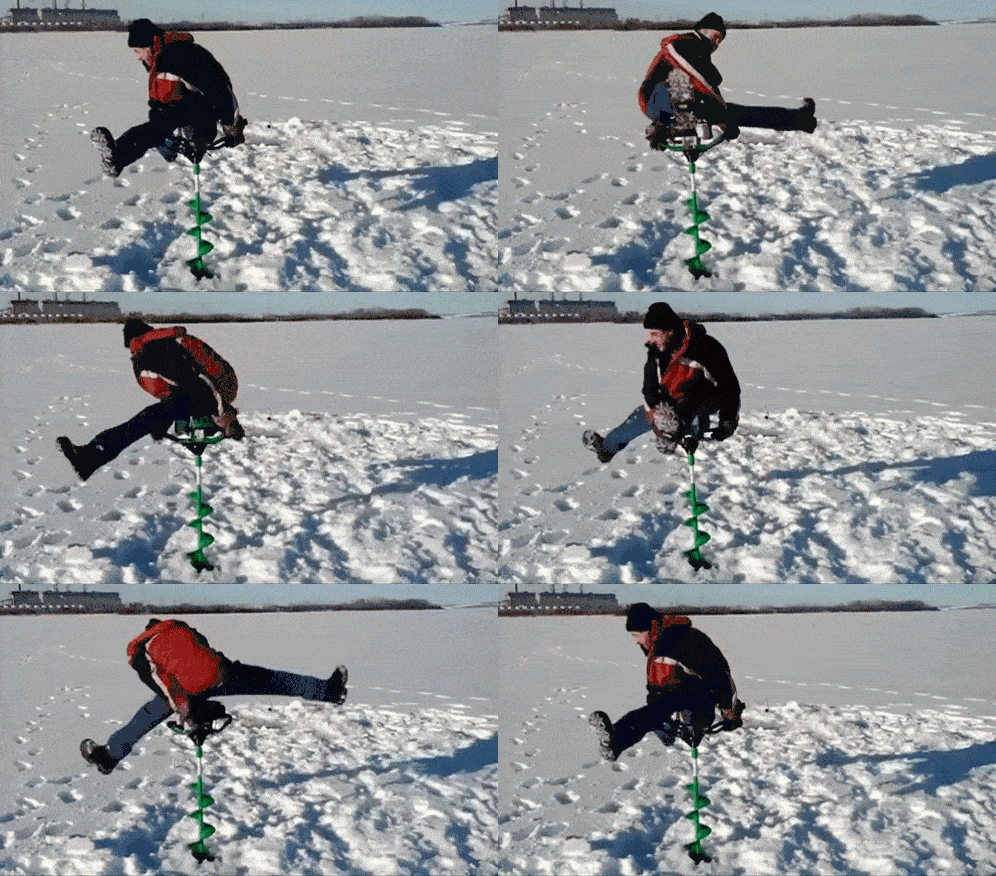
Funny you see people drunk riding augers ice fishin LOL
 
  • Like
Likes   Reactions: Lnewqban
Think of the gears as of two levers connecting each other.
Each is anchored to a common base (chassis of machine) via pivots.
You have reactive linear forces at those pivots, both are 10 lbf, just like the forces between the teeths in contact.

The torque induced by the reactive 10 lbf acting 6 inches away from the center of the bit is counter-acted by the 10 in-lbf torque of the engine, resulting on the 50 in-lbf torque felt by the operator.

Then, you have a pair of forces acting at the anchorage points of the motor to the chassis.
The magnitude of each of those forces equals torque of 10 in-lbf times radial distance to engine shaft.
But again, those are internal forces of the mechanism.

tenor.gif
 
  • #10
Lnewqban said:
Think of the gears as of two levers connecting each other.
Each is anchored to a common base (chassis of machine) via pivots.
You have reactive linear forces at those pivots, both are 10 lbf, just like the forces between the teeths in contact.

The torque induced by the reactive 10 lbf acting 6 inches away from the center of the bit is counter-acted by the 10 in-lbf torque of the engine, resulting on the 50 in-lbf torque felt by the operator.

Then, you have a pair of forces acting at the anchorage points of the motor to the chassis.
The magnitude of each of those forces equals torque of 10 in-lbf times radial distance to engine shaft.
But again, those are internal forces of the mechanism.

View attachment 275038

So you agree with me given you 'liked" my comment above correct? There is a reactive torque created by the auger bit of 60 inlbs. The motor reaction torque is -10inlbs. Sum of these is 50inlbs. However, you are right, these are internal on the mechanism, so the overall auger head(gearcase and motor) rotate opposite of the auger bit(or as the person spinning lol)

THis is why to drill a hole you need to apply 50 in lbs.

Sorry if my numbers don't make sense, just picked some to make the math easy
 
  • Like
Likes   Reactions: Lnewqban
  • #11
Yes. ✅
Note that the reaction from the ground does not touch the chassis until it reaches the anchorage bolts of the engine.
Then, from there to the hands of the operator.
Each link of the chain of transmission may be “feeling” loads that are different among them, but again, all those don’t make any difference on output-input of forces and torques.
 
  • Like
Likes   Reactions: alkaspeltzar
  • #12
Lnewqban said:
Yes. ✅
Note that the reaction from the ground does not touch the chassis until it reaches the anchorage bolts of the engine.
Then, from there to the hands of the operator.
Each link of the chain of transmission may be “feeling” loads that are different among them, but again, all those don’t make any difference on output-input of forces and torques.
Thank you for the peace of mind. Man that had me stuck, start looking at all these reaction/action forces and torque and it gets busy.

In the end I agree, without the bit in the ground to create the load, then the operator would feel very little. As it takes the 50 inch lbs to drill ice then the operator must apply 50 in lbs back. You can break it down piece by piece or look at the aguer as one unit, still comes out the same

It is however interesting to learn how internally the reaction forces generates a large torque to balance out the motor and such, keeps everything even. We mainly take it for granted, that what you get out, you know you have to equally support

Thanks again
 
  • Like
Likes   Reactions: Lnewqban
  • #13
You are welcome, alkaspeltzar. :smile:
Happy holidays!
 
  • Like
Likes   Reactions: alkaspeltzar

Similar threads

  • · Replies 18 ·
Replies
18
Views
3K
  • · Replies 12 ·
Replies
12
Views
4K
  • · Replies 17 ·
Replies
17
Views
4K
  • · Replies 19 ·
Replies
19
Views
4K
Replies
9
Views
3K
  • · Replies 1 ·
Replies
1
Views
2K
  • · Replies 5 ·
Replies
5
Views
8K
Replies
2
Views
3K
Replies
58
Views
8K
  • · Replies 15 ·
Replies
15
Views
4K