Torque, Energy, Number of Turns

  • Thread starter Thread starter smr101
  • Start date Start date
  • Tags Tags
    Energy Torque
Click For Summary
SUMMARY

The discussion focuses on solving a physics problem related to torque, energy, and the number of turns in a rotating system involving a wagon and a drum. The user initially attempted to calculate the total force using linear equations but was advised to instead calculate the torques acting on the drum. Key equations highlighted include the relationship between torque and angular acceleration, as well as the parallels between linear and rotational motion equations. The importance of understanding moment of inertia was emphasized for accurate calculations.

PREREQUISITES
  • Understanding of torque and angular acceleration
  • Familiarity with moment of inertia concepts
  • Knowledge of linear motion equations
  • Basic principles of rotational dynamics
NEXT STEPS
  • Study the relationship between torque and angular acceleration in detail
  • Learn about moment of inertia and its calculation for different shapes
  • Explore the equations of motion for rotational systems
  • Investigate the effects of friction on rotational motion
USEFUL FOR

Students and professionals in physics, mechanical engineering, and anyone involved in analyzing rotational dynamics and torque calculations.

smr101
Messages
72
Reaction score
0
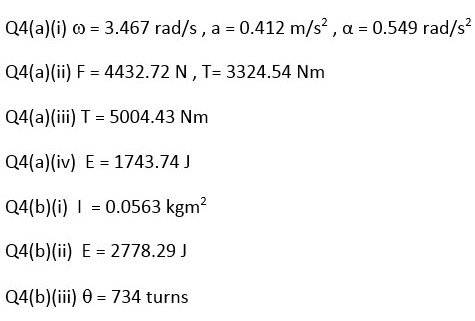
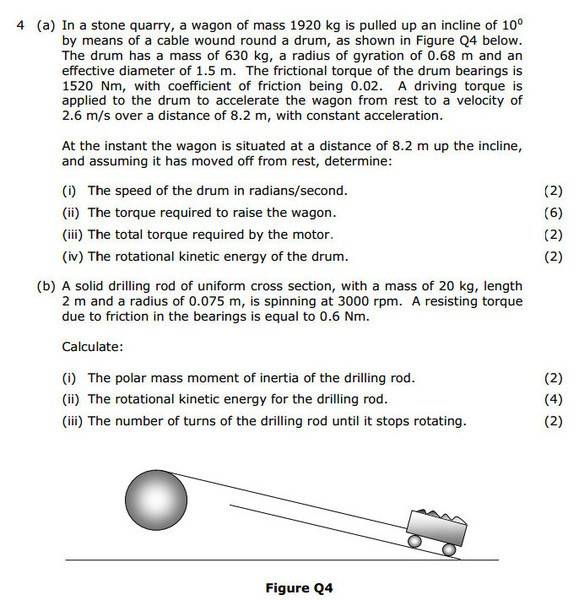
Hi, I'm having problems with 4. (a)(iii) and (b)(iii).

Question and solution attached below.

For 4.(a)(iii) this is what I've tried (for mass I've used the mass of the wagon plus drum):

F = Fu + Ff + Fw
= (ma) + (mg x cosangle x friction coefficient) + (mg x sinangle)
= 2550 x 0.412 + 2550 x 9.81 x cos10 x 0.02 + 2550 x 9.81 x sin10
= 1050.6 + 419.8 + 13608.96
= 15079.4Nm

(b)(iii)

Help is much appreciated.
5j393.jpg

PgBj1.jpg
 
Physics news on Phys.org
For 4.(a)(iii) this is what I've tried (for mass I've used the mass of the wagon plus drum):

That's not correct, you can't add the mass of the drum to the wagon. The drum isn't accelerating in a straight line, it's rotating.

First off don't sum the forces. Work out all the torques acting on the drum and sum them instead. For example one of the torques will be due to the tension in the cable. Another will be the torque required to accelerate the drum (angular acceleration). Find the equation that relates torque and angular acceleration.

Edit: There are other torques that have to be overcome. Make a list.
 
I see you have two questions/threads running. Looking at both of these threads it seems the difficulty you are having is the same in both cases. Perhaps read up on moment of inertia and understand the similarity between the equations for linear motion and rotation...

Linear.......>.......Rotation

Force = mass * acceleration.......Torque = moment of inertia * angular acceleration

Work = force * displacement.......Work = torque * angular displacement

Power = force * displacement/time......Power = torque * angular displacement/time
Power = force * velocity.........Power = torque * angular velocity
 

Similar threads

  • · Replies 5 ·
Replies
5
Views
2K
  • · Replies 8 ·
Replies
8
Views
7K
  • · Replies 10 ·
Replies
10
Views
6K
  • · Replies 8 ·
Replies
8
Views
4K
  • · Replies 3 ·
Replies
3
Views
7K
  • · Replies 18 ·
Replies
18
Views
2K
Replies
21
Views
4K
  • · Replies 8 ·
Replies
8
Views
2K
  • · Replies 6 ·
Replies
6
Views
4K
  • · Replies 3 ·
Replies
3
Views
6K