Torque on a rectangular coil in a uniform magnetic field

Click For Summary

Homework Help Overview

The discussion revolves around the torque experienced by a rectangular coil placed in a uniform magnetic field. Participants explore the relationship between the coil's orientation and the resulting torque, referencing concepts such as Fleming's left hand rule and the mathematical expression for torque.

Discussion Character

  • Exploratory, Conceptual clarification, Assumption checking

Approaches and Questions Raised

  • Participants discuss the reasoning behind considering only two sides of the coil in torque calculations, questioning the implications of the coil's orientation relative to the magnetic field. They also explore the effects of current direction on the forces acting on the coil.

Discussion Status

The conversation is active, with participants providing insights and raising questions about the setup and assumptions. Some guidance has been offered regarding the implications of the coil's orientation and the conditions under which torque is produced.

Contextual Notes

There are mentions of a specific problem statement regarding the orientation of the coil and its sides in relation to the magnetic field lines, which some participants find inconsistent or confusing. The discussion reflects on the need for clarity in the problem setup.

Bolter
Messages
262
Reaction score
31
Homework Statement
See image below
Relevant Equations
F = BIL
So this was a section taken out from a question which I am trying to do shown below
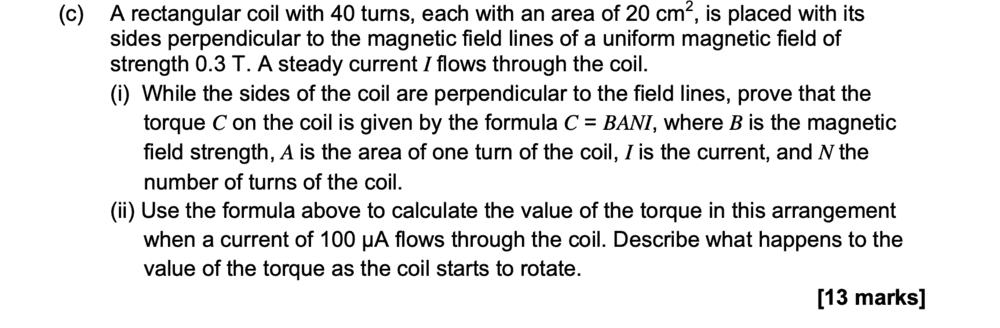
Screenshot 2020-03-25 at 15.04.57.png

I have drawn a sketch to help me visualise of what is going on

I have used Fleming's left hand rule to help me determine what direction the force is facing on each side of the coil.
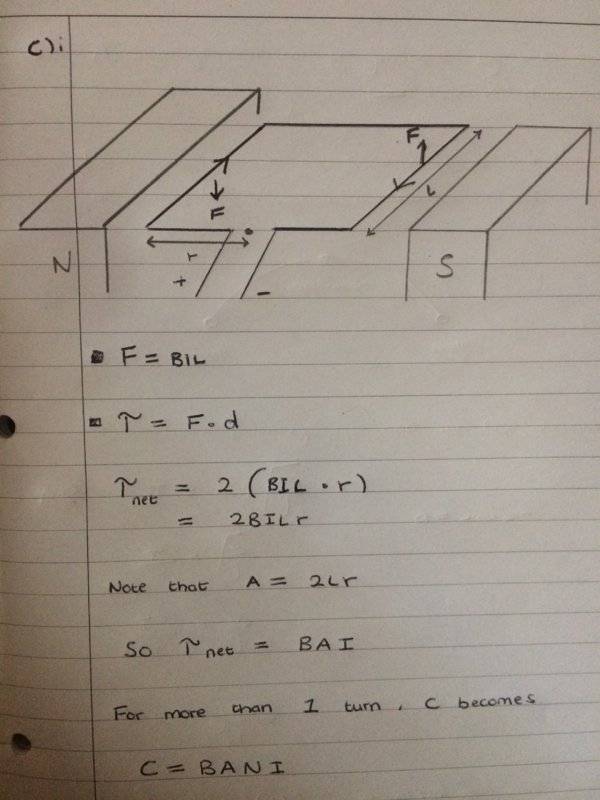
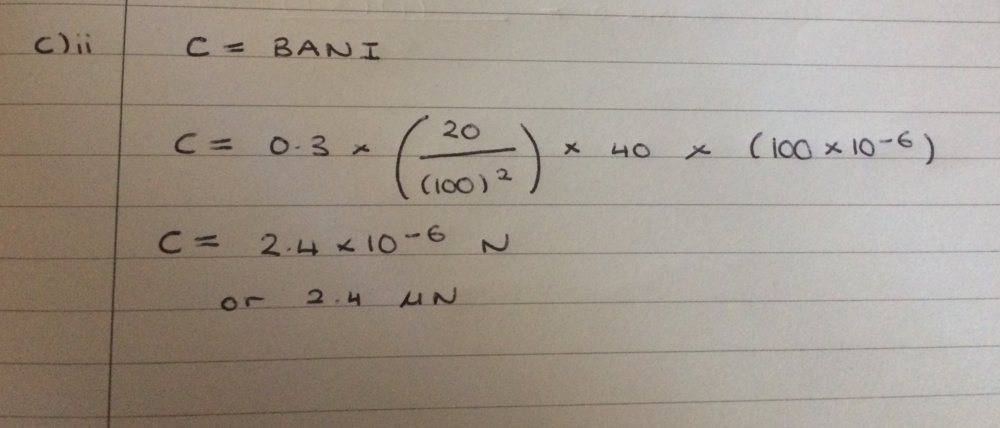
IMG_4348.JPG


IMG_4349.JPG


For the last part in c)ii , this is what I would say as the coil rotates:

As the coil rotates from a sideway to a vertical orientation, less magnetic field lines pass through the coil thus torque value decreases to zero. Maximum torque only occurs when the magnetic field is perpendicular to the normal line of the coil. Where as it is a minimum (zero) torque when the magnetic field is parallel to the normal line of the coil

Would that be sufficient to what the question asks for?

Any help would be really grateful! Thanks
 
  • Like
Likes   Reactions: Merlin3189
Physics news on Phys.org
The coil has 4 sides. You should explain why you consider only 2 sides in your calculation and ignore the other 2. Also, the uniform magnetic field points left to right as deduced by your pole labels. The coil is not drawn "with its sides perpendicular to the magnetic field lines" because only two sides are drawn perpendicular. The ones you ignored are drawn parallel to the field lines.
 
kuruman said:
The coil has 4 sides. You should explain why you consider only 2 sides in your calculation and ignore the other 2. Also, the uniform magnetic field points left to right as deduced by your pole labels. The coil is not drawn "with its sides perpendicular to the magnetic field lines" because only two sides are drawn perpendicular. The ones you ignored are drawn parallel to the field lines.

For the other 2 sides that I have ignored, I cannot use either Fleming's left hand rule or right hand rule because the direction of current and magnetic field are parallel to each other?

However I believe that no torque is produced on those 2 sides as torque is known to be:

C = BANI sin(theta)

If they are both parallel to the field, then the angle theta is 0 degrees hence sin(0) = 0. Which means C = BANI sin(0) = 0 so zero torque on both those 2 sides?

where angle theta is the angle between the perpendicular of the loop and field line
 
Last edited:
Bolter said:
For the other 2 sides that I have ignored, I cannot use either Fleming's left hand rule or right hand rule because the direction of current and magnetic field are parallel to each other?
As I posted earlier, the problem specifies that "the coil is placed with its sides perpendicular to the magnetic field lines". No current is parallel to the field lines. You need a new drawing.
Bolter said:
However I believe that no torque is produced on those 2 sides as torque is known to be:

C = BANI sin(theta)
The torque is not "known" to be that. You are supposed to show that in part (i).
 
kuruman said:
As I posted earlier, the problem specifies that "the coil is placed with its sides perpendicular to the magnetic field lines". No current is parallel to the field lines. You need a new drawing.

The torque is not "known" to be that. You are supposed to show that in part (i).

I have made a new drawing but I can't seem to wrap my head around about what direction the force is acting upon the other 2 sides? :oldconfused:

IMG_4350.jpg


The arrow labelled 'B' on top is indicating the direction of the magnetic field from north to south

Like on one side the direction of current is anti-parallel to the direction of the magnetic field so there should be no force

And on the other side, current is in the direction of the magnetic field but again there would be no force as there's no angle between current or magnetic field?

I'm just very confused right now
 
Last edited:
kuruman said:
The coil has 4 sides. You should explain why you consider only 2 sides in your calculation and ignore the other 2. Also, the uniform magnetic field points left to right as deduced by your pole labels. The coil is not drawn "with its sides perpendicular to the magnetic field lines" because only two sides are drawn perpendicular. The ones you ignored are drawn parallel to the field lines.

Ok maybe my original set up was looking a little wrong here but I have tried making a more simplified correct drawing

IMG_4351.JPG


Used Fleming's right hand rule on all sides of the coil to determine the direction of force acting on that side

I realized that the top and bottom force are antiparallel with each other so will can cancel out and have no effect on the motion of the coil. But this will also do the same the left and right sides of the coil so the coil wouldn't be rotating at all? It seems like the coil would just stay stationary and has a force stretching it outwards on its sides
 
Last edited:
For the directions of the field and current you show, the forces must be in the opposite directions. Regardless of that, your conclusion that the torque is zero is correct. My point is that you cannot satisfy the given condition that "the coil is placed with its sides perpendicular to the magnetic field lines" and have non-zero torque. It's an inconsistently-phrased question. If you relax the given condition and rotate the coil by 90o as you originally had, then the torque is not zero and you have correctly found the expression for it.
 
  • Like
Likes   Reactions: Bolter
kuruman said:
For the directions of the field and current you show, the forces must be in the opposite directions. Regardless of that, your conclusion that the torque is zero is correct. My point is that you cannot satisfy the given condition that "the coil is placed with its sides perpendicular to the magnetic field lines" and have non-zero torque. It's an inconsistently-phrased question. If you relax the given condition and rotate the coil by 90o as you originally had, then the torque is not zero and you have correctly found the expression for it.

Thank you this clears my doubt now. I now understand what you had meant earlier which I had failed to understand before :doh:
 
  • Like
Likes   Reactions: kuruman

Similar threads

  • · Replies 5 ·
Replies
5
Views
2K
  • · Replies 12 ·
Replies
12
Views
3K
Replies
4
Views
2K
Replies
1
Views
2K
  • · Replies 5 ·
Replies
5
Views
2K
Replies
16
Views
2K
  • · Replies 3 ·
Replies
3
Views
4K
Replies
2
Views
1K
  • · Replies 4 ·
Replies
4
Views
2K