Total Angular Momentum of a Tractrix

1 reply · 2K views · last reply
Dr Edward
Messages
9
Reaction score
0
I have a 5.0 m tractrix and am trying to work out angular momentum and total angular momentum for two hitchpoint speeds 60 & 70 km/h.
My result shows a higher total angular momentum for the lower speed.
This is not what I expected.
Here are my equations
Positions:
View attachment 8589
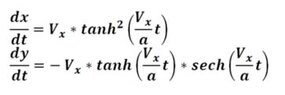
Derivatives
View attachment 8590
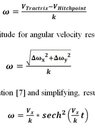
Angular velocity
View attachment 8591
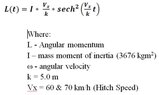
Angular Momentum
View attachment 8592
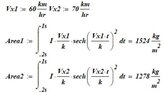
TOTAL ANGULAR MOMENTUM
View attachment 8593
If anyone can help spot the error I would be extremely grateful
 
Attachments
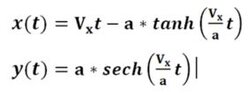
  • Two parametric equations: x(t) = Vx t - a * tanh(Vx/a t) and y(t) = a * sech(Vx/a t), where a is a constant and Vx is the speed of the hitch point.
    Positions.JPG
    4.5 KB · Views: 164
  • Two equations giving time derivatives: dx/dt = Vx * tanh^2(Vx/a t) and dy/dt = -Vx * tanh(Vx/a t) * sech(Vx/a t).
    Derivatives.JPG
    5.7 KB · Views: 176
  • Four equations: omega = (V_Tractrix - V_Hitchpoint)/k; a reference to an altitude for angular velocity; omega = sqrt(Δω_x² + Δω_y²)/k; and omega = (V_x/k) * sech²((V_x/k) t).
    Ang Vel.JPG
    11.3 KB · Views: 169
  • Typeset equation L(t) = I * (Vx/k) * sech^2((Vx/k) t), followed by a list defining L as angular momentum, I as mass moment of inertia (3676 kgm^2), omega as angular velocity, k = 5.0 m, and Vx = 60 & 70 km/h (hitch speed).
    Ang Momentum.JPG
    12.6 KB · Views: 179
  • Two definite integral equations for area, Area1 and Area2, with Vx1 = 60 km/hr and Vx2 = 70 km/hr; Area1 equals 1524 kg/m^2 and Area2 equals 1278 kg/m^2.
    Total Mom.JPG
    11.5 KB · Views: 174
I have spotted the error but don't know how to fix it.
The equation for L(t) is for instantaneous angular momentum.
Momentum is cumulative. i.e. if I add an impulse (F*t) to the classic linear analogy I impart momentum. Newton's 1st law says it will go on forever.
If I now hit it with the same impulse I will double the momentum.
Is there any mathematical genius that will convert the equation for instant angular momentum (L(t)) to total or cumulative momenta.

I should be ever so grateful.