Tracing seismic rays - possible intersection

Click For Summary
SUMMARY

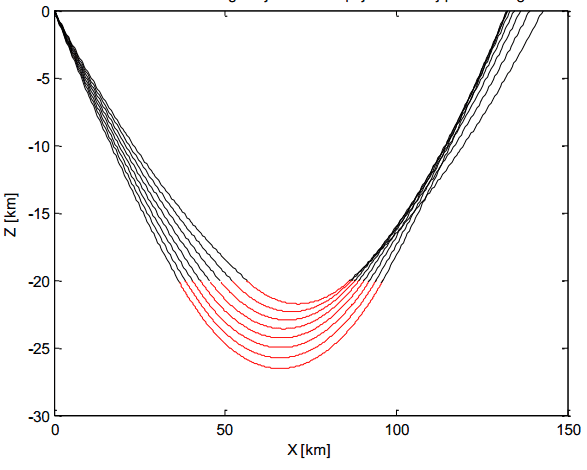
This discussion focuses on the propagation of seismic waves in a non-homogeneous layer over a halfspace, specifically analyzing the intersection of seismic rays after reflecting from the halfspace. The velocity in the layer is defined as v=v0+k1z with k1=0.025, while the halfspace velocity is v=v0+k1H+k2(z-H) with k2=0.01 and H=20km. The author has successfully solved the problem algebraically and in Matlab, noting an unexpected graph outcome where seismic rays intersect. The discussion also draws parallels between seismic wave behavior and optical lens effects.

PREREQUISITES
  • Understanding of seismic wave propagation principles
  • Familiarity with algebraic modeling techniques
  • Proficiency in Matlab for graphing and analysis
  • Knowledge of refractive indices and their effects on wave behavior
NEXT STEPS
  • Explore advanced seismic wave modeling techniques in Matlab
  • Research the impact of varying refractive indices on seismic wave paths
  • Study the mathematical foundations of wave propagation in non-homogeneous media
  • Investigate case studies on seismic wave behavior during earthquakes, such as the Northridge Earthquake
USEFUL FOR

Geophysicists, seismic engineers, and researchers involved in earthquake analysis and seismic wave modeling will benefit from this discussion.

FermatPell
Messages
21
Reaction score
0
This problem is about seismic wave propagation in a non-homogeneous layer over a halfspace. I'm not asking you to solve anything, I've already solved the problem both algebraically and in Matlab. However, the graph that I've gotten mildy surprises me. According to the graph, the seismic rays intersect after returning from the half space.
iyzc06.jpg


Briefly, I was asked to trace the seismic rays originating from a point on the surface.

The velocity in the layer is a function of depth v=v0+k1z where k1=0.025
The velocity in the halfspace is a function of depth v=v0+k1H+k2(z-H) k2=0.01

where H=20km is depth of the layer

NOTE: The y-axis is inverted, z increases with depth.
 
Physics news on Phys.org

Similar threads

Replies
7
Views
2K
  • · Replies 4 ·
Replies
4
Views
3K
  • · Replies 6 ·
Replies
6
Views
2K
  • · Replies 1 ·
Replies
1
Views
2K
  • · Replies 1 ·
Replies
1
Views
2K
  • · Replies 28 ·
Replies
28
Views
7K
  • · Replies 4 ·
Replies
4
Views
3K
  • · Replies 1 ·
Replies
1
Views
7K
  • · Replies 9 ·
Replies
9
Views
9K
  • · Replies 2 ·
Replies
2
Views
11K