Trajectory collision calculation

Click For Summary

Discussion Overview

The discussion revolves around a kinematic intercept problem involving two objects: one moving in a circular path and the other moving in a straight line. The objective is to determine the angle α at which the linear object must be directed to collide with the circular object. The context includes theoretical considerations and practical applications, particularly in the realm of aerial combat scenarios.

Discussion Character

  • Exploratory
  • Technical explanation
  • Conceptual clarification
  • Homework-related

Main Points Raised

  • One participant outlines the problem, specifying the parameters involved, including the distance between objects, the radius of the circular trajectory, and the velocities of both objects.
  • Another participant suggests that the problem can be framed as a kinematic intercept problem, which may facilitate finding a solution.
  • Some participants express uncertainty about the current approach, indicating a potential need for additional equations or a different method altogether.
  • One participant recommends starting with a simpler version of the problem, such as using straight paths instead of circular motion, to build intuition and understanding before tackling the more complex scenario.
  • There is a suggestion to review external resources for similar problems, indicating that this is a recognized challenge in physics and engineering contexts.
  • One participant notes issues with the clarity of mathematical expressions shared in the discussion, prompting a suggestion to use LaTeX for better readability.

Areas of Agreement / Disagreement

Participants do not appear to reach a consensus on the best approach to solve the problem, with multiple competing views and suggestions for alternative methods remaining present throughout the discussion.

Contextual Notes

Participants express uncertainty regarding the completeness of the equations needed to solve the problem, and there are indications that the complexity of the circular motion introduces additional challenges compared to linear motion.

pejsek
Messages
3
Reaction score
2
TL;DR
Calculate α so that the red and blue objects meet using the given parameters
Hello,

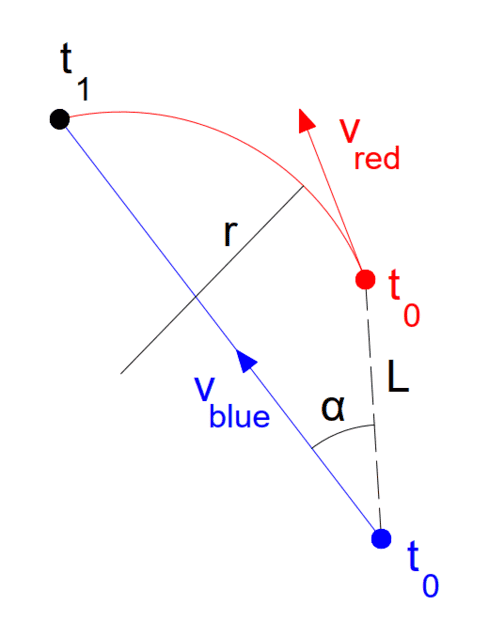
I ask you for your aid in the solution of the following problem. Please see the attached illustration.
1692118566206.png


Two objects (red and blue) are moving in the vicinity of each other. The red object is moving along a closed circle and the blue object is moving along a line. Our objective is to make the two objects collide. We cannot touch the red object, however, we can change the direction of the movement of the blue object by changing the angle α. The goal is to calculate the angle α so that the two objects meet.

Here is what is known:
L ... distance between the two objects at time = 0
r ... radius of the trajectory of the red object
v_red ... magnitude of the tangential velocity of the red object
v_blue ... magnitude of the velocity of the blue object

Magnitudes of both velocities are constant (there is no acceleration except for the centripetal acceleration of the red object).

This problem comes from my idea of calculating the angle at which fighter planes have to fire their guns when shooting down an enemy aircraft in a turn.

Thank you very much indeed for your help,
pejsek
 
Last edited:
Physics news on Phys.org
What's your approach to solving this problem? Do you have any ideas?
 
  • Like
Likes   Reactions: topsquark, vanhees71 and Filip Larsen
This is as far as I have got. I am either missing one more equation or the whole approach is wrong.

1692125326470.png
 
Since A and B eventually has to be at the same position at the same time (a so-called kinematic intercept problem), perhaps you can formulate your problem in a way that facilitates a solution in that way?
 
  • Like
Likes   Reactions: topsquark
Last edited:
  • Sad
Likes   Reactions: vanhees71
pejsek said:
This is as far as I have got. I am either missing one more equation or the whole approach is wrong.

View attachment 330573

Wow, that is mostly illegible for me. Please review the LaTeX Guide link at the lower left of the Edit box to learn how to post math equations here at PF. I will send you a separate Private Message (PM) with more information on using LaTeX.
 
Have you tried solving an easier version of the problem first? For example, replacing the circular path with a straight path.
1692476665961.png

When facing something that initially looks too challenging it is often useful trying to solve similar easier things. It helps to build intuition and practice that can then be used in the original problem.
With the straight lines the system of equations will be significanlly easier and the solution will be unique since two straight lines only cross at one point. With the circular path the system of equations necessary will be more tedious to solve and you'll get more possible solutions since, normally, the straight line will be able to intersect the circle twice.
 

Similar threads

  • · Replies 6 ·
Replies
6
Views
2K
  • · Replies 9 ·
Replies
9
Views
2K
  • · Replies 5 ·
Replies
5
Views
2K
  • · Replies 20 ·
Replies
20
Views
2K
  • · Replies 2 ·
Replies
2
Views
2K
  • · Replies 8 ·
Replies
8
Views
3K
  • · Replies 13 ·
Replies
13
Views
3K
  • · Replies 17 ·
Replies
17
Views
2K
  • · Replies 39 ·
2
Replies
39
Views
5K
  • · Replies 11 ·
Replies
11
Views
4K