Transistor characteristic understanding

Click For Summary

Homework Help Overview

The discussion revolves around understanding the characteristics of transistors, specifically the Ic-Vce characteristics and the implications of varying the VBE voltage. Participants are exploring the behavior of transistors under different voltage conditions and the potential for breakdown.

Discussion Character

  • Exploratory, Conceptual clarification, Assumption checking

Approaches and Questions Raised

  • Participants are questioning what happens when VBE exceeds 1V and whether this leads to breakdown of the PN junction. There is also confusion regarding the behavior of the transistor in saturation and the implications of having VCE equal to 0 while VBE remains non-zero.

Discussion Status

Some participants have provided insights into the limitations of VBE and VCE, suggesting that exceeding certain voltage thresholds can lead to high currents and potential damage to the transistor. Others are seeking clarification on the proper setup for measuring transistor characteristics and the importance of considering the base current in controlling the collector-emitter current.

Contextual Notes

There is mention of a lecture slide that illustrates the early effect, and participants are discussing the constraints on VBE and VCE to avoid damaging the transistor. The conversation reflects a mix of theoretical understanding and practical application concerns.

anhnha
Messages
179
Reaction score
1
Hi, this is not a homework. I need your help to understand basic concepts. I am learning by myself.
attachment.php?attachmentid=59380&stc=1&d=1370742960.jpg

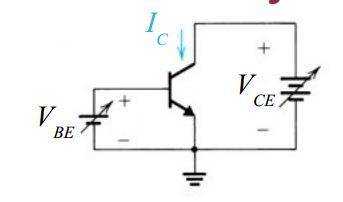
In textbooks, I usually see the circuit used to make Ic -Vce characteristics.
I see that there are no resistors at base and collector/emitter.
What will happen if VBE is larger than 1V or more?
Is the PN juction will break down?
How about if the transistor in saturation? Then if this is ideal transistor Vce = 0 but it is also connected to a external battery VBE ≠ 0. I am totally confused. Please help.
 

Attachments

  • Transistor.JPG
    Transistor.JPG
    5.3 KB · Views: 991
Physics news on Phys.org
anhnha said:
Hi, this is not a homework. I need your help to understand basic concepts. I am learning by myself.
attachment.php?attachmentid=59380&stc=1&d=1370742960.jpg

In textbooks, I usually see the circuit used to make Ic -Vce characteristics.
I see that there are no resistors at base and collector/emitter.
What will happen if VBE is larger than 1V or more?
Is the PN juction will break down?
How about if the transistor in saturation? Then if this is ideal transistor Vce = 0 but it is also connected to a external battery VBE ≠ 0. I am totally confused. Please help.

That is not a real circuit to measure transistor characteristics. In a real one, there are meters (voltmeters and ammeters) and there are resistances. If nothing else, those of the bulk of the semiconductor and the wires.

Read http://www.electronic-factory.co.uk/transistor-operation/ and http://www.electronic-factory.co.uk/transistor-characteristics/, for example.

ehild
 
Thanks,
can you answer my questions with the circuit above? I am confused.
What will happen if VBE is larger than 1V or more?
Is the PN juction will break down?
How about if the transistor in saturation? Then if this is ideal transistor Vce = 0 but it is also connected to a external battery VBE ≠ 0.
 
  • Like
Likes   Reactions: 1 person
Are you sure you study from a proper book?
Yes, but the image above is in a lecture slide I got from the net.
Here is a set up in the lecture to illustrate early effect:
attachment.php?attachmentid=59382&stc=1&d=1370766971.jpg

In this circuit both Vbe and Vce can be changed.
What is the limits that I can apply for Vbe and Vce that don't break down the transistor?
For example, Vbe has to be in 0- 5V?
 

Attachments

  • Early effect.JPG
    Early effect.JPG
    35.4 KB · Views: 1,119
The path Base->Emitter behaves like a forward biased diode.

The emitter is connected to 0V so the base voltage will be limited to roughly 0.7V. If you try and force it higher the transistor might well be damaged by excess current.

4241674044ad7174d56a93db80d272e1e86719a2_large.jpg


Personally I don't like the drawing you posted. You can control a transistor by varying the base voltage BUT it's much better to think of a transistor as a current controlled device. eg It's the base Current contols the Collector->Emitter Current.

This is because Vbe is temperature sensitive. If you try and control the base voltage the circuit can become temperature sensitive.

See this diagram which looks nearly identical but note the curves are labeled Ib rather than Vbe.

IcVce.gif
 
  • Like
Likes   Reactions: 1 person

Similar threads

Replies
3
Views
2K
Replies
2
Views
2K
Replies
68
Views
7K
  • · Replies 19 ·
Replies
19
Views
2K
  • · Replies 3 ·
Replies
3
Views
2K
Replies
10
Views
2K
  • · Replies 3 ·
Replies
3
Views
2K
  • · Replies 5 ·
Replies
5
Views
4K
  • · Replies 3 ·
Replies
3
Views
3K
  • · Replies 4 ·
Replies
4
Views
3K