Transistor questions in control a stepper motor

Click For Summary
SUMMARY

This discussion focuses on the S8050 transistor, specifically its hFE values and their implications for controlling a stepper motor using a transistor-based switch. The hFE values, which vary based on collector current (Ic), are categorized into hfe1, hfe2, and hfe3, each with different minimum, typical, and maximum values. Participants emphasize the importance of designing circuits for worst-case hFE scenarios to ensure reliable operation. The confusion surrounding the data sheet's values is acknowledged, with suggestions to use conservative estimates for design purposes.

PREREQUISITES
  • Understanding of transistor operation and characteristics
  • Familiarity with hFE (DC current gain) and its significance
  • Knowledge of circuit design principles for analog and digital applications
  • Experience with reading and interpreting electronic component datasheets
NEXT STEPS
  • Research the differences between hFE1, hFE2, and hFE3 for the S8050 transistor
  • Learn about designing circuits for worst-case scenarios in transistor applications
  • Explore the impact of collector current (Ic) on hFE values
  • Investigate alternative transistors suitable for stepper motor control
USEFUL FOR

Electronics enthusiasts, hobbyists working with stepper motors, and engineers involved in circuit design and transistor applications will benefit from this discussion.

Sherldonnnn
Messages
3
Reaction score
0
Hello,

I am Sherldonnnn. I'm very happy I can ask my questions here to get your help. If you can help me solving my questions that will be very nice.

Now I am trying to control a stepper motor with a simple transistor-based switch. I still with to consult with the experts here on some basic questions:

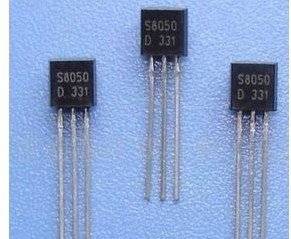
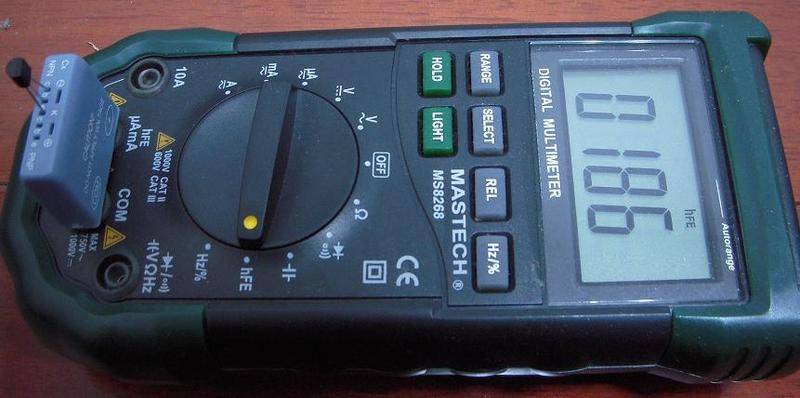
The transistor I bought from kynix semiconductor has labeling as "S8050 D 331". I used a multimeter to measure its hfe value and it shows 186 (varying between 186 and 188).
S8050 D 331.jpg

However, when i browsing kynix electronics .I found a document from http://www.kynix.com/Detail/650928/S8050.html which appears to me somewhat confusing:
1663.hfe.JPG

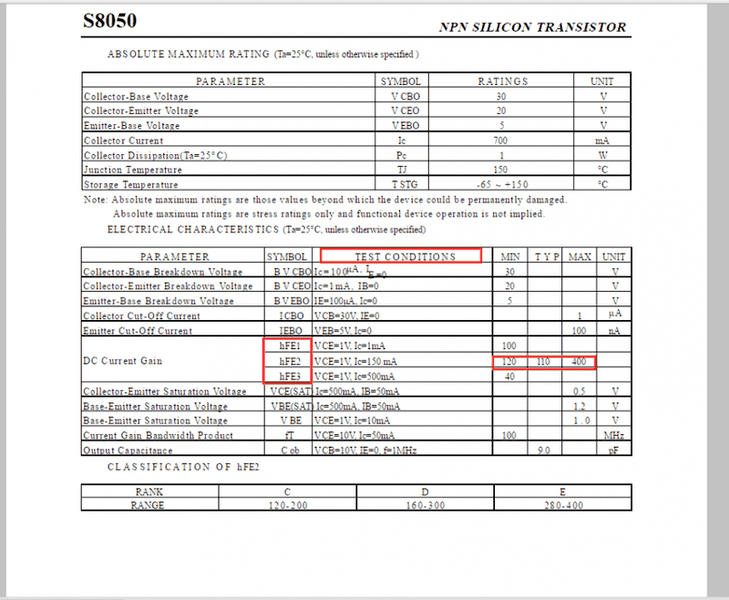
1. There are hfe1, hfe2, hfe3for this S8050 transistor and for each there are associated MIN, TYP and MAX value. for hfe1and hfe3there areonlya MIN value, but for hfe2the values MIN, TYP and MAX areallexist. Why is the difference?

2. What does hfe1, hfe2and hfe3mean? If they all exist, do I still have a unique value? Which one of them correspond to the186value which I got from the multimeter?

3. Why for each of them there are a range of values (MIN, TYP, MAX)? If the hfe has, for example like hfe2, MIN value as low as100and MAX as high as400, then how can I know exactly which hfe value the transistor will operate on, and consequently, how should I design the circuit (resistance values, saturation mode, etc.)?I could hardly see any clue in this data sheet. Help will be greatly appreciated.
Thanks a lot.
Regards,
Sherldonnnn
S8050.png
 
Engineering news on Phys.org
The value of Hfe is hard to control during manufacture so devices are sorted into different grades or ranks after manufacture. The value of Hfe is also current dependent, which is why they identify three different ranges.

The min=120, typ=110, max=400 seems irrational since the typical is less than the minimum. Either there is a typo in the data sheet or the typical and the maximum refers to all classes of the device.

Low Hfe increases the base current required to drive the output load. High Hfe slows down the transistor in high speed applications because it multiplies the miller capacitance between base and collector.

You should always design for the worst case values. That is why the minimum and maximum values are given.
An analogue circuit is designed to minimise gain variation due to Hfe. Hfe spread and variation is then not critical.
A digital circuit will need some way of limiting the base current to the maximum required for the lowest Hfe.

Can you post the circuit diagram that shows how you will use this transistor.
 
Baluncore said:
The min=120, typ=110, max=400 seems irrational...
I agree, looks like an error in the data sheet; I would choose for 110 for both min and typ, and probably design for 100 or less.

You will notice that the three lines of hFE data are for different Collector currents, Ic. This is another case of a confusing data sheet. The hFE of a transistor varies with Collector current and these three lines show the hFE to expect at different currents. In the US at least, data sheets do not number the entries, just leave them all as hFE. The 'binning' for gain is presented as a field in the part number, such as "S8050-1", "S8050-2"; or more often as "S8050-A", "S8050-B". If such binning is used, they typically appear as separate columns on the data sheet.
 
Baluncore said:
The value of Hfe is hard to control during manufacture so devices are sorted into different grades or ranks after manufacture. The value of Hfe is also current dependent, which is why they identify three different ranges.

The min=120, typ=110, max=400 seems irrational since the typical is less than the minimum. Either there is a typo in the data sheet or the typical and the maximum refers to all classes of the device.

Low Hfe increases the base current required to drive the output load. High Hfe slows down the transistor in high speed applications because it multiplies the miller capacitance between base and collector.

You should always design for the worst case values. That is why the minimum and maximum values are given.
An analogue circuit is designed to minimise gain variation due to Hfe. Hfe spread and variation is then not critical.
A digital circuit will need some way of limiting the base current to the maximum required for the lowest Hfe.

Can you post the circuit diagram that shows how you will use this transistor.
Yes,I agree with you .It's really difficult. I am trying to make a diagram. Hope you don't feel offend. I can't do it very fast.Thanks for your suggestion!
 
Tom.G said:
I agree, looks like an error in the data sheet; I would choose for 110 for both min and typ, and probably design for 100 or less.

You will notice that the three lines of hFE data are for different Collector currents, Ic. This is another case of a confusing data sheet. The hFE of a transistor varies with Collector current and these three lines show the hFE to expect at different currents. In the US at least, data sheets do not number the entries, just leave them all as hFE. The 'binning' for gain is presented as a field in the part number, such as "S8050-1", "S8050-2"; or more often as "S8050-A", "S8050-B". If such binning is used, they typically appear as separate columns on the data sheet.
Yes, maybe the datasheet was wrong. Thanks . I will check it out and carefully read the other documents.
 

Similar threads

Replies
18
Views
3K
  • · Replies 5 ·
Replies
5
Views
2K
  • · Replies 3 ·
Replies
3
Views
5K
  • · Replies 5 ·
Replies
5
Views
2K
  • · Replies 1 ·
Replies
1
Views
1K
Replies
2
Views
2K
  • · Replies 2 ·
Replies
2
Views
8K
Replies
3
Views
3K
  • · Replies 2 ·
Replies
2
Views
5K
  • · Replies 4 ·
Replies
4
Views
3K