Limit switches to control motor direction

Click For Summary

Discussion Overview

The discussion revolves around the use of limit switches and DPDT relays to control the direction of a motor. Participants are addressing issues related to motor direction reversal upon limit switch activation and ensuring the motor stops when a specific limit switch is engaged. The scope includes technical wiring, relay behavior, and potential alternative solutions.

Discussion Character

  • Technical explanation
  • Debate/contested
  • Exploratory

Main Points Raised

  • One participant describes a setup involving two limit switches and two relays to control motor direction but encounters issues with the motor not rotating when the second limit switch is engaged.
  • Another participant asks for clarification on the type of motor being used, suggesting it might be a permanent magnet motor.
  • A participant outlines a sequence of events based on the wiring diagram, indicating that the motor may experience chattering due to the relay states changing rapidly.
  • There is a question regarding the relay wiring, specifically whether the relay should short the normally open (NO) pins and disconnect the normally closed (NC) pins when energized.
  • One participant suggests considering a motor driver IC as an alternative solution, highlighting its benefits such as built-in protections and ease of use.

Areas of Agreement / Disagreement

Participants express differing views on the effectiveness of the current relay setup and the potential advantages of using a motor driver IC. The discussion remains unresolved regarding the specific issues with the relay behavior and motor control.

Contextual Notes

There are limitations in the provided information, including assumptions about the relay behavior and the specific motor type. The discussion does not clarify the exact wiring configuration or the characteristics of the relays used.

zxcvb
Messages
10
Reaction score
1
I am trying to use two limit switches(this one) and two DPDT relays to control the direction of the motor. When the power is applied the motor should rotate one direction (direction for this question isn't important). Also, at this point (initialization) neither switch will be energized. The motor will rotate and move until it energizes the second limit switch (labeled Switch 2). At this point, the direction of the motor should reverse. The motor and hardware will then move towards switch one. Once the motor reaches switch one it should stop completely (not reverse direction again). Below is my basic wiring diagram.

I wired it up and when I supply power the motor rotates. However, whenever switch 2 is energized I can hear relay 2 energize and de-energizes quickly but no motor rotation.

Also, I am trying to implement a latching relay when the motor reverses direction. I do not know if my problem is occurring there.

Finally, I am having problems trying to figure out how to have the motor stop once switch 1 is energized.

Any help with my two problems (reversal of direction, and stop when switch 1 energized) would be greatly appreciated.
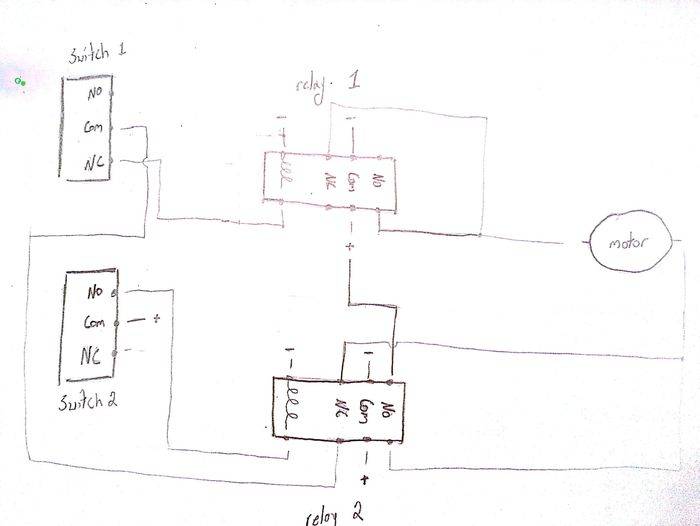
8E5EH.jpg
 
Engineering news on Phys.org
What type of motor? Permanent magnet motor?
 
First some standard shorthand:
K1 = relay 1
K2 = relay 2
S1 = limit switch 1
S2 = limit switch 2

Please verify if this is what you think is happening:

Event 1: (power on) K1 is energized, K2 is de-energized. S1 and S2 are both dis-engaged. Motor is spinning and motion is toward S2.
Event 2: (S2 engaged) K2 is energized, which de-energizes K1. Motor spins to produce motion towards S1.
Event 3: (S2 dis-engaged) K2 is de-energized, which energizes K1. Motor spins to produce motion towards S2.
Event 4: (S2 engaged) K2 is energized, which de-energizes K1. Motor spins to produce motion towards S1.
Event 5: (S2 dis-engaged) K2 is de-energized, which energizes K1. Motor spins to produce motion towards S2.
etc.

This should produce some observable chattering, unless I mis-interpreted your drawing.
 
Do you have a data sheet for the relays? Shouldn't the relay short the NO pins and disconnect the NC pins when it's energized? You have relay 1 wired as if the pins are going to be connected to the common or supply voltages depending on its state.
 
aam... why wouldn't you buy a Motor Driver IC with parameters of your motor? it comes with a datasheet with connection diagrams and operational manual.
these specialized IC s are chap, tiny,Bipolar,have built in voltage/current limiting/regulation and short circuit protection,are available for wide spectrum of motors, and take all the engineering weight off your shoulders. it's a "Buy-Solder-Off You Go" thing.
 

Similar threads

  • · Replies 5 ·
Replies
5
Views
2K
  • · Replies 9 ·
Replies
9
Views
2K
  • · Replies 15 ·
Replies
15
Views
2K
Replies
17
Views
3K
  • · Replies 25 ·
Replies
25
Views
5K
Replies
21
Views
3K
  • · Replies 7 ·
Replies
7
Views
3K
  • · Replies 7 ·
Replies
7
Views
1K
  • · Replies 12 ·
Replies
12
Views
2K
Replies
37
Views
7K