Discussion Overview
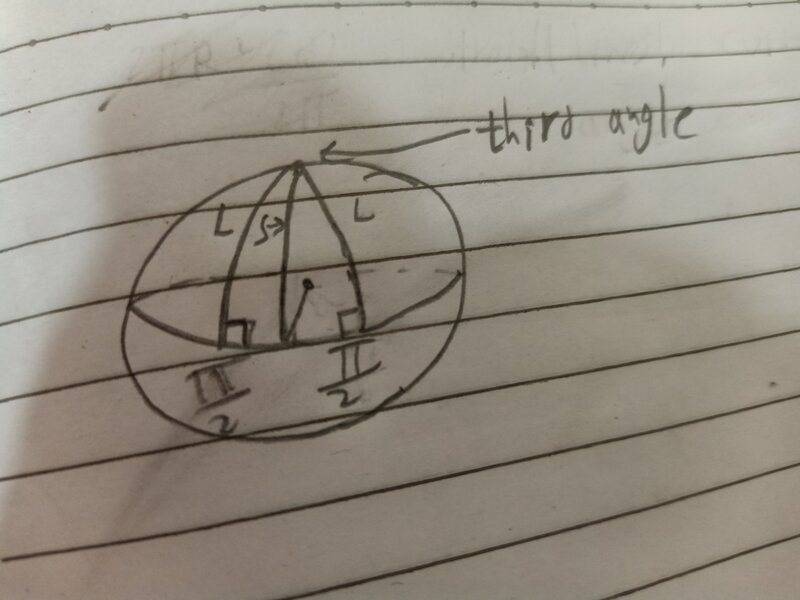
The discussion revolves around the properties of triangles on a sphere, particularly focusing on a triangle with two right angles and the implications regarding its classification as isosceles, as well as the shortest distance between specific points on the sphere. The scope includes theoretical considerations and geometric properties relevant to spherical geometry and general relativity.
Discussion Character
- Exploratory
- Debate/contested
- Technical explanation
Main Points Raised
- Some participants question whether a triangle on a sphere with two right angles can be classified as isosceles, suggesting that the sides are curved and thus do not fit the definition of a polygon.
- Others propose that, to the extent it can be considered a triangle, it may generally be isosceles or even equilateral, depending on the angles involved.
- One participant mentions that if two angles are 90 degrees, the sides opposite those angles would span a quarter of a great circle, which is a property of such triangles.
- There is a suggestion that the sides of the triangle are geodesics, which could allow for a different interpretation of polygonal properties in spherical geometry.
- Some participants express uncertainty about the implications of these properties in the context of general relativity and the area calculations for such triangles.
Areas of Agreement / Disagreement
Participants generally do not reach a consensus on whether the triangle can be classified as isosceles due to the curved nature of its sides. Multiple competing views remain regarding the classification and properties of triangles on a sphere.
Contextual Notes
There are unresolved assumptions regarding the definitions of triangles and polygons in spherical geometry, as well as the implications of curvature on the properties discussed. The discussion also touches on the relationship between angles and side lengths in spherical triangles, which may not align with traditional Euclidean geometry.
Who May Find This Useful
This discussion may be of interest to students and educators in physics and mathematics, particularly those studying geometry, general relativity, or spherical trigonometry.