Question: How does the triboelectric effect produce electricity in generators?

  • Thread starter Thread starter maryy
  • Start date Start date
  • Tags Tags
    Generators
Click For Summary

Discussion Overview

The discussion revolves around the triboelectric effect and its application in triboelectric generators (or triboelectric nanogenerators). Participants explore how these generators produce electricity through contact and separation of materials, the mechanics behind energy conversion, and the implications of power density measurements.

Discussion Character

  • Exploratory
  • Technical explanation
  • Conceptual clarification
  • Debate/contested

Main Points Raised

  • Some participants inquire whether the energy produced by triboelectric generators is solely from contact and separation or if friction plays a significant role.
  • One participant explains that triboelectricity involves two different materials rubbing together, leading to electron transfer and charge separation, akin to a parallel plate capacitor.
  • Another participant emphasizes that to generate a certain amount of power, more mechanical energy must be supplied than the electrical energy produced, raising concerns about the practicality of such energy conversion.
  • There is a discussion about the distinction between triboelectricity and piezoelectricity, with some participants noting that triboelectricity does not require the same pressure as piezoelectric generators.
  • Questions arise regarding the meaning of "energy density" and how it relates to the area of the triboelectric material and the power generated.
  • One participant suggests that the rubbing aspect may be misleading, asserting that the energy conversion primarily results from contact and separation rather than friction.

Areas of Agreement / Disagreement

Participants express varying views on the mechanisms of energy conversion in triboelectric generators, with no consensus reached on the role of friction versus contact in generating electricity. The discussion remains unresolved regarding the specifics of how power density translates to actual energy output.

Contextual Notes

Some participants note limitations in understanding the relationship between mechanical energy input and electrical energy output, as well as the definitions of terms like "energy density." There are unresolved questions about the exact nature of energy transformation in triboelectric generators.
maryy
Messages
6
Reaction score
0
recently i began reading about triboelectric effect and triboelectric generators(and/or triboelectric nanogenerators) but i really need somebody to explain me this.
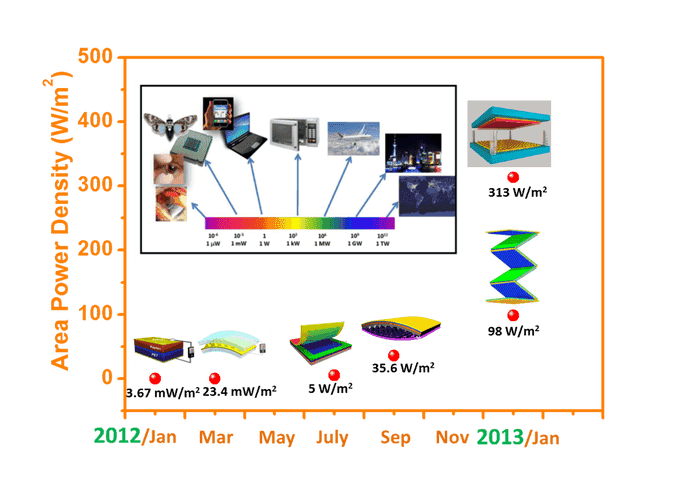
_progress_made_in_the_output_power_density_of_triboelectric_nanogenerators_within_12_months..tif.png

those generators produce the amount of energy mentioned in this pic just from the contact and separation of the layers?. like if i take the triboelectric generator that produce 98 watts per square meter and rub 1000 square cm of it with my palm and with sufficient pressure to make all the layers to contact each other i will produce 9.8 watts just from that simple rubbing motion?.
 
Engineering news on Phys.org
Triboelectricity happens as a result of taking two different materials and rubbing them together. After rubbing, one material gives up its electrons to the other material. This results in one material becoming negatively charged and the other becoming positively charged. When you separate the two you have something like a parallel plate capacitor which can then be used to produce power. I suppose this figure is showing the power densities through out the whole process, with the final state in the top right (i.e. your separated materials that mimic the capacitor).
 
Don't forget that regardless of the type of energy conversion, tiboelectric or otherwise, to make 10 watts of power, your hand has to provide somewhat more than 10 watts. That's a lot. The video below shows a squeeze flashlight that might make 1 watt. So think, 10 times that. It sounds pretty tiresome to me.


By the way, I learned a new word today triboelectric.
 
  • Like
Likes   Reactions: billy_joule
anorlunda said:
Don't forget that regardless of the type of energy conversion, tiboelectric or otherwise, to make 10 watts of power, your hand has to provide somewhat more than 10 watts. That's a lot. The video below shows a squeeze flashlight that might make 1 watt. So think, 10 times that. It sounds pretty tiresome to me.


By the way, I learned a new word today triboelectric.


other forms of energy conversions makes sense to me but what kind of energy triboelectricity actualy converts?, you can press piezoelectricity enough and produce electric current or move a dynamo and produce electric current but with triboelectric generator from what i understood all the current is produced from the contact and separation of layers.

does triboelectric generator are just somekind of piezoelectric generators that work with much less pressure?.
 
Nidum said:
Friction generators have been around for a long time and were used in the earliest researches into electrical science .

https://en.wikipedia.org/wiki/Electrostatic_generator

http://www.sparkmuseum.com/FRICTION.HTM
in the wiki article about nanogenerators there is an explenation(drawings) about "Vertical contact-separation mode of triboelectric nanogenerator"
https://en.wikipedia.org/wiki/Nanogenerator#Triboelectric_nanogenerator
and it doesn't look like there is much of a friction here.

anyway what is that "energy density" in the picture i posted?(that also presented in the wiki article) what exactly "98 W/square meter" means?
 
Energy Density = Power/Area. It is a metric that describes how good a power technology is. If you have 98 Watts/Square meter and you had 1 square meter of triboelectric material, you should expect 98 Watts of power. Or if you have 2 square meters of triboelectric material, you should expect 98 X 2 or 196 Watts of power.
 
BTW triboelectricity is not piezoelectricity. Piezoelectricity uses crystal like materials to generate power when they are subjected to stress, where as triboelectricity uses materials that are brought into contact to generate power.
 
nuclear_chris said:
Energy Density = Power/Area. It is a metric that describes how good a power technology is. If you have 98 Watts/Square meter and you had 1 square meter of triboelectric material, you should expect 98 Watts of power. Or if you have 2 square meters of triboelectric material, you should expect 98 X 2 or 196 Watts of power.

but how does 98 watts are generated? from the friction generated by the pressure or just from the mere contact and separation of the layers?. what kind of energy does thos generators transform to electrical energy?. sorry for all my question but something here just really puzzles me
 
  • #10
maryy said:
what kind of energy does thos generators transform to electrical energy?
Come on. When we provide links to articles, we expect you to read the articles before asking more questions. The Wikipedia article on triboelectrics which was linked in #6 says in the very first sentence:

A triboelectric nanogenerator is an energy harvestingdevice that converts the external mechanical energy into electricity
 
  • #11
anorlunda said:
Come on. When we provide links to articles, we expect you to read the articles before asking more questions. The Wikipedia article on triboelectrics which was linked in #6 says in the very first sentence:

i ALREADY readed that and i already asked "does triboelectric generator are just somekind of piezoelectric generators that work with much less pressure?" which means that i aware to that it uses mechanical energy.

the thing that confuses me is that "power density". like if i take a triboelectric generator with "98 watts per square meter" and press on it with my palm it will produce current for my palm's surface area or for the pressure i made on it with my palm? or both?.
 
  • #12
I think the rubbing or friction aspect of triboelectricity can be misleading. The energy comes from contact and separation. The rubbing just brings material of different electronegativity into better contact with each other. The mechanical energy spent to overcome friction is wasted. Very little of it is converted to electrical energy.
 
  • #13
David Lewis said:
I think the rubbing or friction aspect of triboelectricity can be misleading. The energy comes from contact and separation. The rubbing just brings material of different electronegativity into better contact with each other. The mechanical energy spent to overcome friction is wasted. Very little of it is converted to electrical energy.

Yes .

You can see what is going on much more clearly by looking at a school lab type belt and roller Van Der Graf generator . Generation of charge is by a continual contact - separation process .

@maryy - have a look here :

http://sciedwiki.pppl.wikispaces.ne...tor.pdf/209335520/Van de Graaff generator.pdf
 

Similar threads

Replies
5
Views
3K
  • · Replies 44 ·
2
Replies
44
Views
21K
Replies
4
Views
4K
  • · Replies 52 ·
2
Replies
52
Views
8K
Replies
2
Views
2K
  • · Replies 3 ·
Replies
3
Views
10K
  • · Replies 1 ·
Replies
1
Views
11K
  • · Replies 25 ·
Replies
25
Views
6K
  • · Replies 5 ·
Replies
5
Views
3K
Replies
2
Views
3K