Trigonometry triangle Question

  • Context: High School 
  • Thread starter Thread starter basty
  • Start date Start date
  • Tags Tags
    Triangle Trigonometry
Join the discussion
Ask a follow-up here, or get your own question answered by working scientists, mathematicians and engineers — people, not an autocomplete.
Real named experts · corrections over time · the nuance an AI answer skips
9 replies · 2K views
basty
Messages
94
Reaction score
0
For the triangle shown in the below image,

##\sin 60° = \frac{opposite}{hypotenuse} = \frac{y}{r}##
##\sin 30° = \frac{opposite}{hypotenuse} = \frac{x}{r}##

The questions are:

1. What is the opposite and hypotenuse of sin 90°?
2. I am guessing that the opposite and hypotenuse of sin 90 is
r and y respectively so that ##\sin 90° = \frac{opposite}{hypotenuse} = \frac{r}{y}##.
Why sin 90° = 1?
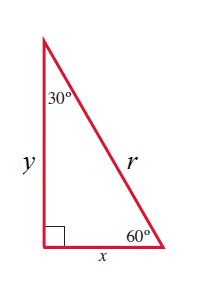
hypotenuse.png
 
Mathematics news on Phys.org
jedishrfu said:
If you use the opposite over the hypotenuse definition then you'd get sin(90) = r/r = 1

Do you mean that the sin 90° is: the opposite = r and the hypotenuse is = r too?
 
How do you obtain ##\cos 90° = \frac{adjacent}{hypotenuse} = \frac{x}{r} = 0##?
 
basty said:
How do you obtain ##\cos 90° = \frac{adjacent}{hypotenuse} = \frac{x}{r} = 0##?
Look at your triangle. As the angle θ gets larger, the length of the base x gets smaller. The radius r remains constant. When θ = 90°, what must x be?
 
SteamKing said:
Look at your triangle. As the angle θ gets larger, the length of the base x gets smaller. The radius r remains constant. When θ = 90°, what must x be?

There is no θ in my triangle. There are 90°, 60°, and 30° angles. Which one you meant as the θ?
 
SteamKing said:
Look at your triangle. As the angle θ gets larger, the length of the base x gets smaller. The radius r remains constant. When θ = 90°, what must x be?

Which side you meant by the radius?

The θ you meant is the one labeled as 60°, but the cos 90° I meant is the right angle.

What should the cos 90° be if the angle is the right angle, not the 60°?
 
basty said:
Which side you meant by the radius?

In your diagram of the triangle, the side labeled "r", which I indicated as "the radius r".

The θ you meant is the one labeled as 60°, but the cos 90° I meant is the right angle.
Yes, but in order to calculate sine and cosine for 90°, you pretend to let the angle labeled 60° in your diagram increase to 90°, and examine what happens to the sides x and y in order for this to happen.

What should the cos 90° be if the angle is the right angle, not the 60°?
cos (90°) = 0, always.

Instead of using just a triangle to define the trig functions, often a unit circle (radius = 1) is used, like this:

Trig_functions_on_unit_circle.PNG

As the point P moves counterclockwise around the circle, the coordinates x and y of P are also the values of cos (θ) and sin (θ), respectively.

Here is another diagram showing how sin (θ) varies for different angles θ drawn on a unit circle:

3.png