Troubleshooting stove heating elements

Click For Summary

Discussion Overview

The discussion revolves around troubleshooting heating elements in a stove, focusing on the performance of burners, potential replacements, and the functionality of a thermostat-like component. Participants explore the implications of different burner designs and their effects on cooking efficiency.

Discussion Character

  • Exploratory
  • Technical explanation
  • Debate/contested

Main Points Raised

  • One participant reports that their stove takes an hour to boil water and is considering replacing the burners, questioning the safety of using a new element with a different design.
  • Another participant suggests that the issue may lie in the stove's controls rather than the burner itself, recommending checking the resistance of the burner element.
  • A participant who replaced their burner notes a significant improvement in boiling time, speculating that the original component may not be activating a second element for higher heat settings.
  • Discussion includes a technical explanation of how older cooktops may use a varying duty cycle to control heat output, with a request for insights into the internal workings of the original component.
  • Several participants discuss the concept of Pulse Width Modulation (PWM) and its relevance to the stove's operation, with varying interpretations of how the thermostat functions.
  • There is a debate over whether the thermostat is designed to activate based on temperature or if it operates differently, with some participants providing detailed descriptions of the heating process within the element.
  • Participants express confusion over terminology related to electrical circuits and thermal switches, leading to clarifications about how the components interact.

Areas of Agreement / Disagreement

Participants express multiple competing views regarding the functionality of the thermostat and the design of the heating elements. The discussion remains unresolved with no consensus on the exact nature of the components or their interactions.

Contextual Notes

Limitations include varying interpretations of technical terms and the lack of clarity on the specific designs of the heating elements being discussed. Some assumptions about the operation of the thermostat and the heating elements are not fully explored.

DaveC426913
Gold Member
2025 Award
Messages
24,286
Reaction score
8,433
TL;DR
Stove elements take an hour to boil water.
Plz forgive. Old man fingers on young whippersnapper phone kb.

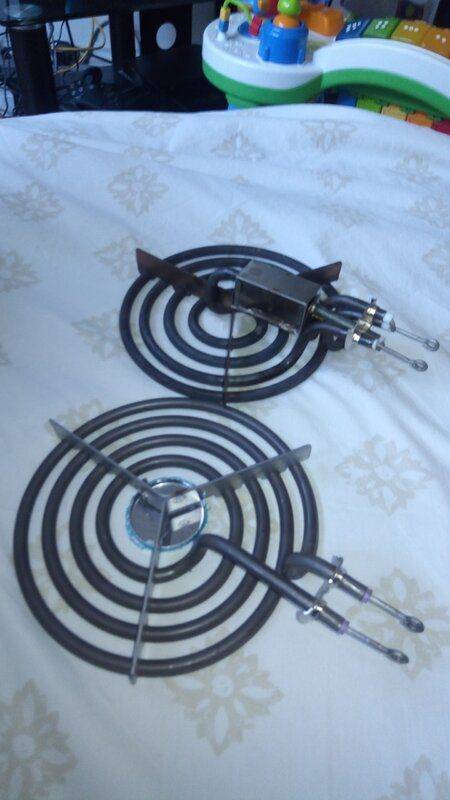
This stove takes an hour to boil a pot of water. I'm looking at replacing the burners right now. They look brand new (top) but who knows?

I bought this one (bottom) which is not exactly the same one. The prongs will fit but the new one has that box thing and it has two coils ,not one (apparently for lo and hi settings). Presumably, the box acts as a splitter but might it also act as a thermostat?

Anyway, is it safe to try the new element without blowing up the stove?
16143632222901847916093.jpg
 
Engineering news on Phys.org
Odds are that the problem is not in the burner, but rather in the controls. Before I replaced the burner I would try digging up the stove manufacturers spec for the resistance of the burner element, check with a VOM.

(And even though this forum is populated by mostly competent people, I wouldn’t trust advice about parts interchangeability that doesn’t come with part and model numbers).
 
  • Like
Likes   Reactions: PhDeezNutz and Lnewqban
I put in this new element and boiled a pot of water in six minutes flat.

I suspect that the box on the original is a thermostat that triggers the second element for cooking on hi. For some reason, it doesn't seem to be kicking in - so on hi I'm only getting half the output.
 
As far as I know most older cook tops of this style vary the duty cycle depending on how far you turn the knob. While technically it is PWM, it occurs at a fairly slow rate maybe between .25 and several Hertz. I've never seen one with a box underneath like that. I'd be mighty appreciative if you cracked it open to tell us what's inside.
 
PWM?

As soon as I am satisfied the new one works under field conditions, l plan to (get permission to) bust the old one open.
 
I used to have a stove that had a "dual" burner where you could select either a six inch diameter center element (for a small pan) or the full eight inch burner. It was not that useful, and I can't remember where the switch was. Could that be what this is?
 
  • Like
Likes   Reactions: DaveC426913
Looks like a thermostat.

Presumably, normally open (circuit) , but closes (electrically ) when sufficently hot.

P_20210226_165142_1.jpg
 
Last edited:
  • Like
Likes   Reactions: hutchphd and Averagesupernova
DaveC426913 said:
PWM?
Pulse Width Modulation. Did you think I meant Pretty Weird Mechanism? :-p
 
  • Like
Likes   Reactions: DaveC426913
DaveC426913 said:
Presumably, normally open (circuit) , but closes (electrically ) when sufficently hot.
There are too many ways to interpret the English language.
"Normally closed" NC, means the second element has power when cold, but the switch contacts open to disconnect the power when hot.

It is a thermostat that regulates temperature by connecting the second element when below temperature. It will switch at the thermal time constant of the controlled element and sensor, probably about a 15 second period. So, yes it is an early PWM or bang-bang controller.
 
  • Like
Likes   Reactions: Averagesupernova
  • #10
Baluncore said:
There are too many ways to interpret the English language.
"Normally closed" NC, means the second element has power when cold, but the switch contacts open to disconnect the power when hot.
Yeah. As I was writing, I realized that the terms could apply to circuitry or to physical flow. And they have opposite meanings.

An 'open circuit' means nothing passes, whereas an 'open flow' generally means something passes freely.

And I realized I wasn't actually sure which, exactly, this device was doing. Electricity? Or heat? Where exactly does the electricity in an element get converted into heat? Before or after this switch?
Baluncore said:
It is a thermostat that regulates temperature by connecting the second element when below temperature. It will switch at the thermal time constant of the controlled element and sensor, probably about a 15 second period. So, yes it is an early PWM or bang-bang controller.
I don't follow. I assumed this was a heat thermostat that turned 'on' the second element when the first one got hot enough - to provide a "high" heat setting.
 
  • #11
DaveC426913 said:
Where exactly does the electricity in an element get converted into heat? Before or after this switch?
The heat appears along the internal resistance wire of the element. The heat passes radially through the mineral insulation to the outer heated radiating envelope, that is earthed through the stove chassis.

DaveC426913 said:
I don't follow. I assumed this was a heat thermostat that turned 'on' the second element when the first one got hot enough - to provide a "high" heat setting.
Either is possible, but I assume it was designed for a fast start, then lower power to simmer. It might be designed as you suggest for more heat, but with reduced cold start current.
When it is cold, measure the resistance across the external element terminals. Then measure the resistance across the internal switched element terminals. If they are the same it is my fast start scenario, if they differ it is your initial surge current reduction scenario, or a faulty thermostat.
 
  • #12
Averagesupernova said:
Pulse Width Modulation. Did you think I meant Pretty Weird Mechanism? :-p
I was working on "Powerful Wave Motion" Gun. :wink:
1614398854958.png
 
  • #13
Baluncore said:
The heat appears along the internal resistance wire of the element. The heat passes radially through the mineral insulation to the outer heated radiating envelope, that is earthed through the stove chassis.
:slaps forehead:

It didn't occur to me that the element wasn't homogenous.
(My dumb brain was trying to reconcile either:
- heat being conducted from the terminal all the way through the coil's length,
or
- a coil that is, itself, electrically conductive.) :doh:

Of course there's a conductive wire running through the its core, electrically insulated from the ceramic sheath, so as not to zonk every hapless user.

Baluncore said:
When it is cold, measure the resistance across the external element terminals. Then measure the resistance across the internal switched element terminals.
Er. Ya lost me. external/internal switched?
 
  • #14
DaveC426913 said:
Er. Ya lost me. external/internal switched?
I can't see in the picture which spiral is which, but the thermal switch controls one element of a two element assembly, I think it is the inner turns that are switched.

The assembly has two external terminals. Follow one element from a terminal, through the thermal switch, and around and around to the other terminal. That is the controlled element.

Then follow the other element from one terminal to the other terminal, I think that element is the outer turns.

When the thermal switch conducts, the two elements are in parallel.
 

Similar threads

  • · Replies 11 ·
Replies
11
Views
10K
  • · Replies 29 ·
Replies
29
Views
20K