Troubleshooting TV Power Issues: Signs of Blown Capacitors?

  • Thread starter Thread starter Q_Goest
  • Start date Start date
  • Tags Tags
    Capacitors
Click For Summary
SUMMARY

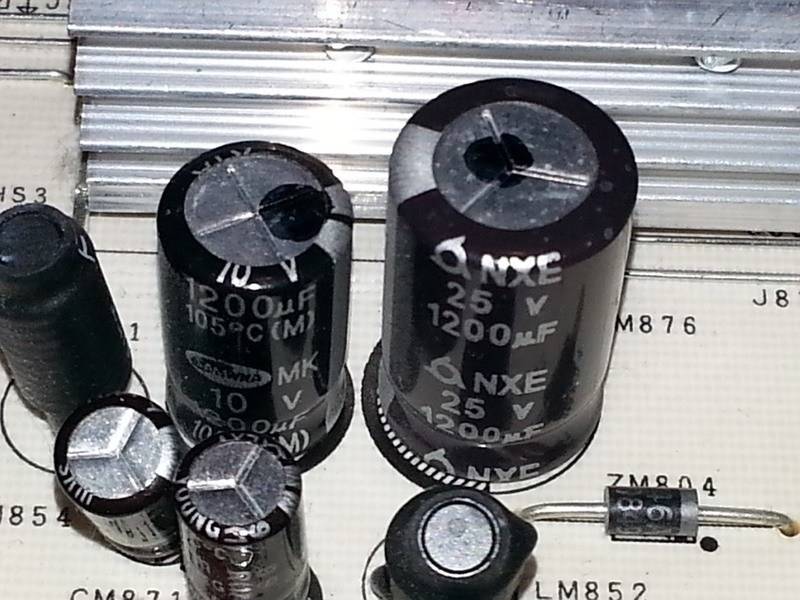
The discussion centers on troubleshooting power issues in a Samsung TV, specifically examining the role of capacitors in the power supply unit (PSU). Users identified that capacitors often fail without visible bulging, as evidenced by the presence of black spots on the tops of the capacitors in question. Recommendations include using a digital multimeter (DMM) with a capacitor testing function to assess capacitor health and replacing suspected faulty capacitors with high-quality brands like Panasonic or Rubycon. The conversation emphasizes the importance of checking solder joints and other components in the PSU to ensure comprehensive troubleshooting.

PREREQUISITES
  • Understanding of basic electronics and circuit board components
  • Familiarity with digital multimeters (DMM) and their functions
  • Knowledge of soldering techniques, particularly with lead-free solder
  • Awareness of common capacitor failure modes, including the "capacitor plague"
NEXT STEPS
  • Learn how to use a digital multimeter for testing capacitors and other components
  • Research the "capacitor plague" and its impact on electronics reliability
  • Explore soldering techniques for replacing capacitors on circuit boards
  • Investigate common power supply issues in Samsung TVs and their solutions
USEFUL FOR

Electronics enthusiasts, DIY repair technicians, and anyone troubleshooting power issues in televisions, particularly Samsung models.

Q_Goest
Science Advisor
Messages
3,013
Reaction score
42
My daughter's TV won't turn on. Seems like the power panel. I'm not much of an electronics person but after looking around the net it seems capacitors are often to blame. Everything I've seen though shows a bulge in the capacitor with the potential of there being some loss of fluid inside that might appear as brown or black stuff.

Attached is a picture of the 2 suspect capacitors. They're not bulging out but they both have black spots on the top. They look a bit like someone just marked them with a black drop of paint but none of the other capacitors have this black dot.

Do you think these capacitors are blown?
attachment.php?attachmentid=59981&d=1372602960.jpg
 

Attachments

  • Capacitors.jpg
    Capacitors.jpg
    72.2 KB · Views: 9,736
Engineering news on Phys.org
Did they always have the black spots on them? Was someone highly prescient, way back in the life of the TV? haha. What's the background to this? TV just stopped working?
Many DVMs have a Capacitor measuring facitly these days so you could take them out and test them. You could be lucky and be able to change them (watch the polarity for the replacements). They are cheap enough. But, for two components to go, you would probably be looking at some other, common cause. You are right about Capacitors being the weak link.
If you aren't into electronics circuits, fault repairing will probably be a bit beyond you (a really good way to spoil your day - I have been there too. If you can dis the outputs and look for DC outputs of 12V and 5V etc., without the receiver circuitry load, then that will tell you about the PSU. You could possibly get a new one - but you could probably get 'a local man' to look at it for not much money. New TVs are laughably cheap nowadays (the basic ones). If you really love your daughter, you could buy her a flashy big new one - or just tell her to do more homework for entertainment in her room, if you are a stingy ol' sod like me.
 
They don't look like swollen to me, and these black points look like just some mark, not a leak.

Not that I am sure of anything.
 
I have repaired TVs by inspection and bulged caps are a good thing to replace. I can't tell if those the pic are bulged. It does not take much though. My last repair the caps were barely bulged, but replacing them did the trick.

Modern circuit boards use lead free solder which requires a hotter soldering iron then the common hobbyist iron. What I did was to melt regular solder on top of the lead free this enabled me to remove the lead free and remove the caps. I replaced with regular solder.
 
These could be examples of the notorious "capacitor plague" capacitors .These were poor quality capacitors most of which, I think, were manufactured in Taiwan They used inferior quality electrolyte which caused early failure. Try googling for details.

Is it a Samsung TV? Some models have problems with cheap capacitors.
 
Last edited:
sophiecentaur said:
What's the background to this? TV just stopped working?
It started with the TV shutting off randomly. After a while it would get worse and the TV would turn on at random. Kinda spooky I suppose if you're sleeping and the TV comes on all of a sudden in the middle of the night! Apparently that happened a few times, so my daughter exorcised the demon by unplugging it. Thank god for conservation of energy.

Finally, the TV just gave up altogether and it wouldn't come on. So regardless of whether you tried the remote or the power switch on the side of the TV, it didn't do anything. From my limited experience, I'm thinking it's the power board.

I figure I have nothing to lose by experimenting a bit. If I can't fix the power board, I could buy a new one if they're cheap enough or just get a new TV. It's not a large TV and no, she's not getting a big one! lol She'll be a sophomore in college next year so she doesn't need more distractions.
 
Thanks for the feedback everyone. Yea, it's a Samsung. The capacitor says "Sam Young" on the side (made in S. Korea). A quick search found this from a message board:
To my surprise it didn't even have bulging or blown tops on these capacitors, and they weren't even the CapXon capacitors I've heard so much about in the failure papers. They did have a brand name I've never heard of, "Sam Young" whatever those are.

I ordered some new capacitors online, Panasonic and Rubycon ones are really well made, fired up my trusty soldering iron and went to work to replace 2x 1000uF, a 680uF, and 2x 220uF capacitors on the power pcb. I put the monitor back together and BAM everything works great, its just like new
http://hardforum.com/showthread.php?t=1576580

So I decided these must be the culprits and removed them. It was pretty easy with a copper wicking wire I saw a guy use on YouTube. Only took a few minutes. I ordered some new ones and will put them in and see how it goes. I'm just wondering if the 10 others on the board shouldn't be replaced as well but it's easy enough to take apart. I'll leave them for now I suppose.
 
Oh - one more thing. Can these be tested? I put a ohm meter on them and the resistance slowly rises. Shorting it out brought the resistance back down and measuring resistance slowly brings it up. I'm thinking that might be normal though. Any ideas?
 
Sounds normal.

Caps look fine to me. But the cans can hide a multitude of problems. Go ahead and replace them. While you're closely scrutinizing the board, look for a dodgy solder joint somewhere, that also could be the cause of the trouble, or a poor connection on a connector. Luck plays a large part in identifying faults!

Good luck! :smile:
 
  • #10
Both cap's seem to be good... <sigh> I read the instructions in my Fluke meter book and realized it has a capacitor tester and they both checked out within 10%.

After carefully scrutinizing every solder joint on the board I'm coming up empty. I'll replace the caps now that I have 2 coming in but I'm not holding out hope.

Is there any way to test cap's without removing them from the board? I assume not. :(

Any suggestions would be great!
 
  • #11
Is there any way to test cap's without removing them from the board? I assume not. :(

Not a sure-fire one size fits all test...

What you can do for line frequency filter capacitors in power supplies is this -
measure the voltage across capacitor with meter set to DC volts, write down the number.
measure the voltage with meter set to AC, write down the number.

The AC voltage across the cap should be maybe 10% of the DC value, not 25% or 50%.
That's on the line side of the switcher where you're working with 5 or 60 (or 100 or 120) hz.

On other side of switcher where you're dealing with tens or hundreds of khz you can try similar readings, but many DMM's aren't very good on high frequency AC measurements. Check your Fluke manual for its AC frequency response.

Basic premise is this - the function of those filter capacitors is to remove AC from the DC supply. Symptom when they fail is there's lots of AC in your DC supply, and the DC reads about 1/3 low.. That's because when cap is failed open circuit, DC voltage dips clear to zero twice per line cycle.

Oh - one more thing. Can these be tested? I put a ohm meter on them and the resistance slowly rises. Shorting it out brought the resistance back down and measuring resistance slowly brings it up. I'm thinking that might be normal though. Any ideas?

That sounds normal. The cap is being charged by the current from your ohmmeter. Lower ohm scale should charge it more quickly. So let it charge, then switch your meter to DCVolts and watch it discharge. You should see a time constant of RXC where R is input resistance of your Fluke (from manual - probably ten megohms).

old jim
 
  • #12
Q_Goest said:
Both cap's seem to be good... <sigh> I read the instructions in my Fluke meter book and realized it has a capacitor tester and they both checked out within 10%.

After carefully scrutinizing every solder joint on the board I'm coming up empty. I'll replace the caps now that I have 2 coming in but I'm not holding out hope.

Is there any way to test cap's without removing them from the board? I assume not. :(

Any suggestions would be great!

Apart from the relative probability factor, what makes you suspect the Capacitors? Have you checked all the voltages emerging from the PSU? Does your Fluke have a frequency measuring setting? You can see whether your switcher is actually oscillating. You are looking for a value in excess of 20kHz. Is the board actually getting full mains volts on it?
Sorry for what may be obvious points to you but fault finding is an esoteric field and requires a particular approach.
Have you tried a search on the model you have? There may be a repair forum that 'knows' about your specific problem with your particular PSU. I have had some great success with Fridge Freezers, dish washers and smart phones , using help from a youTube movie. I never would have managed to replace the phone's screen without seeing it on youTube.
 
  • #13
Also pretty common for TV's to lose a MOV in the incoming power connection - or even a fuse... I am sure there is a lablel in the TV that says - no user serviceable part inside - generally good advice.
If you can find a local repair shop - they will generally give a basic analysis - maybe $25? Or a local vocational school with electronics class would be happy to give it a go.
 

Similar threads

  • · Replies 6 ·
Replies
6
Views
4K
  • · Replies 16 ·
Replies
16
Views
4K
  • · Replies 152 ·
6
Replies
152
Views
11K
  • · Replies 2 ·
Replies
2
Views
4K
  • Poll Poll
  • · Replies 4 ·
Replies
4
Views
5K
  • · Replies 15 ·
Replies
15
Views
6K
  • · Replies 8 ·
Replies
8
Views
6K
  • · Replies 25 ·
Replies
25
Views
5K
  • · Replies 1 ·
Replies
1
Views
2K
  • · Replies 38 ·
2
Replies
38
Views
26K