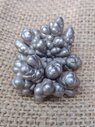
Trying to identify a weird metal object found on a beach

  • Thread starter Thread starter xtempore
  • Start date Start date
  • Tags Tags
    Metal Weird
Click For Summary

Discussion Overview

The discussion revolves around identifying a metal object found on a beach, described as hard, heavy, and resistant to scratching. Participants explore various hypotheses regarding its composition and suggest methods for testing its properties.

Discussion Character

  • Exploratory
  • Debate/contested
  • Technical explanation

Main Points Raised

  • Some participants propose that the object could be osmiridium or iridosmine, suggesting it may be valuable and offering methods for field identification.
  • Others suggest measuring the density using water displacement as a way to narrow down the possibilities.
  • One participant speculates it could be chromium, while another suggests it resembles iron formed by the Thermit process.
  • There are claims that the object might be botryoidal goethite or hematite, with discussions on their properties and identification methods.
  • Some participants express skepticism about the object's identification as nickel, citing its hardness and magnetic properties.
  • Participants discuss the geological context of the find, questioning the history of mining in the area and the potential for glacial transport of the object.
  • Several participants emphasize the importance of the object's magnetic property, suggesting it could indicate steel slag.
  • There are ongoing debates about the hardness of nickel and whether it could withstand scratching tests.

Areas of Agreement / Disagreement

Participants do not reach a consensus on the identity of the object, with multiple competing views and hypotheses remaining throughout the discussion.

Contextual Notes

Limitations include the lack of direct testing by the original poster and reliance on second-hand information. The discussion also highlights uncertainties regarding the object's exact properties and geological context.

Who May Find This Useful

Individuals interested in mineral identification, geology, or those who have found unusual objects in natural settings may find this discussion relevant.

  • #31
numismaticneighbor said:
I have one of those just like the 1 in the picture. But mine's much larger and it is magnetic.
The OP misspoke. He called it 'magnetic', but he said 'a magnet sticks to it'.
So, what he meant was that it is ferromagnetic.

Presumably, this is what you mean too?

Pics? Location of find?
 
  • Like
Likes   Reactions: russ_watters
Earth sciences news on Phys.org
  • #32
1000000894.jpg
 
  • Like
Likes   Reactions: DaveC426913
  • #33
  • Like
  • Haha
Likes   Reactions: diogenesNY and Tom.G
  • #34
It could be a chemical deposition feature, that forms slowly on a piece of steel that was buried in the mud. Without environmental context, it is difficult to tell. I need the position of the find, as a latitude and longitude on Google Earth.
 
  • #35
Baluncore said:
I need the position of the find, as a latitude and longitude on Google Earth.
And please be precise! :wink:
 
  • Haha
Likes   Reactions: sophiecentaur
  • #36
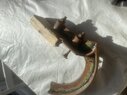
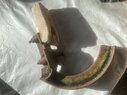
Hi apologies for intruding on your chat but I have been looking online as I have found an item on a beach /metal and wood) but haven't a clue what it is? How do I attach the picture on here?
 
  • #37
hbs10 said:
Hi apologies for intruding on your chat but I have been looking online as I have found an item on a beach /metal and wood) but haven't a clue what it is? How do I attach the picture on here?
There is an icon in the reply menu or use CTRL+P on keyboard and follw prompts
 
  • #38
I figured it out, any advice welcome. Thankyou.
 

Attachments

  • IMG_9179.jpeg
    IMG_9179.jpeg
    51 KB · Views: 43
  • IMG_9180.jpeg
    IMG_9180.jpeg
    49.3 KB · Views: 48
  • #39
@hbs10
Welcome to PF.

That looks like part of a farm implement or cart from circa 1920.

The bolt-holes appear to be a casting, but the curved T-section would have been wrought iron. That suggests the iron part was fabricated, with welds near the casting. The two mild steel coach bolts have rusted away, faster than the wrought or cast iron material.

It might help if you could identify the Google Earth coordinates of the find.
 
  • Like
Likes   Reactions: russ_watters
  • #40
hbs10 said:
How do I attach the picture on here?

I just use drag and drop from the original to where you want it in your text on my macbook pro. But then, Apple has always made life easy.
 
  • #41
Baluncore said:
@hbs10
Welcome to PF.

That looks like part of a farm implement or cart from circa 1920.

The bolt-holes appear to be a casting, but the curved T-section would have been wrought iron. That suggests the iron part was fabricated, with welds near the casting. The two mild steel coach bolts have rusted away, faster than the wrought or cast iron material.

It might help if you could identify the Google Earth coordinates of the find.
Hi and thankyou so much for replying that's fascinating.

I've only just worked out how to access this forum again, apologies for the delay.

It was in Tenby, wales, uk
51°40'14"N 4°41'46"W. Coordinates may be slightly different but it was near the rock pools. I didn't know the family member had found it until we were back in Birmingham😞.
 
  • #42
I was hoping to identify the item from the local agricultural history of the location, but for Tenby, that would be tourism. Maybe it was a structural part of an old donkey cart.

I expect some implement, built a century ago, was left up on the cliffs, in the bushes above the beach, and that it disintegrated, or was cut up, and fell down onto the beach.

I don't think it is part of a set of steps, or a handrail that gave access to the beach, and can't see how it could be part of barbed wire beach defences from WW2.

Take a look at the ends of the 'T' section. Was it cut with a hacksaw?
Were the 'T' sections bent during manufacture, or when the structure was demolished?
 
  • #43
Baluncore said:
I was hoping to identify the item from the local agricultural history of the location, but for Tenby, that would be tourism. Maybe it was a structural part of an old donkey cart.

I expect some implement, built a century ago, was left up on the cliffs, in the bushes above the beach, and that it disintegrated, or was cut up, and fell down onto the beach.

I don't think it is part of a set of steps, or a handrail that gave access to the beach, and can't see how it could be part of barbed wire beach defences from WW2.

Take a look at the ends of the 'T' section. Was it cut with a hacksaw?
Were the 'T' sections bent during manufacture, or when the structure was demolished?
Thankyou so much for the information. It has helped me find some experts on farm/agricultural experts on the time period stated so maybe they'll know. I really appreciate your help.
 
  • Like
Likes   Reactions: berkeman
  • #44
sophiecentaur said:
I just use drag and drop from the original to where you want it in your text on my macbook pro. But then, Apple has always made life easy.
Thankyou I managed to get the coordinates, much appreciated.
 
  • Like
Likes   Reactions: berkeman
  • #45
hbs10 said:
It has helped me find some experts on farm/agricultural experts on the time period stated so maybe they'll know.
Here is an old picture of St Catherine's Island, Tenby, Wales, with bathing machines.
https://en.wikipedia.org/wiki/Bathing_machine
The beach was used for bathing machines in Victorian times, maybe one was stranded and wrecked by a winter storm. Your find was from South Beach, behind, and to the right of the photographer.
Bathing Machines Tenby.jpg


Tenby is a lovely little coastal town set atop high sheer cliffs with lovely sandy beaches below. Crumbling castle walls surround much of the town dating back to Norman times, giving a glimpse of the towns history. The towns beaches and bays were also one of the places used by troops training in preparation for D-Day.
There’s an island close to the town with a fort built to defend the town against the French, it was a gun emplacement during the war before being converted to a zoo until it closed. It now caters for visitors during low tide when the beach between it and Tenby is uncovered.
We also tried to visit one of the islands not far off he coast but the weather has been against us with the boat trip being cancelled most days due to sweep. In Victorian times Tenby was the place to flee from the city to enjoy medicinal baths in its water. They even had bathing boxes on horse carriages.
https://www.leggingit.com.au/oh-tenby-love/
 
  • Like
Likes   Reactions: Rive, Flyboy and russ_watters
  • #46
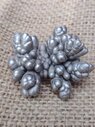
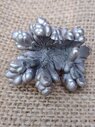
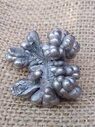
I have this unknown specimen similar to the one Xtempore has. This belonged to my deceased sister whom lived in North Central Florida. It is magnetic and weighs 89.0 grams & measures approximately 1.3/4" Long, by 1.1/2" Wide by 1.1/2" Height at the fattest side. I haven't beat on it but it feels quite hard. The center bubbles remind me of lead and the larger ones remind me more of the color of nickel. The bottom looks strange to me and little porous type holes are part of the metal.
 

Attachments

  • mini_IMG_20250427_172307231.jpg
    mini_IMG_20250427_172307231.jpg
    49.1 KB · Views: 47
  • mini_IMG_20250427_172339837.jpg
    mini_IMG_20250427_172339837.jpg
    53 KB · Views: 33
  • mini_IMG_20250427_172348186.jpg
    mini_IMG_20250427_172348186.jpg
    54.6 KB · Views: 19
  • mini_IMG_20250427_172325293.jpg
    mini_IMG_20250427_172325293.jpg
    49 KB · Views: 59
  • #47
Silver Streak said:
I have this unknown specimen similar to the one Xtempore has. This belonged to my deceased sister whom lived in North Central Florida. It is magnetic and weighs 89.0 grams & measures approximately 1.3/4" Long, by 1.1/2" Wide by 1.1/2" Height at the fattest side. I haven't beat on it but it feels quite hard. The center bubbles remind me of lead and the larger ones remind me more of the color of nickel. The bottom looks strange to me and little porous type holes are part of the metal.
You could determine its volume by dunking it in a full container of water and measuring how much water was displaced. With the volume and mass, you could work out the density, which will give you a clue as to its elemental composition.


or you could cheat and use Google lens to look it up and it will tell you explicitly...
 
Last edited:
  • Like
Likes   Reactions: BillTre
  • #48
Maybe it is an alloy of silver, copper, and nickel coins, melted during a house fire.

Find a big pawn broker, in a big city. They will often buy precious metals for scrap. You might claim you believe it is silver, and say you are considering selling it for scrap. They will do an XRF analysis of the heavy metal content to identify the composition before making an offer.

For example, if you are in Central Florida;
https://pawnorlando.com/gold-testing-service/
 
  • #49
DaveC426913 said:
You could determine its volume by dunking it in a full container of water and measuring how much water was displaced. With the volume and mass, you could work out the density, which will give you a clue as to its elemental composition.


or you could cheat and use Google lens to look it up and it will tell you explicitly...
Eureka!
 
  • Love
  • Like
  • Haha
Likes   Reactions: Bystander, BillTre and DaveC426913

Similar threads

  • · Replies 1 ·
Replies
1
Views
2K
  • · Replies 47 ·
2
Replies
47
Views
5K
  • · Replies 6 ·
Replies
6
Views
4K
  • · Replies 3 ·
Replies
3
Views
3K
  • · Replies 14 ·
Replies
14
Views
3K
Replies
9
Views
3K
  • · Replies 9 ·
Replies
9
Views
5K
  • · Replies 16 ·
Replies
16
Views
7K
  • · Replies 5 ·
Replies
5
Views
2K
  • · Replies 25 ·
Replies
25
Views
6K