PainterGuy
- 938
- 73
Hi,
I was trying to see how the frequency equation for a tuning fork is derived. It looks like it's based on the equation of cantilevered beam. In other words, I'd say that historically the equation for a tuning fork was derived somewhat in a similar fashion as was done for a cantilevered beam. Please compare the following two.
Number 1:
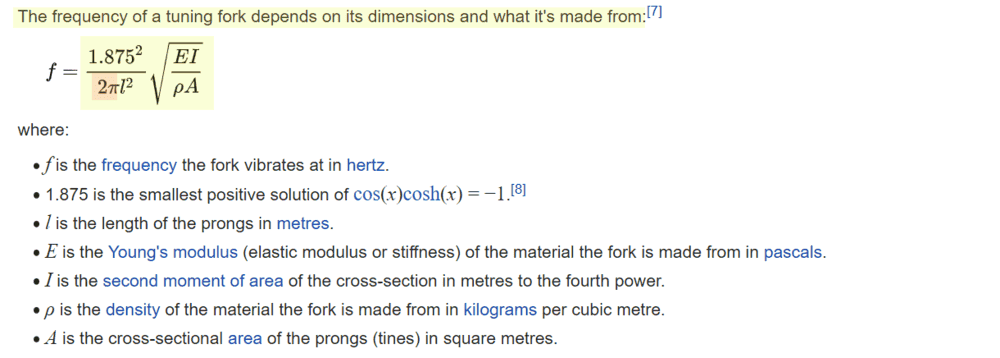
Source: https://en.wikipedia.org/wiki/Tuning_fork#Calculation_of_frequency
Where ρA is density per unit length and can be denoted as μ, "l" is length, and 1.875²= 3. 5156.
Number 2:
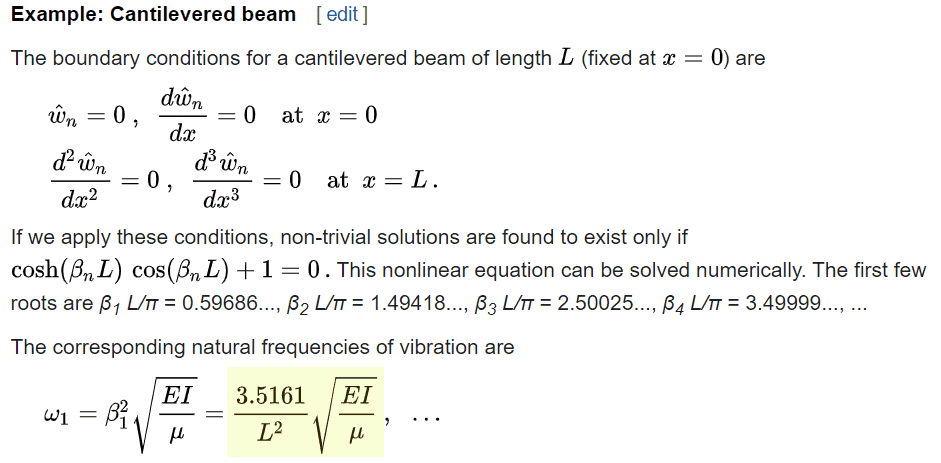
Source: https://en.wikipedia.org/wiki/Euler–Bernoulli_beam_theory#Example:_Cantilevered_beam
The only difference is that "Number 1" has factor of "1/2π" but "Number 2" doesn't have it. What is the reason for it? Could you please me with it?
I was trying to see how the frequency equation for a tuning fork is derived. It looks like it's based on the equation of cantilevered beam. In other words, I'd say that historically the equation for a tuning fork was derived somewhat in a similar fashion as was done for a cantilevered beam. Please compare the following two.
Number 1:
Source: https://en.wikipedia.org/wiki/Tuning_fork#Calculation_of_frequency
Where ρA is density per unit length and can be denoted as μ, "l" is length, and 1.875²= 3. 5156.
Number 2:
Source: https://en.wikipedia.org/wiki/Euler–Bernoulli_beam_theory#Example:_Cantilevered_beam
The only difference is that "Number 1" has factor of "1/2π" but "Number 2" doesn't have it. What is the reason for it? Could you please me with it?