Tuple Relational Calculus in a DBMS

  • Thread starter Thread starter momentum
  • Start date Start date
  • Tags Tags
    Calculus
Click For Summary

Discussion Overview

The discussion revolves around the use of tuple relational calculus (TRC) in a database management system (DBMS), specifically addressing a problem related to querying employee names from a database. Participants are examining the roles of different tuple variables in the context of a given query.

Discussion Character

  • Technical explanation
  • Debate/contested

Main Points Raised

  • One participant questions the necessity of using the tuple variable S in the expression, suggesting that t could suffice since both represent tuples.
  • Another participant clarifies that t represents a tuple containing only the name of an employee, implying that it is not a member of the WORKS relation.
  • There is a repeated inquiry about whether the variable S is also considered a tuple, with one participant affirming that S is indeed a tuple as it is an element of the WORKS relationship.
  • Participants discuss that the expression defines a relation consisting of tuples with a single attribute, specifically the names of employees, indicating a focus on the distinction between the tuples t and S.

Areas of Agreement / Disagreement

Participants express differing views on the necessity and roles of the tuple variables t and S, indicating that the discussion remains unresolved regarding their usage in the context of the query.

Contextual Notes

There are unresolved questions about the definitions and roles of the tuple variables in the relational calculus expression, as well as the implications of their usage in the query.

momentum
Messages
111
Reaction score
0
<Moderator's note: Moved from a technical forum and thus no template.>

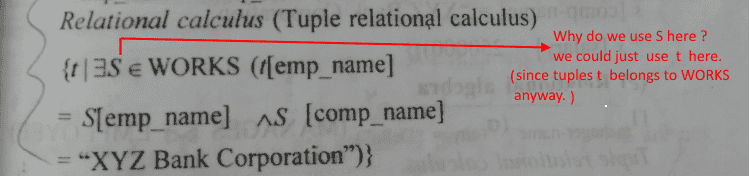
I'm solving a problem using tuple relational calculus ( TRC) in DBMS.

Problem
Find the name of all the employees who work for XYZ Bank Corporation.

Solution ( as given in my book)
tKsmNP0.png


I don't understand why book is using S . We have t . Since both of them represents tuples , we could just use t in place of S and get moving.

Can anyone please explain why we required S ?
 

Attachments

  • tKsmNP0.png
    tKsmNP0.png
    27.2 KB · Views: 483
Last edited by a moderator:
Physics news on Phys.org
t is a tuple that contains only the name of an employee, so it is not a member of WORKS. I think the exporesson for the query should start with {t : {emp_name} | ∃S ∈ WORKS ...
 
willem2 said:
t is a tuple that contains only the name of an employee, so it is not a member of WORKS. I think the exporesson for the query should start with {t : {emp_name} | ∃S ∈ WORKS ...
It returns t or S ?
 
momentum said:
It returns t or S ?

The entire expression {t: {emp_name} | ∃ S ∈ WORKS ( ... ) } defines a relation that is a set of tuples with just one attribute. (only the names of the employess of XYZ). t is used, because we only want the employee names, not the comp_names
 
willem2 said:
The entire expression {t: {emp_name} | ∃ S ∈ WORKS ( ... ) } defines a relation that is a set of tuples with just one attribute. (only the names of the employess of XYZ). t is used, because we only want the employee names, not the comp_names
okay ...my confusion here is ,
we call t as tuple.
do we also call S as tuple here ? Yes/No ?
 
momentum said:
okay ...my confusion here is ,
we call t as tuple.
do we also call S as tuple here ? Yes/No ?
S is an element of the WORKS relationship, so it must be a tuple.
 
  • Like
Likes   Reactions: momentum

Similar threads

  • · Replies 4 ·
Replies
4
Views
3K
  • · Replies 1 ·
Replies
1
Views
2K
  • · Replies 5 ·
Replies
5
Views
3K
  • · Replies 1 ·
Replies
1
Views
1K
  • · Replies 16 ·
Replies
16
Views
2K
  • · Replies 6 ·
Replies
6
Views
3K
  • · Replies 13 ·
Replies
13
Views
2K
  • · Replies 8 ·
Replies
8
Views
2K
Replies
28
Views
5K
Replies
1
Views
976