Dan350
- 44
- 0
1. Would you correct, revise my problem please?
Two Blocks sit on a symmetric double slope. Rightmost block has twice the mass of the of the other block, and the angle that each side makes with the horizontal is the same.
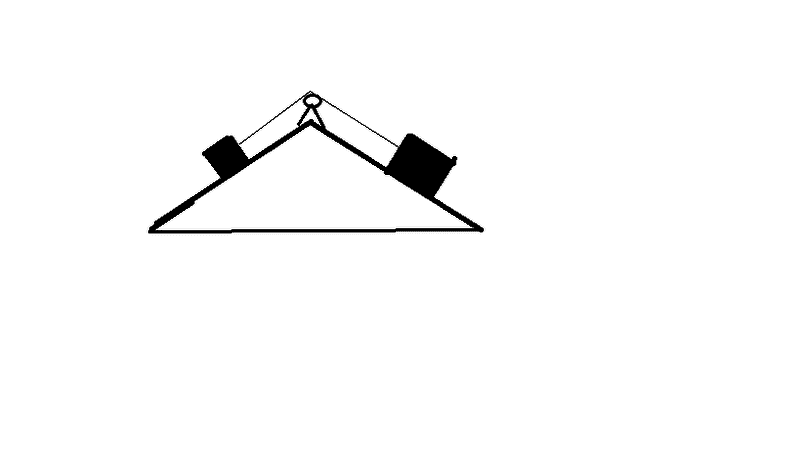
a) Suppose that there is no friction. and suppose that the slope angles are 25°, what is the acceleration of the blocks.
b)Suppose,again,that the slope angles are 25° and that there is no friction. Now suppose also that the tension rope is 100N. What is the mass of the smaller block?
c)Suppose again that there is no friction. Suppose that the slope angles are equal, but not necessarily 25. If the acceleration of the blocks is g/5. What are the slope angles?
d)For 25° angles, what is the minimum coefficient of friction for the blocks to remain stationary?
2.Newton's Second Laws
3. The Attempt at a Solution
a) Block A: ma= +T - mgsin@; Block B: 2ma= -T + 2mgsin@ adding the two equations,, tension cancels so, 3ma=mgsin@
I got 1.38m/s^2
b) for b i used my acceleration and the tension , then I solved for m, so T/(gsinθ+a)=m ; I got 18.11kg for the smaller block
c) I am lost in this one
d) for the coeffiecient,, I took my a,m, but only one side,, I used equation ma= +T - mgsin@-umgcosθ,,, I got .60 as the coeficient
Two Blocks sit on a symmetric double slope. Rightmost block has twice the mass of the of the other block, and the angle that each side makes with the horizontal is the same.
a) Suppose that there is no friction. and suppose that the slope angles are 25°, what is the acceleration of the blocks.
b)Suppose,again,that the slope angles are 25° and that there is no friction. Now suppose also that the tension rope is 100N. What is the mass of the smaller block?
c)Suppose again that there is no friction. Suppose that the slope angles are equal, but not necessarily 25. If the acceleration of the blocks is g/5. What are the slope angles?
d)For 25° angles, what is the minimum coefficient of friction for the blocks to remain stationary?
2.Newton's Second Laws
3. The Attempt at a Solution
a) Block A: ma= +T - mgsin@; Block B: 2ma= -T + 2mgsin@ adding the two equations,, tension cancels so, 3ma=mgsin@
I got 1.38m/s^2
b) for b i used my acceleration and the tension , then I solved for m, so T/(gsinθ+a)=m ; I got 18.11kg for the smaller block
c) I am lost in this one
d) for the coeffiecient,, I took my a,m, but only one side,, I used equation ma= +T - mgsin@-umgcosθ,,, I got .60 as the coeficient
Attachments
