Two Masses, a Pulley, and an Inclined Plane help

Click For Summary
SUMMARY

The discussion focuses on calculating the mass ratio \( m_1/m_2 \) for two blocks connected over a frictionless pulley, with block 2 on an inclined plane experiencing kinetic friction. The equations of motion derived are \( m_1g - T = m_1a \) and \( T - m_2gsin(\theta) - \mu m_2gcos(\theta) = m_2a \). The correct mass ratio is given by the formula \( m_1/m_2 = (g(sin(\theta) + \mu cos(\theta) + a))/(g - a) \). Participants identified a missing term in the numerator during the calculation, which was crucial for arriving at the correct solution.

PREREQUISITES
  • Understanding of Newton's laws of motion
  • Familiarity with inclined plane dynamics
  • Knowledge of kinetic friction and its coefficient
  • Basic algebra for solving equations
NEXT STEPS
  • Study the principles of Newton's second law in multi-body systems
  • Learn about inclined plane physics and frictional forces
  • Explore the derivation of equations of motion for connected bodies
  • Investigate common mistakes in solving physics problems involving pulleys and friction
USEFUL FOR

Students of physics, educators teaching mechanics, and anyone interested in solving problems related to dynamics and friction in multi-body systems.
pcmarine
Messages
6
Reaction score
0
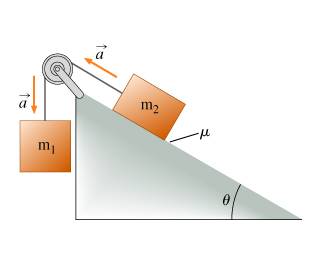
Block 1, of mass m1, is connected over an ideal (massless and frictionless) pulley to block 2, of mass m2, as shown. Assume that the blocks accelerate as shown with an acceleration of magnitude a and that the coefficient of kinetic friction between block 2 and the plane is mu.

MLD_2l_2_v2_2_a.jpg


Find the ratio of the masses m1/m2.

:confused:
 
Physics news on Phys.org
Let the tension in the thread be T. ok. now eq of motion of the 2 masses are...
(m1)g - T = (m1)a
T - (m2)gsin(theta) - (mu)(m2)gcos(theta) = (m2)a

Solving them by addng the two eqns u get,

m1/m2 = (g(sin(theta) + (mu)cos(theta)))/(g - a)
 
Thanks rammstein, but after inputting m1/m2, I get "aren't you missing a term?" Thanks a bunch for the help though!
 
pcmarine said:
Thanks rammstein, but after inputting m1/m2, I get "aren't you missing a term?" Thanks a bunch for the help though!

That's right. The equations of motion are correct, he just dropped a term when he solved for m1/m2. Go ahead and solve the system and see what you get.

-Dan
 
I tried setting the two equations equal to each other through T, but was unable to discover the missing term...
 
pcmarine said:
I tried setting the two equations equal to each other through T, but was unable to discover the missing term...

m_1g-T=m_1a So T=m_1g-m_1a

(m_1g-m_1a)-m_2gsin \theta-\mu m_2gcos \theta=m_2a

m_1g-m_1a=m_2gsin \theta+\mu m_2gcos \theta+m_2a

m_1(g-a)=m_2(gsin \theta+\mu gcos \theta+a)

\frac{m1}{m2}=\frac{gsin \theta+\mu gcos \theta+a}{g-a}

rammstein left out the last "a" in the numerator.

-Dan
 
  • Like
Likes   Reactions: Qexyario

Similar threads

  • · Replies 3 ·
Replies
3
Views
2K
  • · Replies 3 ·
Replies
3
Views
2K
  • · Replies 102 ·
4
Replies
102
Views
8K
Replies
2
Views
2K
  • · Replies 17 ·
Replies
17
Views
3K
  • · Replies 6 ·
Replies
6
Views
3K
  • · Replies 5 ·
Replies
5
Views
2K
  • · Replies 68 ·
3
Replies
68
Views
13K
  • · Replies 1 ·
Replies
1
Views
3K
Replies
17
Views
2K