Two simple questions about equivalent resistance and kirchoff laws

Click For Summary
SUMMARY

The discussion centers on understanding equivalent resistance and Kirchhoff's laws, specifically addressing a homework problem involving a circuit with a calculated resistance of Rab = (27/17) Ω. Participants clarify that the rules for calculating equivalent resistances in series and parallel cannot be applied due to the circuit's configuration, which lacks direct parallel connections. Additionally, the conversation explores the principles of battery charging, emphasizing that current flows into a battery's positive terminal during charging, which is essential for recharging secondary cells.

PREREQUISITES
  • Understanding of Ohm's Law and basic circuit theory
  • Familiarity with series and parallel resistor configurations
  • Knowledge of Kirchhoff's Voltage and Current Laws
  • Basic principles of battery chemistry and operation
NEXT STEPS
  • Study advanced circuit analysis techniques using Kirchhoff's Laws
  • Learn about the behavior of resistors in complex circuits
  • Research the chemistry of rechargeable batteries and their charging mechanisms
  • Explore practical applications of equivalent resistance in real-world circuits
USEFUL FOR

Students studying electrical engineering, educators teaching circuit theory, and hobbyists interested in electronics and battery technology.

carlos125
Messages
13
Reaction score
0
two simple questions about equivalent resistance and kirchhoff laws! pleaseeeee! :D

EQUIVALENT RESISTANCE:
Hi everybody . greetings from Peru.I know it's a dumb question but help please .please read below

Homework Statement


For the network shown in the figure, show that the resistance Rab = (27/17). Ω
View attachment er.bmp

The Attempt at a Solution


This is the the soltuion I found on the internet ,
View attachment serway.bmp
but i don't get WHY rules of equivalent resistances in parallel and series cannot be applied to this problem . obvously using those rules I get another answer which is wrong, can ayone help me please?
KIRCCHOFF:
And i have another question can a batery charge another one?
it looks like i have missed something in class because i don't understand ... like in the solution of this problem :

A dead battery is charged by connecting it to the live
battery of another car with jumper cables (Fig. P28.25).
Determine the current in the starter and in the dead
battery.
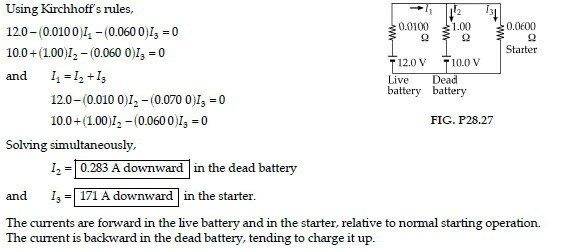
sol.jpg


the solution says "the current is backward in the dead baterry tending to charge it up" why? ,I mean ¿what direction of current is needed so that a batery can be charged? ¿from high potntial to less potential ? i just don't get it
can someone explaian this to me please , if you have links it would be great too. Thank you very much
 
Last edited by a moderator:
Physics news on Phys.org


but i don't get WHY rules of equivalent resistances in parallel and series cannot be applied to this problem

Because the circuit doesn't contain resistors that directly "in parallel" with another.


carlos125 said:
i don't get WHY rules of equivalent resistances in parallel and series cannot be applied to this problem .
Hi carlos125, http://img96.imageshack.us/img96/5725/red5e5etimes5e5e45e5e25.gif

You should be able to see there is no pair of parallel resistors in that figure[/color][/color], nor are there two resistors in series. You need to get it clear in your mind exactly what it means for a pair of resistors to be in parallel.
And i have another question can a batery charge another one?
it looks like i have missed something in class because i don't understand ... like in the solution of this problem :

A dead battery is charged by connecting it to the live
battery of another car with jumper cables (Fig. P28.25).
Determine the current in the starter and in the dead
battery.
If current flows out of the + terminal of a battery into an external circuit, the battery is discharging. If current flows into the + terminal of a battery from an external circuit, the battery is charging. (Assuming we are talking about secondary cells).
 
Last edited by a moderator:


the current is backward in the dead baterry tending to charge it up" why?

Thats the way batteries work. Current flows one way during discharge and the other way during charge.

If you want to know why take a look at the chemistry that goes on in a battery. Rechargable batteries use a reversible chemical reaction that creates a flow of electrons. In order to reverse the reaction you have to "push" electrons the other way, typically using a higher voltage than that of the battery.


thank you guys for your quick replies ,but aren't the 1-ohm resistance(upper left) and the 3-ohm resistance in series? . The definition for resitance in series is "Two or more elements are in series if they are cascaded or connected sequentially " ,aren't they sharing the same wire? so why aren't they in series? look:
res.gif

thanks . btw the wire I'm talking about doesn't separate in two branches too , I'm confused


Elements are in series iff the exact same current that passes through one also passes through the other/s.

Elements are in parallel iff both of the ends of those elements connect to the same points.

The 1Ω and the 3Ω would be in series iff nothing was ever connected at point 'a', because with nothing connected at point 'a' those two resistors would carry the same current. But point 'a' is where the external circuit connects, delivering to those resistors unrelated and different currents.
 

Similar threads

  • · Replies 1 ·
Replies
1
Views
3K
  • · Replies 3 ·
Replies
3
Views
3K
Replies
16
Views
2K
  • · Replies 7 ·
Replies
7
Views
23K
  • · Replies 6 ·
Replies
6
Views
3K
  • · Replies 12 ·
Replies
12
Views
1K
Replies
15
Views
10K
  • · Replies 11 ·
Replies
11
Views
3K
  • · Replies 5 ·
Replies
5
Views
2K
  • · Replies 9 ·
Replies
9
Views
7K