Types of Rotations - Hi Everybody, Ask Your Questions Here

Click For Summary
SUMMARY

This discussion focuses on the mathematical relationships involved in Minkowski rotations and their representation in different coordinate systems. The participants emphasize the importance of distinguishing between rotating points in a fixed coordinate system and expressing fixed points in a new, rotated coordinate system. Key equations for obtaining contravariant and covariant components using hyperbolic functions are provided, specifically utilizing matrices for transformation. The discussion concludes with a clarification on the use of inverse matrices for covariant components.

PREREQUISITES
  • Understanding of Minkowski geometry and its applications
  • Familiarity with trigonometric and hyperbolic functions
  • Knowledge of linear algebra, particularly matrix transformations
  • Ability to work with coordinate systems and vector representations
NEXT STEPS
  • Study the derivation of Minkowski rotation matrices
  • Learn about the differences between contravariant and covariant vectors
  • Explore applications of hyperbolic functions in physics
  • Investigate the implications of coordinate transformations in relativity
USEFUL FOR

Mathematicians, physicists, and students studying relativity or advanced geometry who seek to deepen their understanding of coordinate transformations and vector representations in Minkowski space.

Adrian555
Messages
7
Reaction score
0
Hi everybody,

This is my first post, so I apologise for all the possible mistakes that I can make now and in the future. I promise that I'll learn from them!

My question is the following: It's well-known the relationship between two pair of cartesian axes when a circular rotation is made:
Circular rotation.png


Nevertheless, when dealing with a Minkowski rotation like this one:
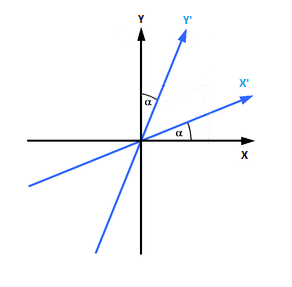
Hyperbolic rotation.png


I was wondering if a relationship between the new (blue) and old (black) pair of axis as function of the circular angle alpha can be obtained (that is to say, without using an hyperbolic angle).

Thanks in advance for your help.
 
Physics news on Phys.org
A relationship similar to the equations above?
Sure. Just use trigonometry: find vectors that correspond to the new axes (x', y') expressed in the old coordinate system (x and y), then find a way to express an arbitrary point on the plane (given in the old coordinates) in the new coordinates. It is a linear equation system.
Alternatively, start with a point given in the new system and transform back to the old one. That gives the same equations but written in a different way.
 
  • Like
Likes   Reactions: Adrian555
First of all, thanks for your answer, I really appreciate your quick response.

So, if I have understood well, the first thing I have to do is to represent a vector and relate its components in both coordinate systems using trigonometry:
Hyperbolic rotation 2.png


But, what should I do now? I'm a little confused...
 
If you convert that sketch to formulas, you get something equivalent to the formulas for the rotation in the first picture.
If that is not what you are looking for, I don't understand the question.
 
There are two closely related concepts that it is essential to keep separated:

a) Rotating points in a fixed coordinate system and expressing their new positions in that coordinate system in terms of the old points and the angle of rotation;

b) Keeping points in a fixed position in some coordinate system but expressing them in terms of a new, rotated coordinate system.

Although the formulas for these two things are very similar, they are distinct concepts and should not be confused with each other.
 
Thank you for your replies! My question now is related to the previous one, but has changed. Suppossing that we have the following situation:
coord contrav cov.png


According to the picture, we have a vector in an orthogonal frame (with coordinates 2, 2). I want to obtain the contravariant (green) and covariant (blue) components in a new frame where the axes have been rotated an hyperbolic angle alpha.

I have checked that the contravariant components can be obtained as follows:

\begin{bmatrix}{a^1}\\{a^2}\end{bmatrix}=\begin{bmatrix}{cosh(\alpha)}&{-sinh(\alpha)}\\{-sinh(\alpha)}&{cosh(\alpha)}\end{bmatrix}\begin{bmatrix}{a_x}}\\{a_y}\end{bmatrix}

My question is, which is the expression to obtain the covariant components? Maybe I should use the inverse matrix?

\begin{bmatrix}{a_1}\\{a_2}\end{bmatrix}=\begin{bmatrix}{cosh(\alpha)}&{sinh(\alpha)}\\{sinh(\alpha)}&{cosh(\alpha)}\end{bmatrix}\begin{bmatrix}{a_x}\\{a_y}\end{bmatrix}

Thanks for your help.
 
Last edited:

Similar threads

  • · Replies 2 ·
Replies
2
Views
2K
  • · Replies 4 ·
Replies
4
Views
2K
  • · Replies 3 ·
Replies
3
Views
10K
  • · Replies 20 ·
Replies
20
Views
4K
  • · Replies 12 ·
Replies
12
Views
2K
  • · Replies 49 ·
2
Replies
49
Views
5K
  • · Replies 6 ·
Replies
6
Views
3K
  • · Replies 7 ·
Replies
7
Views
4K
  • · Replies 1 ·
Replies
1
Views
2K
Replies
1
Views
8K