Under what conditions can glass crack spontaneously?

Click For Summary
SUMMARY

Glass does not crack spontaneously under normal conditions; the most likely cause of the rear windshield cracking in the discussed incident is a prior unnoticed impact. The temperature difference of 20°C between the inside and outside of the car is insufficient to cause spontaneous failure in toughened glass. Instead, the glass likely experienced stress from previous damage, which was exacerbated by normal operational stresses such as temperature gradients and vibrations. The consensus among forum participants is that an external impact, possibly from a small object or prior damage, initiated the catastrophic failure.

PREREQUISITES
  • Understanding of toughened glass properties and behavior
  • Knowledge of thermal stress and its effects on materials
  • Familiarity with automotive glass installation and stress factors
  • Basic principles of impact mechanics and fracture patterns
NEXT STEPS
  • Research the properties and failure mechanisms of toughened glass
  • Learn about thermal stress and its impact on automotive materials
  • Investigate common causes of windshield damage and repair techniques
  • Explore case studies on automotive glass failure due to prior impacts
USEFUL FOR

Automotive engineers, glass manufacturers, vehicle safety inspectors, and anyone interested in understanding the mechanics of glass failure in vehicles.

rugerts
Messages
153
Reaction score
11
Are there any conditions under which glass cracks spontaneously?
Just now, my mother's rear windshield cracked spontaneously.
The story according to her:
Slowly approaching a stop sign. No busy traffic. No trees/animals in sight. Few people. Suddenly, the rear windshield cracked with a loud boom with no evidence as to what caused it. A police officer happened to be directing traffic and saw it occur. The officer did nothing about it since there was no indications as to what caused it.

This is very strange! I don't believe that this could have just happened without a something hitting the window. I suspect it happened so quickly no one saw it. But, apparently, there were no cars, and few people, so they believe that the object impacting the glass scenario is not possible.

My question now is: is it possible that the glass cracked spontaneously? For reference, the temperature outside was 34 degrees Fahrenheit, the temperature inside about 70 degrees Fahrenheit.

Thanks for any replies/insight!
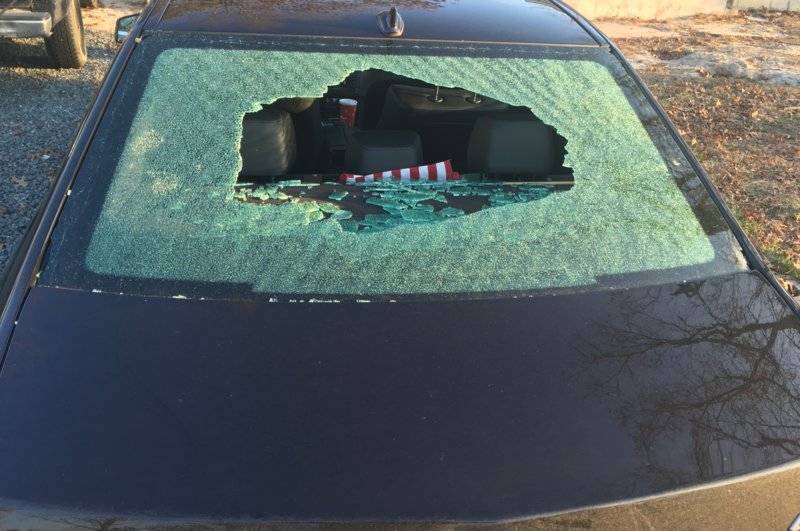
IMG-1203.JPG
IMG-1204.JPG

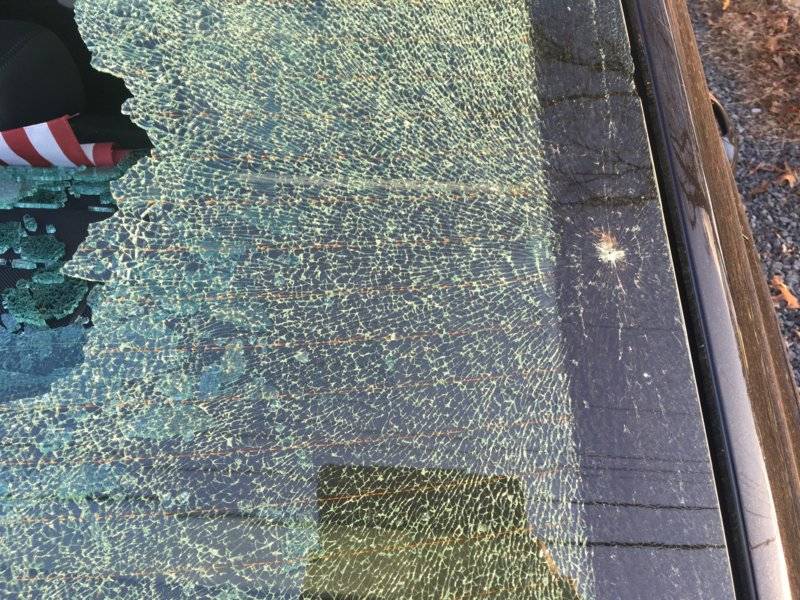
In this picture above, you can see the indications that some impact occurred.
 

Attachments

  • IMG-1203.JPG
    IMG-1203.JPG
    67 KB · Views: 831
  • IMG-1204.JPG
    IMG-1204.JPG
    136.2 KB · Views: 770
Physics news on Phys.org
Given that the outside temperature was about 1°C and the inside temperature was near 21°C, I would make the trivial guess that it was a drop of water. But can it be spontaneous when temperature difference is 20°C? That's a question. Moreover, a single drop of water will create cracks that originate from a point and spread, but not smash the glass like that. I can surely see some cracks traveling from the impact, but I doubt whether a drop can smash the whole glass.
 
rugerts said:
In this picture above, you can see the indications that some impact occurred.
That would be my guess as well. Given how many millions of cars are on the road in similar temperature conditions without spontaneous fracture, some outside impact seems likely.

Search the back of the car -- unless it was a large ice ball from a passing airliner, there may be a rock or branch or other evidence of an impact.

<< I'm moving this thread from the technical forums to the General Discussion forum for now...>>
 
Last edited:
You know? It just possibly could have been a meteorite.
Stranger things have happened.

Me - I'd take the time to go back to the site and scour the ground.
 
  • Like
Likes   Reactions: berkeman
It's also possible by the way, that there were independent events.
The first impact may have occurred at any time in the past, creating fractures in the glass that went unnoticed for days, weeks, years.
Then something (maybe not even a second impact) caused the glass to collapse.
 
  • Like
Likes   Reactions: Klystron, Asymptotic, Wrichik Basu and 2 others
DaveC426913 said:
The first impact may have occurred at any time in the past, creating fractures in the glass that went unnoticed for days, weeks, years.
Then something (maybe not even a second impact) caused the glass to collapse.
That would be my guess. A temp difference of only 20 deg (C) wouldn't do it, I don't think.
 
That rear window appears to be regular toughened glass not laminated like a front screen is. Toughened glass is prone to sudden failure after minor damage. The chip need not have happened recently, could have happened weeks ago, then the stress of going over a small bump in the road triggered the failure.

PS: shower screens are also toughened glass and you have to look after the edges during transportation and assembly as a minor nick can cause a later sudden failure.
 
Thanks for all the replies. They all seem very reasonable and likely. Here's a video on the topic but I didn't seem to come away convinced with a concrete explanation.
 
Some random bullet fired into the sky from a gun/rifle miles away?
 
  • Like
Likes   Reactions: Klystron
  • #11
As some people in another thread have been arguing, it could be aliens! Prove it's not!

Glass does not spontaneously do this. If it did, we wouldn't use it as we do. By far the likeliest possibility is something like what CWatters said: that it was chipped some moments back and was unnoticed until it failed catastrophically.
 
  • #12
Vanadium 50 said:
Glass does not spontaneously do this.

We are talking about glass that is mounted in a car, so it is under many different stresses all the time - like temperature gradients and car frame shaking, bending and twisting. Plenty of forces that could start non-spontaneous failure.

That doesn't rule out earlier damage, could be a combination of both.
 
  • Like
Likes   Reactions: collinsmark
  • #13
It looks like the cause was as the others have said. Edge damage (circled) and particularly the impact mark (arrow) very likely initiated stress cracking which went unnoticed until the final, catastrophic failure.

Chipped rear window(annotated).jpg


Once compromised, normal stressors such as thermal cycling of the defroster wire grid will contribute to final failure.

Unless your mom enjoys loud music this doesn't apply, but I once rented an SUV for a work-related road trip, and while driving east listening to Aes Dana's Leylines noticed caustics from late afternoon sunlight dancing on the dashboard. Looked back, and rear window was visibly pulsing in time with the kick drum.
 

Attachments

  • Chipped rear window(annotated).jpg
    Chipped rear window(annotated).jpg
    25.1 KB · Views: 599
  • Like
Likes   Reactions: berkeman and Dr Transport
  • #14
Borek said:
We are talking about glass that is mounted in a car, so it is under many different stresses all the time - like temperature gradients and car frame shaking, bending and twisting. Plenty of forces that could start non-spontaneous failure.
If that were true, it would have to be a design or manufacturing flaw. Engineers don't design things to fail under normal operating conditions.
 
  • #15
Borek said:
We are talking about glass that is mounted in a car

That's right. Car glass gets impacts and abrasions all the time. Even if it looks "spontaneous", it's often not.
 
  • Like
Likes   Reactions: russ_watters
  • #16
russ_watters said:
If that were true, it would have to be a design or manufacturing flaw.

1. Which both happen all the time despite best efforts of the engineers designing the car itself and the manufacturing process.

2. Yes, in most cases such things don't happen, which is why there was probably some additional element. We know nothing about how old the car is and what its history was.

My window (story linked earlier in the thread) wasn't designed to crack, yet it did for no apparent reason.
 
  • #17
russ_watters said:
If that were true, it would have to be a design or manufacturing flaw. Engineers don't design things to fail under normal operating conditions.

Yes, it could have been a manufacturing flaw. Tempered glass contains a lot of internal stresses by its very nature. That's what makes it tempered glass. (One could reduce the internal stresses by annealing it, or simply not tempering it, but then it wouldn't be tempered glass.) The tricky bit is make sure the internal stresses are distributed roughly evenly throughout the glass, and such that the internal stresses are within acceptable thresholds at every location. I'm guessing that's easier said than done.

On the other hand, stresses might also come from outside the manufacturing process. If the car was ever in a fender-bender -- even a mild one -- the auto shop will likely pound out or replace the dented fender, but would never replace the rear window if there were no visible signs of damage in the rear window. The new, extra, uneven stresses [edit: might*] remain in the window though. The OP might know more about the car's history, of course, unless the OP's mother obtained the car second-hand; in which case it's anybody's guess.

*[depends on the nature of the fender-bender and the rear window's mounting, etc.]
 
Last edited:
  • Like
Likes   Reactions: russ_watters
  • #18
collinsmark said:
Yes, it could have been a manufacturing flaw.
If it were a flaw, could it fail in a way that looks like the closeup in post #13?

I mean, that really looks like an impact.
 
  • Like
Likes   Reactions: russ_watters
  • #19
Regrettably must agree with earlier posts that impact from gunfire remains probable.
 
  • Like
Likes   Reactions: russ_watters
  • #20
DaveC426913 said:
If it were a flaw, could it fail in a way that looks like the closeup in post #13?

I mean, that really looks like an impact.
I agree. It does visually appear like an impact. The pattern seems to radiate from a specific point.

I guess what I'm saying is that, particularly given the testimony by the OP's mother,
  • We don't really know how long before shattering that the impact spot was there,
  • If some sort of impact did coincide with the shattering (maybe a small, hard pebble or piece of porcelain thrown out from the street by a nearby truck tire), the impact might not have been the only stress factor involved, and
  • maybe there wasn't an impact, and that spot just happened to be the point on the glass that was most brittle. Even if the shattering happens spontaneously, it has to start from somewhere.
Or maybe it was from an small caliber firearm or air rifle (i.e., BB gun). It's kind of difficult to tell from the picture. It seems kind of odd though that somebody would be brazen enough to shoot at traffic with a police officer right there directing traffic. So let's not jump to conclusions.
 
  • #21
DaveC426913 said:
If it were a flaw, could it fail in a way that looks like the closeup in post #13?

I mean, that really looks like an impact.
Klystron said:
Regrettably must agree with earlier posts that impact from gunfire remains probable.
To me it looks exactly like one I got in my front windshield once. Tiny hole and a pit (iirc on the inside). But that was definitely a rock. Stopped at a stop sign, rear windshield...bb gun?
 
  • Like
Likes   Reactions: Klystron
  • #22
This video not only demonstrates how a small thing moving at relatively low velocity can break tempered glass, but also brings up a good discussion topic for "hardness," which is well suited for PF. :smile:

 
Last edited:
  • #23
collinsmark said:
  • We don't really know how long before shattering that the impact spot was there,
  • If some sort of impact did coincide with the shattering (maybe a small, hard pebble or piece of porcelain thrown out from the street by a nearby truck tire), the impact might not have been the only stress factor involved, and.
This is true. The one I had didn't immediately shatter. Something less sinister than a gun could be a rock kicked up by a lawnmower.
 
Last edited:
  • Like
Likes   Reactions: collinsmark
  • #24
collinsmark said:
  • maybe there wasn't an impact, and that spot just happened to be the point on the glass that was most brittle. Even if the shattering happens spontaneously, it has to start from somewhere.
I think that a spontaneous shatter can be ruled out. I strongly suspect that the only way to get
  1. a hole
  2. a gradient that correlates amount of damage with distance from centre,
  3. radiating fractures, and finally
  4. concentric fractures
is from an impact of sufficient force to push the glass inward.

Frankly, I think a small rock is highly unlikely too.

Something hit it hard/fast enough to make a hole and deform the glass. Look at the larger concentric break (#4).

shatter.jpg
 

Attachments

  • shatter.jpg
    shatter.jpg
    63.3 KB · Views: 796
  • Like
Likes   Reactions: Klystron
  • #25
rugerts said:
Are there any conditions under which glass cracks spontaneously?

Good question as this has also recently, a month ago, happened to my cars' front windscreen.
It hasn't shattered like the one in you mom's car It started as a 4-5" crack that has been slowly growing as it
meanders in a staggered path across the central left side of the windscreen.
The car is a small 2013, 5 door, Toyota Yaris hatch. There is absolutely no sign of an impact point of being struck by something

Tis dark here at the moment ... will post a pic in the new day cheers
Dave
 
  • #26
This thing nagging me for some time. After some searching what I've found: safety glasses tends to have more localized impact damages than this. Chipping, small holes with a few cracks around and such (as it seems these kind of faults are feeding a whole industry around 'windshield repairs').

It is a mechanical stress/surface tension what makes safety glasses shatter. This can either start around an existing fault point or triggered by a new fault point.

As it seems some vehicles were built so that glass is actually parts (or, at least too rigidly connected) of the mechanical structure of the vehicle, and when some (metal) parts got weakened or deformed (rusted away or bent, for example) the glass shatters, seemingly by itself.
 
Last edited:
  • Like
Likes   Reactions: collinsmark and russ_watters
  • #27
DaveC426913 said:
I think that a spontaneous shatter can be ruled out. I strongly suspect that the only way to get
  1. a hole
  2. a gradient that correlates amount of damage with distance from centre,
  3. radiating fractures, and finally
  4. concentric fractures
is from an impact of sufficient force to push the glass inward.

Frankly, I think a small rock is highly unlikely too.

Something hit it hard/fast enough to make a hole and deform the glass. Look at the larger concentric break (#4).

View attachment 235576
Here are some videos I found on YouTube demonstrating how easy it is to break a tempered glass window if the small projectile is hard enough. I haven't verified the authenticity of any of these videos or their sources (or even if what they are doing is legal), but they do seem somewhat consistent anyway. But for what it's worth, here are a few.

Video #1. Pause at 1:05 for a mildly OK image of the results (bad reflection though).

  1. a hole: check
  2. a gradient: check
  3. radiating fractures: check
  4. concentric fractures: iffy. I don't spot any for sure, but it's kinda hard to tell.
Video #2. Pause at around 0:38 for a fairly clear image.

  1. a hole: no. Well, not necessarily. There does seem to be a chip that might fall out at any moment, but I don't see a definite hole in the video.
  2. a gradient: check
  3. radiating fractures: check
  4. concentric fractures: maybe. That's up for interpretation.
Video #3. This is demonstration by firemen, showing how to break a tempered glass window with a small yet hard object.

  1. a hole: check
  2. a gradient: inconclusive. The hole is too big.
  3. radiating fractures: inconclusive. The hole is too big.
  4. concentric fractures: yes, in the form of a really big hole.
I think that the picture in the OP is at least not inconsistent with any of these. I think it likely that the damage may have been caused by a hard piece of debris on the road getting kicked up by a tire and hitting the windshield. I also wouldn't rule out that the original fault point happened in the past, and the additional stress on the window passing over a bump or something was "the straw that broke the camel's back," causing the window to shatter.

@rugerts, You mentioned that there was a police officer nearby directing traffic. Why was the officer directing traffic? Was it because of a recent car accident (causing lots of debris in the road), or maybe there was some temporary construction going on in the road?
 
Last edited:
  • #28
collinsmark said:
Here are some videos I found on YouTube demonstrating how easy it is to break a tempered glass window if the small projectile is hard enough. I haven't verified the authenticity of any of these videos or their sources (or even if what they are doing is legal), but they do seem somewhat consistent anyway. But for what it's worth, here are a few.

Video #1. Pause at 1:05 for a mildly OK image of the results (bad reflection though).

  1. a hole: check
  2. a gradient: check
  3. radiating fractures: check
  4. concentric fractures: iffy. I don't spot any for sure, but it's kinda hard to tell.
Video #2. Pause at around 0:38 for a fairly clear image.

  1. a hole: no. Well, not necessarily. There does seem to be a chip that might fall out at any moment, but I don't see a definite hole in the video.
  2. a gradient: check
  3. radiating fractures: check
  4. concentric fractures: maybe. That's up for interpretation.
Video #3. This is demonstration by firemen, showing how to break a tempered glass window with a small yet hard object.

  1. a hole: check
  2. a gradient: inconclusive. The hole is too big.
  3. radiating fractures: inconclusive. The hole is too big.
  4. concentric fractures: yes, in the form of a really big hole.
I think that the picture in the OP is at least not inconsistent with any of these. I think it likely that the damage may have been caused by a hard piece of debris on the road getting kicked up by a tire and hitting the windshield. I also wouldn't rule out that the original fault point happened in the past, and the additional stress on the window passing over a bump or something was "the straw that broke the camel's back," causing the window to shatter.

@rugerts, You mentioned that there was a police officer nearby directing traffic. Why was the officer directing traffic? Was it because of a recent car accident (causing lots of debris in the road), or maybe there was some temporary construction going on in the road?
none of your videos nor their links are showing ... nothing to watch
 
  • #29
davenn said:
none of your videos nor their links are showing ... nothing to watch

JFTR I was and am able to view all the youtube clips and content.Time hack: NOW!

--Norm
 
  • #30
-
Klystron said:
JFTR I was and am able to view all the youtube clips and content.Time hack: NOW!

--Norm
they are all still blank ... :frown:EDIT ... but they are OK on Chrome :smile:
 

Similar threads

  • · Replies 8 ·
Replies
8
Views
846
  • · Replies 44 ·
2
Replies
44
Views
15K
  • · Replies 4 ·
Replies
4
Views
2K
  • · Replies 10 ·
Replies
10
Views
3K
  • · Replies 25 ·
Replies
25
Views
5K
  • · Replies 17 ·
Replies
17
Views
3K
  • · Replies 9 ·
Replies
9
Views
8K
  • · Replies 1 ·
Replies
1
Views
1K
  • · Replies 21 ·
Replies
21
Views
5K
  • · Replies 46 ·
2
Replies
46
Views
5K