Understand Chemistry Bond Symbol for Antioxidants and Free Radicals

Click For Summary

Discussion Overview

The discussion revolves around the understanding of chemical bond representations in the context of antioxidants and free radicals, specifically focusing on the structure of Hydrogen Peroxide (H2O2). Participants explore the implications of different bond symbols and their meanings in 2D representations of 3D molecular structures.

Discussion Character

  • Exploratory
  • Technical explanation
  • Conceptual clarification

Main Points Raised

  • One participant expresses confusion about the bond symbols (triangle, broken triangle, rectangle) used in molecular representations and seeks clarification on their meanings.
  • Another participant explains that the symbols represent bonds in different orientations relative to the page, indicating how they project in three-dimensional space.
  • A later contribution notes that Hydrogen Peroxide is not a planar molecule, mentioning a dihedral angle of 120°.
  • Further discussion includes a participant questioning the orientation of the broken triangle bond and whether it should appear upside down, reflecting on the spatial arrangement of the atoms.
  • Participants discuss the implications of having three atoms in a molecule, with one asserting that this allows for a defined plane, while another suggests that Hydrogen Peroxide's structure is three-dimensional.
  • There is a mention of geometric principles related to molecular shapes, with one participant acknowledging a newfound understanding of the spatial arrangement of atoms in molecules.

Areas of Agreement / Disagreement

Participants generally agree on the basic interpretations of the bond symbols and the non-planarity of Hydrogen Peroxide, but there are nuances in understanding the spatial relationships and orientations of the atoms that remain somewhat unclear or debated.

Contextual Notes

Some participants express uncertainty regarding the exact spatial relationships of the atoms and the implications of bond orientations, indicating a need for further clarification on these concepts.

Who May Find This Useful

This discussion may be useful for individuals interested in chemistry, particularly those seeking to understand molecular geometry and bond representations in chemical structures.

Stephanus
Messages
1,316
Reaction score
104
Dear PF Forum,
I'm trying to understand antioxidant and free radicals. But I'm afraid that my chemistry is weak.
Perhaps someone can help me with this picture?
https://en.wikipedia.org/wiki/Hydrogen_peroxide
Wasserstoffperoxid.jpg

This is Hydrogen Peroxide. Neutral.
As much as I can surmise in this picture is...
1. It's H2O2, I don't need the picture to guess H2O2, Hydrogen Peroxide is clear.
2. Oxygen (Z = 8, electron configuration: 1s2 2s2 2s4 , Oxygen lacks 2 electrons in its outer shell.
3. Hydrogen (Z = 1, 1s1 ), lacks 1 electron
4. Left Oxygen is bound to upper left Hydrogen and right Oxygen, making it complete.
5. So is Right Oxygen.
6. Upper left Hydrogen is bound to left Oxygen, making it complete
7. So is Right Hydrogen.

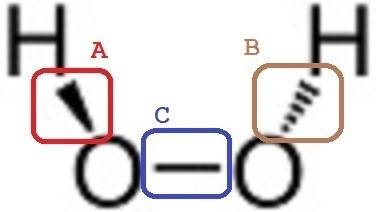
What I want to ask is that symbol
A: Triangle
B: Broken triangle
C: Rectangle
Why A, B and C pictures are different? Are they bonded in different ways?

Thanks for any help.
 
Chemistry news on Phys.org
A and B are common 2D representations of 3D structures. A is for a bond that is partially sticking out of the page, and B for a bond that is partially back of the page. C is for a bond that is in the plane of the page.

See, e.g., http://www.chemeddl.org/resources/stereochem/threed3.htm or https://en.wikipedia.org/wiki/Skeletal_formula#Stereochemistry
 
  • Like
Likes   Reactions: Stephanus
Thanks Dr. Claude. I understand.
 
I should add that in the case of H2O2, this illustrates that the molecule is not planar. The dihedral angle is 120°.
 
  • Like
Likes   Reactions: Stephanus
Thanks.
One more thing. Do you think that B - bond should be upside down? If you know what I mean I just click your link. No, it's the right picture. The broken triangle (B) should be as in the original picture, not upside down. Both hydrogens are 'close' to us. If we can say that.
I'm trying to edit the picture but your second reply just comes up.
And if H2O is three atom, that makes it planar, 2D
Then this Hydrogen peroxide perhaps is 3D?

Now, I think I can move on a little
Thanks DrClaude
 
Stephanus said:
Both hydrogens are 'close' to us. If we can say that.
Not sure what you mean here, but one hydrogen is closer to us than the oxygens, and one is farther away.

Stephanus said:
And if H2O is three atom, that makes it planar, 2D
Yes, with 3 atoms, you can always define a plane, except for linear molecules.

Stephanus said:
Then this Hydrogen peroxide perhaps is 3D?
All the atoms aren't in one plane, which is why you need the wedges to draw it in 2D.
 
  • Like
Likes   Reactions: Stephanus
DrClaude said:
Not sure what you mean here, but one hydrogen is closer to us than the oxygens, and one is farther away.
Yes, yes. I understand. All this time, I've never taken a glance at chemistry. I've never realized the molecule could be cubed or perhaps tetrahedron (dodecahedron??). Should have taken just 5 minutes to ponder it myself to realize it.
DrClaude said:
Yes, with 3 atoms, you can always define a plane, except for linear molecules.
Yes! Mathematic principle?
DrClaude said:
All the atoms aren't in one plane, which is why you need the wedges to draw it in 2D.
Ok.
Thank you very much DrClaude
 
Stephanus said:
Yes! Mathematic principle?
Yes. Three non-colinear points define a plane.
 

Similar threads

  • · Replies 8 ·
Replies
8
Views
4K
  • · Replies 1 ·
Replies
1
Views
11K
  • · Replies 7 ·
Replies
7
Views
4K
  • · Replies 1 ·
Replies
1
Views
10K
Replies
1
Views
12K
  • · Replies 1 ·
Replies
1
Views
7K
  • · Replies 8 ·
Replies
8
Views
4K
  • · Replies 4 ·
Replies
4
Views
3K
  • · Replies 5 ·
Replies
5
Views
3K
  • · Replies 5 ·
Replies
5
Views
3K