Understand Postulates of Relativity & Inertial Frames

  • Context: Graduate 
  • Thread starter Thread starter Sampad Saha
  • Start date Start date
  • Tags Tags
    Postulates Relativity
Click For Summary
SUMMARY

The discussion centers on the postulates of relativity and their relationship with inertial frames. It establishes that the laws of physics are consistent across all inertial frames and that the speed of light remains constant for all observers. The conversation highlights a common misconception regarding experiments that appear to violate these postulates due to non-inertial frames, clarifying that inertial frames can be defined under specific conditions, such as a rocket coasting with its engines off. The participants emphasize the importance of understanding these concepts to accurately interpret experimental results in the context of relativity.

PREREQUISITES
  • Understanding of Einstein's Theory of Relativity
  • Familiarity with inertial and non-inertial frames of reference
  • Basic knowledge of the speed of light as a constant
  • Concept of Earth-Centered Inertial Frame
NEXT STEPS
  • Study Einstein's Theory of Special Relativity in detail
  • Explore the implications of inertial frames in physics experiments
  • Learn about the Earth-Centered Inertial Frame and its applications
  • Investigate classical mechanics versus relativistic mechanics regarding speed limits
USEFUL FOR

Students of physics, educators teaching relativity, and anyone interested in the foundational principles of modern physics and their implications in experimental scenarios.

Sampad Saha
Messages
15
Reaction score
0
I think postulates of Relativity is related to Inertial frames. As according to postulates "1)The laws of physics, including electromagnetism, are the same in all inertial frames. 2)Every observer measures the same value c for the speed of light (in vacuum) in all inertial frames. "
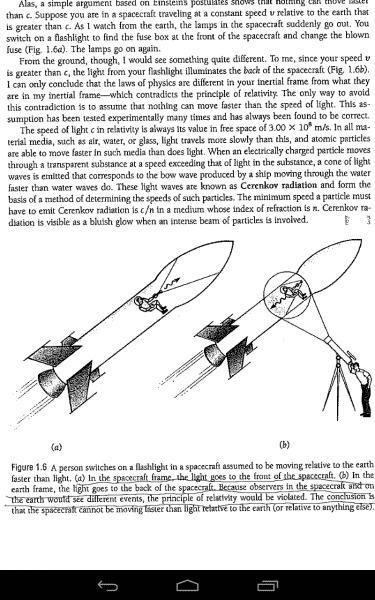
But in the experiments to show that the speed of anything couldn't be more than speed of light (Shown in image) the frames that are used is not inertial ! So how can we say that "As the observers in the spacecraft and on the ground would see different events, the postulates are violeted"
As I think postulates are about inertial frames and the experiment is not about inertial frame.(I think my concepts of about both Postulates and Inertial frames are wrong, please acknowledge me if I'm going wrong " Thank you..
Screenshot_2015-03-28-12-13-19.png
 
Physics news on Phys.org
Sampad Saha said:
But in the experiments to show that the speed of anything couldn't be more than speed of light (Shown in image) the frames that are used is not inertial ! So how can we say that "As the observers in the spacecraft and on the ground would see different events, the postulates are
If the rocket is coasting with its motors off, a frame on which the rocket is at rest is an inertial frame. That's the " spacecraft frame" of the example on your book.

A frame in which an observer standing on the surface of the Earth (the ground observer's frame) is not inertial because of gravity and because of centrifugal force from the Earth's rotation. However, these effects are so small that for most practical purposes we can consider this to be an inertial frame. And if that's not good enough, we could imagine doing the thought experiment when the second observer is not standing on the surface of the Earth but is instead is floating in space while the rocket zooms by - then there's no doubt that the frame in which the observer is bat rest is an inertial frame.

So as far as this example is concerned, we're doing it with just inertial frames. But even if we weren't, the argument would still be valid:

As I think postulates are about inertial frames and the experiment is not about inertial frame
The postulates are about what is observed in an inertial frame (more precisely, what is observed by an observer who is at rest in an inertial frame). However, once we have used the postulates to determine what will be observed by an inertial observer, we can ask the question "what would an observer who is not at rest in an inertial frame see when he watches the experiment being done?"
 
Sampad Saha said:
I think postulates of Relativity is related to Inertial frames. As according to postulates "1)The laws of physics, including electromagnetism, are the same in all inertial frames. 2)Every observer measures the same value c for the speed of light (in vacuum) in all inertial frames. "
Your textbook messes up the postulates. It should be:
2) The measured speed of light (in vacuum) is a constant, independent of the motion of the light source.
Accepting 1) and 2) gives you then what you wrote as 2).
- see the intro of http://www.fourmilab.ch/etexts/einstein/specrel/www/
But in the experiments to show that the speed of anything couldn't be more than speed of light (Shown in image) the frames that are used is not inertial ! So how can we say that "As the observers in the spacecraft and on the ground would see different events, the postulates are violeted"
As I think postulates are about inertial frames and the experiment is not about inertial frame. [..]
Perhaps you misunderstand what the author tries to say. The illustration is given that such experiments will be impossible according to relativity theory. According to classical mechanics it should be possible in principle to go faster than light, just as an airplane can go faster than sound.

A rocket that has its engines switched off and that is far from gravitational fields is in inertial motion so that it can serve as basis for an inertial frame. Similarly the Earth can serve as basis for an inertial frame as long as its rotation and orbit about the Sun can be neglected. For navigation the "Earth Centred Inertial Frame" is used, in which the Earth's rotation is accounted for but not its orbit - see https://en.wikipedia.org/wiki/Earth-centered_inertial .
 
Last edited:

Similar threads

  • · Replies 57 ·
2
Replies
57
Views
8K
  • · Replies 9 ·
Replies
9
Views
2K
  • · Replies 36 ·
2
Replies
36
Views
5K
  • · Replies 38 ·
2
Replies
38
Views
4K
  • · Replies 4 ·
Replies
4
Views
2K
  • · Replies 16 ·
Replies
16
Views
2K
  • · Replies 11 ·
Replies
11
Views
2K
  • · Replies 15 ·
Replies
15
Views
3K
  • · Replies 11 ·
Replies
11
Views
3K
  • · Replies 13 ·
Replies
13
Views
1K