Understanding AC Amplifiers: DC vs. AC Circuits and Oscilloscope Analysis

  • Thread starter Thread starter genxium
  • Start date Start date
  • Tags Tags
    Ac Amplifier
Click For Summary

Discussion Overview

The discussion focuses on understanding the behavior of AC amplifiers, particularly the relationship between collector current (Ic) and base current (Ib) as observed in oscilloscope outputs. Participants explore the implications of circuit configurations for both AC and DC currents, and the effects of component values on the observed results.

Discussion Character

  • Exploratory
  • Technical explanation
  • Debate/contested
  • Experimental/applied

Main Points Raised

  • One participant questions why the ratio Ic/Ib is negative in the oscilloscope graph for the AC case, suggesting it may be related to capacitance between the base and collector electrodes.
  • Another participant proposes that the negative ratio could be due to using too small voltages for the source drive, potentially introducing calculation errors in the simulation.
  • A participant reports changing the sense resistors from 1 Ohm to 1k Ohm and 5k Ohm but still obtaining the same negative result for Ic/Ib.
  • One participant expresses confusion about the concept of "phase" and its relevance to the current directions, suggesting that "phase" should be considered over time rather than at a single moment.
  • Another participant mentions conducting similar experiments with AC amplifiers using different tools and devices, consistently observing the negative Ic/Ib ratio.

Areas of Agreement / Disagreement

Participants express various hypotheses regarding the negative Ic/Ib ratio, but there is no consensus on the cause. The discussion remains unresolved with multiple competing views on the factors influencing the observed results.

Contextual Notes

Limitations include potential calculation errors due to low voltage settings in the simulation, and the ambiguity surrounding the definition and implications of "phase" in the context of AC circuits.

genxium
Messages
137
Reaction score
2
Although this question may seem too simple, I still want to ask it on the forum because I’m really confused……

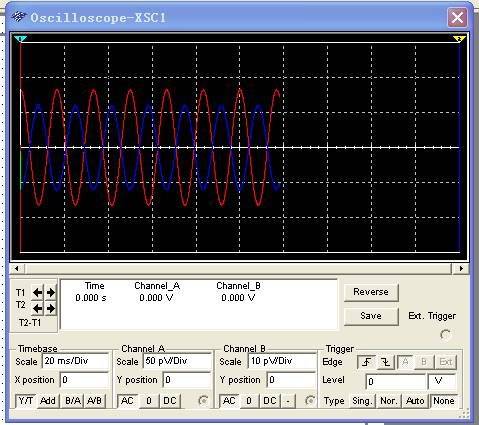
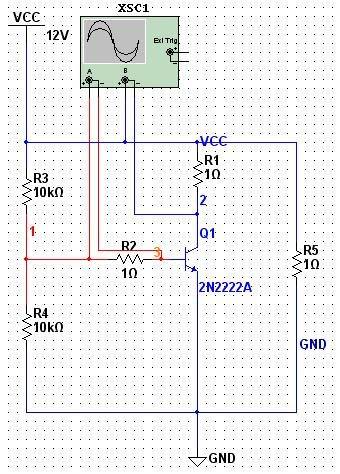
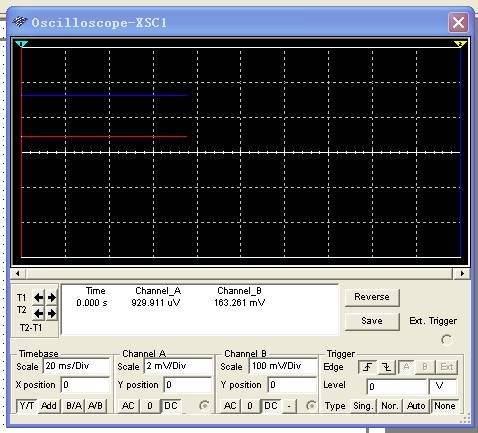
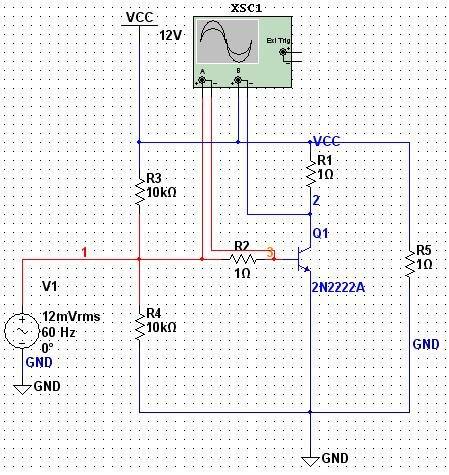
Here are the easiest amplifiers circuits for DC and AC currents, and what’s shown in the oscilloscope I’ve got in Multisim (corresponding), I want to know why ic/ib is negative in the second picture of oscilloscope graph, is it caused by the capacitance between base electrode and collector electrode? If so , what exactly the division is for the current (around the transistor)?
5362039283_81b139d9fe.jpg

5362039339_12a2054087.jpg

5362649468_5d9b5c5ce3.jpg

5362649508_d975b4d85d.jpg
 
Last edited:
Physics news on Phys.org
genxium said:
Although this question may seem too simple, I still want to ask it on the forum because I’m really confused……

Here are the easiest amplifiers circuits for DC and AC currents, and what’s shown in the oscilloscope I’ve got in Multisim (corresponding), I want to know why ic/ib is negative in the second picture of oscilloscope graph, is it caused by the capacitance between base electrode and collector electrode? If so , what exactly the division is for the current (around the transistor)?
5362039283_81b139d9fe.jpg

5362039339_12a2054087.jpg

5362649468_5d9b5c5ce3.jpg

5362649508_d975b4d85d.jpg

Hmm. That is indeed weird. The way you've set up your voltage probes, they should show Ic and Ib in phase, as they do for the DC case.

My only idea at this point is that you are using way too small voltages for the source drive in the AC case (in the DC case too, but whatever). That may be introducing calculation errors into the simulator. I've seen that happen before.

Increase the 1 Ohm sense resistors to more like 1k Ohm, and try to get at least 1Vpp out of the collector circuit. Do the waveforms end up in phase now?
 
I changed those "1 Ohm"s to 1k and 5k to test,and I got the same result,I drawed a picture of currents through the transistor and guessed it might be just easy as the situation in DC circuit,I would post it as long as I get my laptop
 
I guess that the currents might go through the transistor in this way,when Vb>Ve at some moments : (picture shown below)

5375244945_c62cd0574e.jpg


Firstly I got some problems understanding what the "phase" actually is and was quite confused about the directions of currents, but after a discussion with my friends, we all think that there is no "phase" for a certain moment ("phase" should be a concept along with the whole time line), so the picture above maybe right.

Always expecting answers for this problem~ I'm still not sure about that, and I've also done some other similar experiments about AC amplifiers, on Qucs, even on real devices (also with transistor 2N2222A), but I just got the same result: ic/ib is negative...

Any explanation will be appreciated~
 

Similar threads

  • · Replies 7 ·
Replies
7
Views
2K
  • · Replies 3 ·
Replies
3
Views
3K
Replies
13
Views
3K
  • · Replies 7 ·
Replies
7
Views
2K
  • · Replies 10 ·
Replies
10
Views
3K
  • · Replies 2 ·
Replies
2
Views
2K
  • · Replies 14 ·
Replies
14
Views
4K
  • · Replies 3 ·
Replies
3
Views
3K
  • · Replies 28 ·
Replies
28
Views
7K
  • · Replies 1 ·
Replies
1
Views
2K