Understanding Accelerating Pulley Systems: Tension, Forces, and Analysis

Click For Summary
SUMMARY

The discussion focuses on the dynamics of an accelerating pulley system involving two masses, M and m, and an applied force F. It establishes that if the applied force F is less than or equal to the combined weight of the masses (F ≤ (M+m)g), the system remains stationary. The tension in the string is confirmed to be half the applied force when the pulley is massless and frictionless, leading to the conclusion that the behavior of the system depends on the ratio of the masses and the applied force. A free body diagram can effectively illustrate these relationships.

PREREQUISITES
  • Understanding of Newton's laws of motion
  • Basic principles of tension in strings and pulleys
  • Concept of free body diagrams
  • Knowledge of gravitational force calculations
NEXT STEPS
  • Study the principles of tension in massless pulley systems
  • Learn how to construct and analyze free body diagrams for complex systems
  • Explore the effects of friction in pulley systems
  • Investigate the dynamics of multi-mass systems under varying forces
USEFUL FOR

Physics students, mechanical engineers, and anyone interested in understanding the mechanics of pulley systems and force dynamics.

Alan Sammarone
Messages
5
Reaction score
1
Hello. I am having some trouble to understand conceptually the behaviour of such a system:
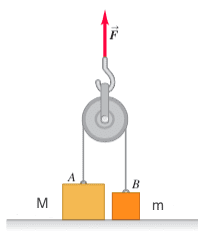
upload_2015-12-10_10-42-38.png


So, both blocks are in contact with the floor, one has mass M and the other has mass m. Then we apply an upwards force F on the axel of the pulley. How does the system behave?

My initial thought is that if

$$ \vec{F} > (m + M)g $$

Then the whole system accelerates upwards. If that's not the case, then only the lighter mass would accelerate (upwards).

That doesn't seem to be case. Particularly, it seems that i should consider that the tension in the string is half the applied force. In general, any pulley attached to a ceiling is going to exert double the tension force on the ceiling. Why is that?So, my question is: how should i go about analysing the behaviour of this system, conceptually, and why? And why is the tension half the force the pulley experiences (if that's even true)?

Thanks!

(This is my first post here. This is not a Homework question, but it was in a book that I've been studying. If I've posted that in the wrong place, i am sorry)
 
Last edited:
Physics news on Phys.org
Hi Samarone:

There are some missing facts from the problem statement, and some assumptions are needed to deal with that.
1. Assume the weight of the pulley, the hook, and the rope/wire connected to the weights are negligible.
2. Assume the frictional force of the rope/wire with the pulley is negligible.

You have already solved the problem if F ≤ (M+m)g: nothing happens.

There are three parts of the motion to solve:
a. How do the hook and pulley behave?
b. How does the M weight behave?
c. How does the m weight behave?

For each of these three, work out the total force (including gravity) accelerating the weight. Keep in mind that the downward gravity force on M acts as an upward force on m.

Hope this helps.

Regards,
Buzz
 
Buzz Bloom said:
You have already solved the problem if F ≤ (M+m)g: nothing happens.
Are you sure? Is it possible for the result to be that one weight only lifts off the floor? Can that happen for F ≤ (M+m)g? Can that happen for F >= (M+m)g

Edit: Consider the implications of the simplifying assumptions. If the string, pulley and hook are frictionless and massless then how does the force on either mass vary depending on the motion of the other mass?
 
jbriggs444 said:
Are you sure? Is it possible for the result to be that one weight only lifts off the floor? Can that happen for F ≤ (M+m)g? Can that happen for F >= (M+m)g
Hi jbriggs:

Good point. You are right. I missed that possibility. Ir depends on the ratio between M and m. I think that if M < 2m, then it is not possible.

Regards,
Buzz
 
Buzz Bloom said:
Good point. You are right. I missed that possibility. Ir depends on the ratio between M and m. I think that if M < 2m, then it is not possible.
I am trying to suggest that it is simpler than that. The original poster is on the right track with:
Alan Sammarone said:
Particularly, it seems that i should consider that the tension in the string is half the applied force. In general, any pulley attached to a ceiling is going to exert double the tension force on the ceiling. Why is that?
That is exactly right. A free body diagram focused on the pulley can verify it. If the mass of the pulley assembly is zero, its momentum must be zero. It can be under no net force.
 
we have tension=(2Mm)g/M+m,but the acceleration of the system is a=F/(M+m)-g.The system has a psudo force acting in the bodies and
so tension=(2Mm)(g+a)/M+m=2Mmg/(M+m)+(2Mm)F/(M+m)^2-2Mmg/(M+m)=(2Mm)F/(M+m)^2
acceleration of larger body,M=Mg-(2Mm)F/(M+m)^2
 

Similar threads

  • · Replies 14 ·
Replies
14
Views
1K
  • · Replies 3 ·
Replies
3
Views
1K
  • · Replies 3 ·
Replies
3
Views
4K
  • · Replies 16 ·
Replies
16
Views
3K
  • · Replies 4 ·
Replies
4
Views
3K
  • · Replies 12 ·
Replies
12
Views
1K
  • · Replies 6 ·
Replies
6
Views
16K
  • · Replies 6 ·
Replies
6
Views
4K
  • · Replies 12 ·
Replies
12
Views
2K
  • · Replies 27 ·
Replies
27
Views
3K