Understanding Angular Magnification in Simple Magnifiers and Telescopes

  • Level: Undergrad 
  • Thread starter ThatDude
  • Start date
  • Tags Tags
    Telescope
2 replies · 2K views · last reply
ThatDude
Messages
33
Reaction score
0
So basically, in the text below, they say that maximum angular magnification is achieved when the object is placed 25 cm from the eye, i.e. at the near point. The minimum angular magnification is achieved when the object is placed at the focal length.

However, for the chapter on the telescope, they explain that to achieve maximum angular magnification, you need the image at infinity, therefore the object must be at the focal length!

Is this not contradictory?
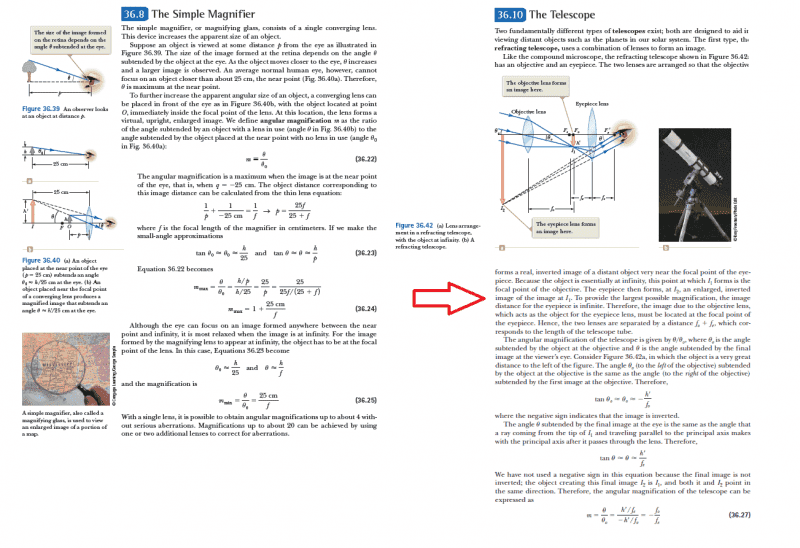
Two-page textbook spread: left page covers the simple magnifier with ray diagrams of an object at the near point and at the focal point, right page covers the refracting telescope with a ray diagram of a two-lens system and a photo of a telescope.
 
Attachments
  • Textbook page layout: left, figures 36.39 to 36.40 showing a simple magnifier with ray diagrams and an eye at the near point; right, section 36.10 with figure 36.42 showing a refracting telescope with objective and eyepiece lenses and ray diagrams.
    tele.png
    109.1 KB · Views: 579
Last edited by a moderator:
I think you may be confused on the difference between the telescope and the magnifier. The highest angular magnification still occurs at the eye's focal point, which would be at the focal point of the eye piece of the telescope, the object lens on the telescope is what needs to see the image at infinity. Please note that these are also "Mickey Mouse" equations that only deal with special scenarios and thin lens, because a real lens will have some type of aberration, and the better telescopes will use a parabolic-reflector which offers no aberration (a simple derivation of this would be a good exercise as I did it yesterday and was quite fun!)
 
Also think about what happens when an image is infinitely far away, using Pythagoras theorem we see that the object is very very tall, but judging it from very far we can also use a small angle approximation.