Understanding Bolted Joints: Basics & Forces Explained

  • Thread starter Thread starter havsula
  • Start date Start date
  • Tags Tags
    Joints
Click For Summary

Discussion Overview

The discussion revolves around the mechanics of bolted joints, focusing on how they function under load, the role of preload, and the contributions of different components to the overall stiffness of the joint. Participants explore theoretical concepts and practical implications related to bolted joint design and behavior.

Discussion Character

  • Exploratory
  • Technical explanation
  • Debate/contested

Main Points Raised

  • One participant expresses confusion about how bolted joints can take up load when the components are not physically connected, suggesting that only the bolt should carry the load.
  • Another participant explains that the bolt acts as a clamp, with the shank in tension and the clamped pieces in compression, and mentions the role of washers in distributing clamping force.
  • A participant questions how the stiffness of the clamps contributes to the overall stiffness of the system, noting that the clamps do not seem to connect physically.
  • It is proposed that the bolt adds only a small amount of stiffness to the joint, with the plates dominating the stiffness once preload is exceeded.
  • One participant likens the bolt to a spring and describes how the clamped parts also behave like springs in compression, suggesting that the overall system behaves as a combination of these springs.
  • Another participant encourages deriving the equation for the overall spring rate of the system, emphasizing the interaction between the bolt and the clamped members.
  • There is a reiteration of the confusion regarding how the joints can contribute to stiffness when only the bolt is physically connecting the components.

Areas of Agreement / Disagreement

Participants express differing views on the mechanics of bolted joints, particularly regarding the contributions of the bolt and the clamped components to the overall stiffness. The discussion remains unresolved with no consensus reached on these points.

Contextual Notes

Participants highlight the complexity of the interactions between the bolt and the clamped components, noting assumptions about physical connections and stiffness contributions that may not be fully addressed.

havsula
Messages
22
Reaction score
2
Hello
I really struggle with understand how and why bolted jonts actually works:
The following figure copied from http://ocw.mit.edu/courses/mechanic...pring-2009/lecture-notes/MIT2_72s09_lec10.pdf shows a bolted joint:
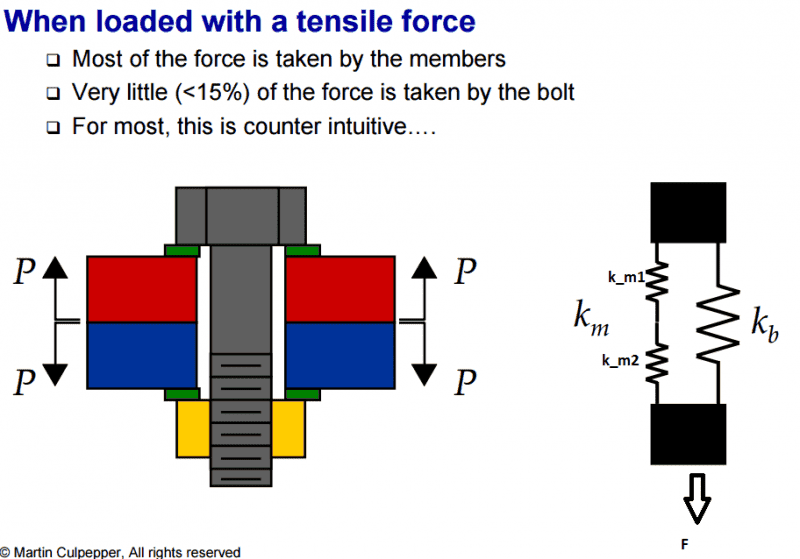
upload_2015-5-20_9-21-12.png


After the bolt is preloaded we have as system where k_m1 and k_m2 are in compression and k_b are streched.

The theory I have founds states that when an externcal force of F is applied to this system, some of the force is taken by the bolt F_b and some of the force are taken by the joints F_a
F = F_b + F_a

But I do not understand how the joints can take up load when they are not connected together. In my head only the bolt can take up force. What do I not understand?
 
Engineering news on Phys.org
A bolt is essentially a clamp which can be adjusted by turning the nut. While the shank of the bolt is in tension, the pieces being clamped together are in compression. The washers in the figure above, located under the head of the bolt and under the nut, help to spread out the clamping force, reducing the chance that any permanent set will be placed in the pieces being clamped.

http://en.wikipedia.org/wiki/Bolted_joint
 
SteamKing said:
A bolt is essentially a clamp which can be adjusted by turning the nut. While the shank of the bolt is in tension, the pieces being clamped together are in compression. The washers in the figure above, located under the head of the bolt and under the nut, help to spread out the clamping force, reducing the chance that any permanent set will be placed in the pieces being clamped.

http://en.wikipedia.org/wiki/Bolted_joint
Hello
But what I do not understand is how the stiffness of the clamps will add to the stiffness of the system
These forces pulls in each direction, the green lines is in some way the where the force will act in my head. There are no physical connection between the clamps so I cannot see that they add anything to the total stiffness. In my head the bolt carry all the load.

upload_2015-5-21_7-53-36.png
 
Highly recommended:

An Introduction to the Design and Behavior of Bolted Joints (Mechanical Engineering, Volume 97) Hardcover – July 19, 1995
by https://www.amazon.com/s/ref=dp_byline_sr_book_1?ie=UTF8&field-author=John+Bickford&search-alias=books&text=John+Bickford&sort=relevancerank&tag=pfamazon01-20 (Author)

https://www.amazon.com/dp/0824792971/?tag=pfamazon01-20
 
havsula said:
Hello
But what I do not understand is how the stiffness of the clamps will add to the stiffness of the system
These forces pulls in each direction, the green lines is in some way the where the force will act in my head. There are no physical connection between the clamps so I cannot see that they add anything to the total stiffness. In my head the bolt carry all the load.

View attachment 83813

In most cases, the bolt only adds a small amount of stiffness to the joint (maybe 5-15% depending on the plate stiffnesses). Think of preload as a load bank account. As the joint (plates and bolt together) start to separate, you are withdrawing some (pre)load from the bank account, and the plates dominate the stiffness of the joint. Once preload is exceeded on the applied force, then you are in trouble, because the bolt now carries the total preload plus the applied load, and your "bank account" is empty (i.e., the plates do not help you any more).
 
Consider the bolt as a spring, just like it shows in your figure. It has some spring rate just like a spring does. The increase in length that occurs when you pull on the ends is linearly proportional to the tensile force.

Similarly, the parts clamping between the head and nut also act as springs, albeit much stiffer ones. They're in compression. The decrease in thickness of those parts is linearly proportional to the compressive force.

So when you take a spring (bolt) and pull it to stretch it, then hook it to a couple of much stiffer springs which go under compression, the bolt (light spring in tension) remains fairly well stretched while the members being clamped (heavy springs in compression) are compressed only slightly.

Do you know how to calculate the overall spring rate of the system as you've shown in the OP? Consider how to calculate the overall spring rate of that system of 3 springs (one bolt and two members being clamped). Can you write the equation for three springs as shown in that picture?

Now consider that when the system of 3 springs is pulled apart, you're actually pulling on the overall system of springs, not just the bolt. The ends of the springs (bolt and clamped members) move together, not independently. So when you move the ends of the bolt, you're pulling on the bolt but you're also reducing the compressive stress in the clamped members. What you're doing is actually pulling on 3 springs that are acting as one spring that has an overall spring rate that is much higher than either the bolts or the clamped members.

See if you can derive the equation for 3 springs as shown in the OP and then determine how forces acting on that set of 3 springs changes the overall length compared to how the same force would change the length of the bolt alone.
 
Q_Goest said:
Consider the bolt as a spring, just like it shows in your figure. It has some spring rate just like a spring does. The increase in length that occurs when you pull on the ends is linearly proportional to the tensile force.

Similarly, the parts clamping between the head and nut also act as springs, albeit much stiffer ones. They're in compression. The decrease in thickness of those parts is linearly proportional to the compressive force.

So when you take a spring (bolt) and pull it to stretch it, then hook it to a couple of much stiffer springs which go under compression, the bolt (light spring in tension) remains fairly well stretched while the members being clamped (heavy springs in compression) are compressed only slightly.

Do you know how to calculate the overall spring rate of the system as you've shown in the OP? Consider how to calculate the overall spring rate of that system of 3 springs (one bolt and two members being clamped). Can you write the equation for three springs as shown in that picture?

Now consider that when the system of 3 springs is pulled apart, you're actually pulling on the overall system of springs, not just the bolt. The ends of the springs (bolt and clamped members) move together, not independently. So when you move the ends of the bolt, you're pulling on the bolt but you're also reducing the compressive stress in the clamped members. What you're doing is actually pulling on 3 springs that are acting as one spring that has an overall spring rate that is much higher than either the bolts or the clamped members.

See if you can derive the equation for 3 springs as shown in the OP and then determine how forces acting on that set of 3 springs changes the overall length compared to how the same force would change the length of the bolt alone.

I can put up the equations for the three springs if I have assumed that they are the part of the same system. But in order to try to explain:
As I can see the system it looks like that. Only the bolt have a physical connection between the upper and lower part of this system. So how can the joints add to the total stiffness of the system. When I apply a force, as far as I can see, all the tension will go in the bolt, which is physical connected to the upper part.

upload_2015-5-22_9-19-36.png
 
Hi havsula,
havsula said:
After the bolt is preloaded we have as system where k_m1 and k_m2 are in compression and k_b are streched.

The theory I have founds states that when an externcal force of F is applied to this system, some of the force is taken by the bolt F_b and some of the force are taken by the joints F_a
F = F_b + F_a

But I do not understand how the joints can take up load when they are not connected together. In my head only the bolt can take up force. What do I not understand?
I think it's the part in bold above that you're having a conceptual issue with. The statement made is fairly commonly used when talking about bolted joints. It means that the joint is under compression and that compressive load diminishes when the parts are in tension. It does NOT mean that the joint goes into tension. All the tension is still in the bolt after the force is applied. All they are saying is that the compressive load on the joint diminishes to a greater degree than the tensile load in the bolt increases. That's a very important thing to understand because bolts are not good at resisting alternating stresses because of fatigue. They will tend to crack at the thread root, so the alternating stresses in bolts have to be minimized and a well designed bolted joint accomplishes that by providing a very high spring constant in the joint when compared to the bolt.
 

Similar threads

  • · Replies 8 ·
Replies
8
Views
5K
  • · Replies 4 ·
Replies
4
Views
2K
  • · Replies 12 ·
Replies
12
Views
5K
Replies
5
Views
3K
Replies
6
Views
5K
  • · Replies 10 ·
Replies
10
Views
14K
  • · Replies 6 ·
Replies
6
Views
3K
  • · Replies 12 ·
Replies
12
Views
2K
Replies
1
Views
2K
  • · Replies 27 ·
Replies
27
Views
11K