Understanding Complex Planes-Graphs - Get Explanations Here

  • Thread starter Thread starter Bassalisk
  • Start date Start date
  • Tags Tags
    Complex
Click For Summary
Colorful graphs of complex functions can be visually intriguing, but understanding their meanings can be challenging. A user seeks resources to learn how to interpret these graphs, specifically mentioning the mapping of z to z^2 and its representation as a disc wrapping around itself. The discussion includes a description of how this mapping resembles a spiral staircase, illustrating the complexity of these functions. Suggestions for further research include searching for "winding number" for more visual explanations. Overall, the conversation emphasizes the need for clearer resources to grasp the concepts behind complex plane graphs.
Bassalisk
Messages
946
Reaction score
2
Hello,

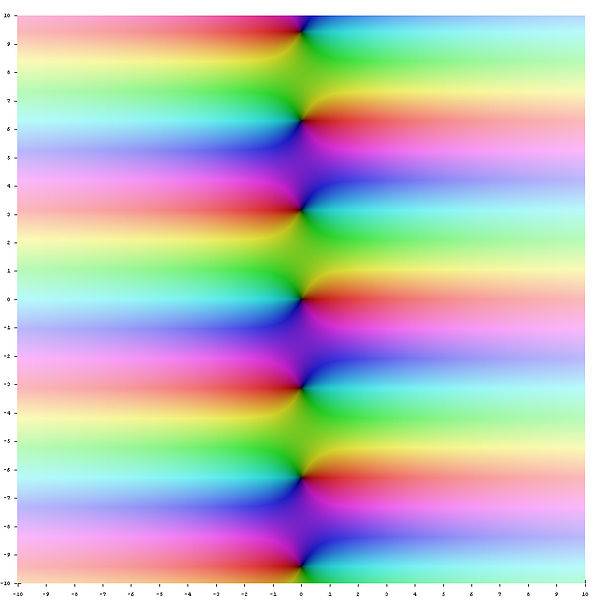
I find those colourful graphs of complex functions very interesting.
600px-Complex_Sinh.jpg


But other than being thrilled by various colours, I have no idea what any of those mean.

Can anybody provide a good source of explanations of these graphs? I would really like to learn how to read them. I don't know what terms do I have to google to get an explanation for this.
 
Physics news on Phys.org
well try to picture a disc wrapping around itself twice, sending th center to the center.

I.e. try to picture the map z-->z^2 in the plane. you take a disc and cut it along a radius. then you wrap it around itself twice and try to glue the edges back together. theydon't quite work since you would have to pass one edge through the other.

but you get something looking like a spiral staircase. if you look at your picture, it is just a bunch of spiral staircases, spiraling at those special points in the middle.
 
mathwonk said:
well try to picture a disc wrapping around itself twice, sending th center to the center.

I.e. try to picture the map z-->z^2 in the plane. you take a disc and cut it along a radius. then you wrap it around itself twice and try to glue the edges back together. theydon't quite work since you would have to pass one edge through the other.

but you get something looking like a spiral staircase. if you look at your picture, it is just a bunch of spiral staircases, spiraling at those special points in the middle.

Interesting approach. Not going to lie and tell you that I understand you 100%, but I am on the right track.

Thank you.
 
I don't know what terms do I have to google to get an explanation for this.

Google "winding number" (perhaps choose the images tab - Wiki or Wolfram are quite technical)
 

Similar threads

  • · Replies 9 ·
Replies
9
Views
1K
  • · Replies 4 ·
Replies
4
Views
3K
  • · Replies 10 ·
Replies
10
Views
2K
  • · Replies 2 ·
Replies
2
Views
2K
  • · Replies 8 ·
Replies
8
Views
2K
  • · Replies 1 ·
Replies
1
Views
2K
  • · Replies 3 ·
Replies
3
Views
2K
  • · Replies 2 ·
Replies
2
Views
2K
  • · Replies 1 ·
Replies
1
Views
2K
  • · Replies 4 ·
Replies
4
Views
2K