Understanding Dual Output Zener PSU

Click For Summary
The discussion focuses on understanding the voltage behavior in a dual output Zener power supply unit (PSU). It clarifies that the peak DC voltage after rectification can exceed the RMS input voltage due to the smoothing capacitor's effect. The negative voltage at the bottom rail is explained as a result of the two Zener diodes acting as a voltage divider, with ground reference affecting voltage readings. Participants emphasize the importance of adding output capacitors for each rail and highlight the circuit's cross-regulation issues, suggesting that a better design would use linear or DC-DC converters for improved stability. Overall, the conversation aims to resolve confusion around voltage drops and the functionality of Zener diodes in the circuit.
Mzzed
Messages
67
Reaction score
5
I am struggling to understand the voltages present in the circuit below. So as stated in the diagram, there is 30V AC at the secondary of the transformer, this is equivalent of 42.4Vpeak. The bridge rectifier changes this to DC and drops the voltage down to roughly 26.3Vpeak DC where each diode is assumed to have 0.7V drop. The zener voltage is 15V so there must be a 11.3V drop across R1 and R2 total. Then ground is indicated as seen on the far right, so there must be a 15V drop across the zener diode ZD1. ZD2 also has a zener voltage of 15v so the bottom output is -15V meaning there is a 15V drop across that zener diode as well... Adding up the total voltage drop across the circuit, that would be 45V... from a 42.4Vpeak source voltage.

How is the bottom rail able to be negative? and why does it seem like there is a 45V drop across the circuit where the supply is only 42.4Vpeak AC (30V RMS)?
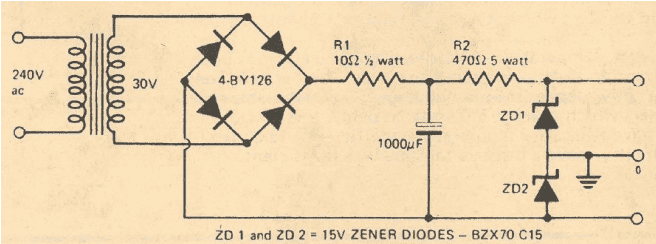
upload_2018-3-15_17-16-39.png
 

Attachments

  • upload_2018-3-15_17-16-39.png
    upload_2018-3-15_17-16-39.png
    40.7 KB · Views: 2,097
Engineering news on Phys.org
Mzzed said:
and why does it seem like there is a 45V drop across the circuit where the supply is only 42.4Vpeak AC (30V RMS)?
because you have forgotten that the smoothing cap increases the DC voltage

lets take out the zeners for a moment

your Vsec = 30V - 1.4Vthrough 2 diodes = 28.6VDC
28.6V x 1.414 ( the effect of the capacitor) = 40.44VDC OPEN CIRCUIT voltage

40.44V - ( little drops through the 2 resistors) = maybe ~ 38V ( you can do the math)

Now the above is with the secondary voltage on the diagram ... if the voltage is higher, then the sec voltage must be a bit higher
Mzzed said:
How is the bottom rail able to be negative?

because the 2 zeners are acting like a voltage divider
with the central point 0V relative to the top or bottom rails ... as shown
if you put you meter negative lead on the centre of the 2 zeners and the positive of the meter to the top rail, you will read a + V
if you put you meter negative lead on the centre of the 2 zeners and the positive of the meter to the bottom rail, you will read a - Vjust a basic explanation :smile:

Dave
 
  • Like
Likes Mzzed
Thankyou!

By converting to units in Vpeak form I was considering the capacitor by multiplying the 30Vrms by SQRT(2) or ~1.41, the capacitor will just bring Vrms up to this peak voltage. But i think all those specific voltages will fall into place once I understand why there is able to be a negative voltage after the two zener diodes.

Just to help me wrap my head around this, I'd like to think of an example where each zener diode is replaced with a resistor of some random value.
what would the bottom rail voltage be then? What determines where the ground is? is the bottom rail still negative? hahah sorry this confuses me quite a lot.

If the two zener diodes were replaced with two resistors of equal value, would they each have a 15V drop across each of them? (just not regulating at that voltage like a zener would do)
 
Remove the ground symbol from the schematic as I think it is confusing you. Then take another look. Work out the voltages and etc. Get your head wrapped around it. After that, reinsert the ground symbol and ask yourself why that should change anything since there is no other reference to that symbol on the schematic.
 
  • Like
Likes Mzzed
Mzzed said:
If the two zener diodes were replaced with two resistors of equal value, would they each have a 15V drop across each of them? (just not regulating at that voltage like a zener would do)

yes, exactly ... they are still a voltage divider :smile:
 
  • Like
Likes Mzzed
Some quick thoughts (apologies if they have been mentioned already above -- I'm skimming):

  • There should be an output capacitor for each output rail. So add 2 more polar caps right at the outputs with respect to Ground
  • This circuit has a pretty bad "cross-regulation" problem. The output current loading on one of the two outputs will change the output voltage of the other output. That is generally a bad thing in power supply design.
  • A better way to get split supplies from a single positive DC source is to use a linear or DC-DC step-down regulator for the positive rail, and an inverting DC-DC converter for the negative rail. Since both of those voltage regulator circuits are effectively in parallel, there is much less of a cross-regulation issue.
 
  • Like
Likes davenn and Mzzed
Mzzed said:
I am struggling to understand the voltages present in the circuit below.

berkeman said:
  • There should be an output capacitor for each output rail. So add 2 more polar caps right at the outputs with respect to Ground
  • This circuit has a pretty bad "cross-regulation" problem. The output current loading on one of the two outputs will change the output voltage of the other output. That is generally a bad thing in power supply design.
  • A better way to get split supplies from a single positive DC source is to use a linear or DC-DC step-down regulator for the positive rail, and an inverting DC-DC converter for the negative rail. Since both of those voltage regulator circuits are effectively in parallel, there is much less of a cross-regulation issue.
yes, agree with all Berkeman's comments
and added to that, which I was eventually going to comment on...

... current supply from the "average" zener is generally very low 100mA max, give or take a little (unless a high wattage zener)
... also as the load varies, so does the current drawn and therefore so does the voltage.

They are a very poor way to get a "fixed" voltage, specially if circuit conditions vary, and even a worse in the configuration shown aboveDave
 
  • Like
Likes berkeman and Mzzed
@Mzzed

The best and most conventional way to produce a dual rail PSU is to use a centre tapped transformer, eg ...

35-Volt-Dual-power-supply.png


you could then use the appropriate voltage regulators at the +- 35V outputs to regulate down to what you need
you could use linear regulators ... say 7812, 7912 ... 7815, 7915 etc eg ...

regulated-dual-power-supply-circuit.jpg


Articlpsu01_sch_523924033.gif


circuit.png
or you could use switching regulators which are much more efficient

D76y7.jpg
https://m.eet.com/images/eetimages/powermanagementdesignline/2010/12/C0678-Figure5.gifDave
 

Attachments

  • 35-Volt-Dual-power-supply.png
    35-Volt-Dual-power-supply.png
    12.3 KB · Views: 916
  • regulated-dual-power-supply-circuit.jpg
    regulated-dual-power-supply-circuit.jpg
    34.8 KB · Views: 1,173
  • Articlpsu01_sch_523924033.gif
    Articlpsu01_sch_523924033.gif
    6 KB · Views: 995
  • circuit.png
    circuit.png
    7.3 KB · Views: 2,290
  • D76y7.jpg
    D76y7.jpg
    15.8 KB · Views: 879

Similar threads

  • · Replies 14 ·
Replies
14
Views
2K
  • · Replies 38 ·
2
Replies
38
Views
5K
  • · Replies 16 ·
Replies
16
Views
4K
  • · Replies 10 ·
Replies
10
Views
4K
  • · Replies 5 ·
Replies
5
Views
3K
  • · Replies 14 ·
Replies
14
Views
5K
Replies
4
Views
3K
Replies
12
Views
2K
  • · Replies 7 ·
Replies
7
Views
4K
  • · Replies 12 ·
Replies
12
Views
3K