Understanding Basic Rectifiers: Question and Explanation

  • Thread starter Thread starter Abdullah Almosalami
  • Start date Start date
Click For Summary

Discussion Overview

The discussion revolves around the functioning of basic half-wave rectifiers, specifically focusing on the behavior of the output voltage with and without a reservoir capacitor. Participants explore the relationship between the input voltage, the capacitor's voltage, and the role of the diode in the circuit.

Discussion Character

  • Exploratory
  • Technical explanation
  • Debate/contested

Main Points Raised

  • One participant expresses confusion about why a capacitor holds its voltage while the input voltage drops, questioning the passive nature of the capacitor in this context.
  • Another participant explains that the diode allows current to flow only when the anode is sufficiently higher than the cathode, and when the diode is reverse-biased, the capacitor discharges only through a resistor.
  • A participant reiterates the importance of the diode's role, emphasizing that the capacitor's voltage does not follow the input voltage due to the diode's behavior.
  • One participant shares a realization from an EE professor regarding the relationship between current and voltage in the capacitor, stating that if the capacitor were to follow the input voltage, it would contradict the diode's function.
  • Another participant encourages the understanding of the derivative-integral relationship between voltage and current, suggesting that this concept is crucial for grasping related topics like inductance.

Areas of Agreement / Disagreement

Participants express differing views on the behavior of the capacitor in relation to the input voltage, with some emphasizing the role of the diode and others questioning the passive nature of the capacitor. The discussion remains unresolved regarding the clarity of these concepts in educational materials.

Contextual Notes

There are limitations in the assumptions made about the behavior of the capacitor and diode, and the discussion does not resolve the mathematical relationships involved in the circuit analysis.

Abdullah Almosalami
Messages
49
Reaction score
15
This has been frustrating me to no end, and I can't really find an answer in any textbook. So, here's my issue. A basic half-wave rectifier circuit with just a reservoir capacitor looks like this:
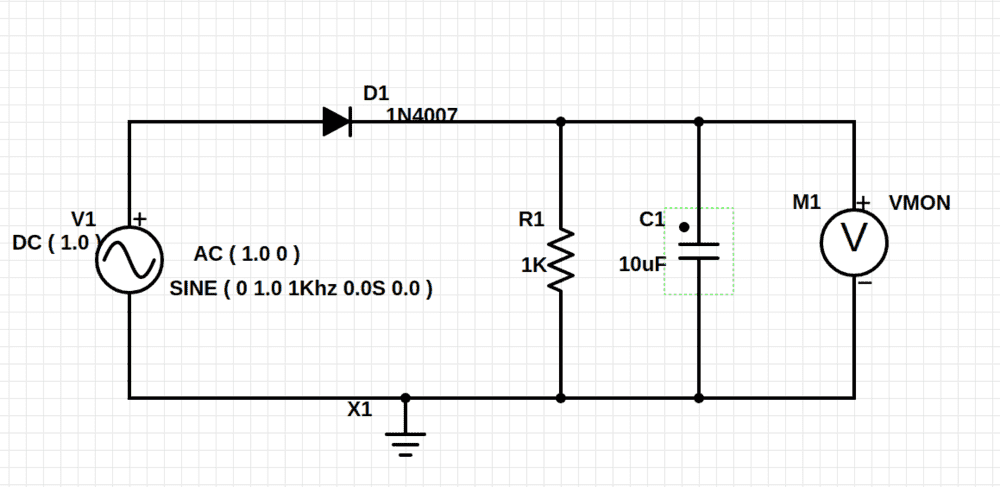
Half-Wave Rectifier Circuit with Reservoir Capacitor.png


And the output, as expected, is this "rippled DC" voltage:
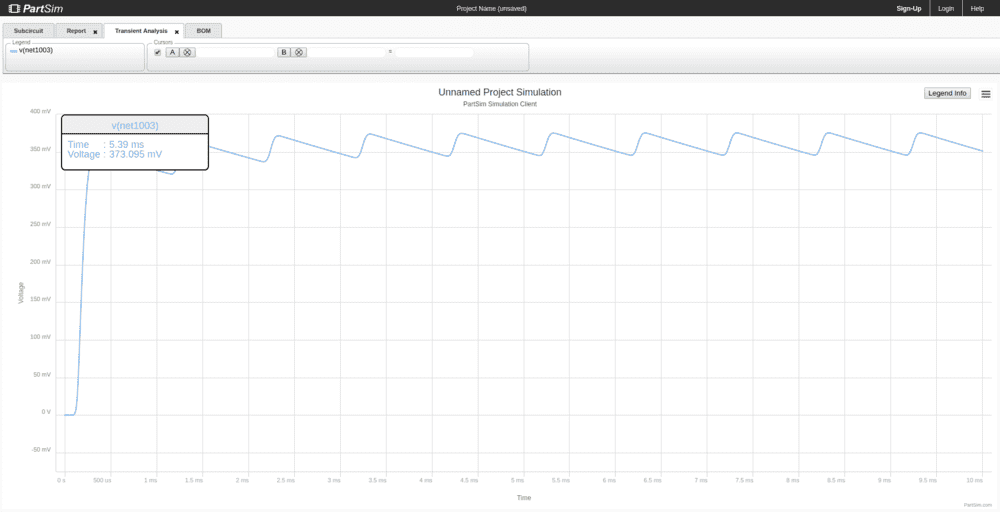
Half-Wave Rectifier With 10uF Reservoir Capacitor.png


Alright. My issue is if we take a step back and get the voltage output of the circuit without the reservoir capacitor, like so (slightly different diode but shouldn't change anything):
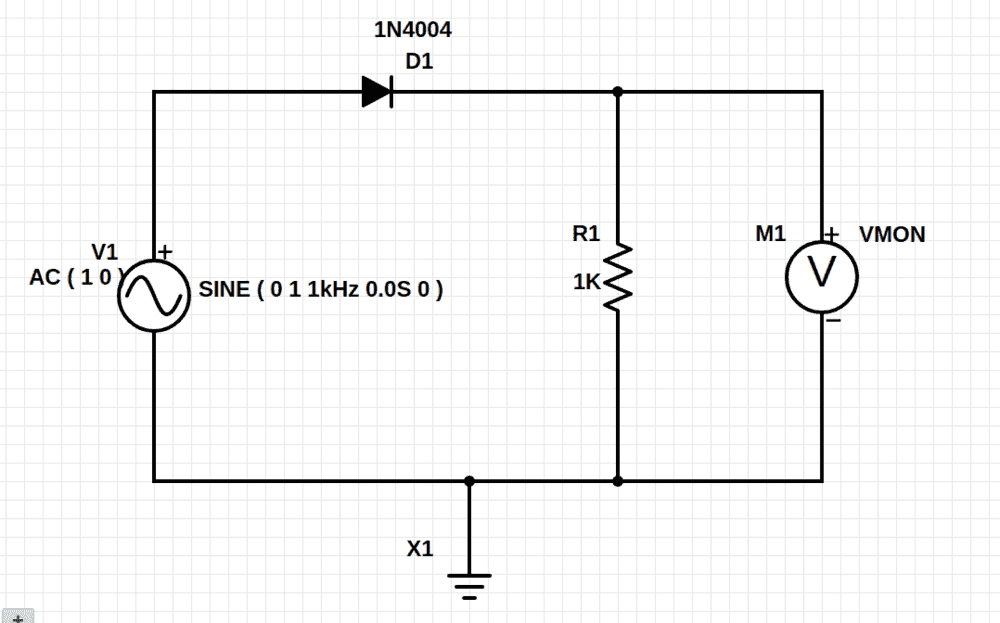
Half-Wave Rectifier Circuit without Reservoir Capacitor.png


The output, as you would expect, would be a half-rectified sine wave:
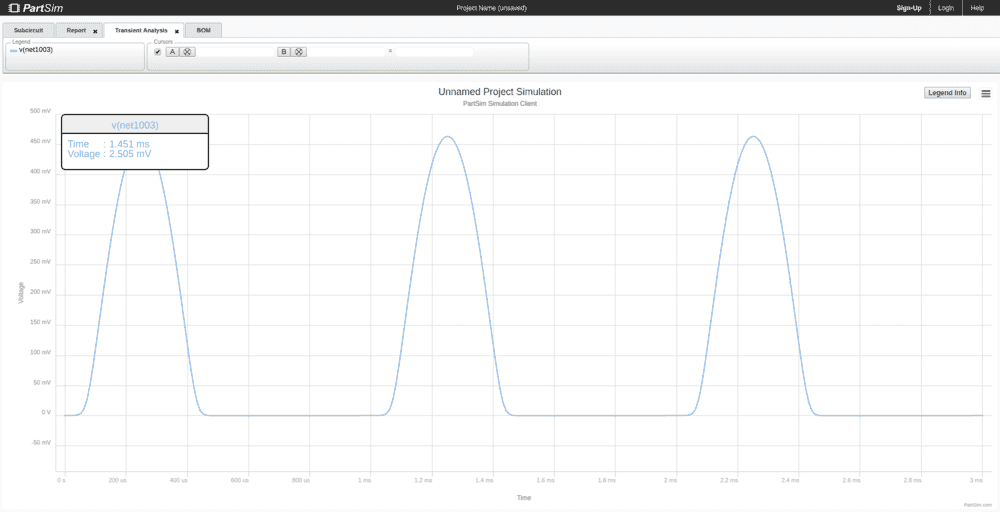
Output on Half-Wave Rectifier Without Reservoir Capacitor.png


So, where is the link between the latter and former case! Most textbooks and literally everybody everywhere says that once the voltage source reaches peak, the capacitor will also be at peak minus the voltage drop across the diode, and then as the voltage source drops, it will become less than the capacitor's voltage and so the diode will become reverse-biased and that part of the circuit essentially gets disconnected until the voltage source rises back up again to meet back with the capacitor's voltage, and in the meantime the capacitor discharges its charge and maintains the slightly decreasing voltage across it. My issue is, why would the capacitor hold its voltage while the voltage source drops! It is a passive component. It should just follow the voltage as seen ^ in the latter case. For example, if I had this case:
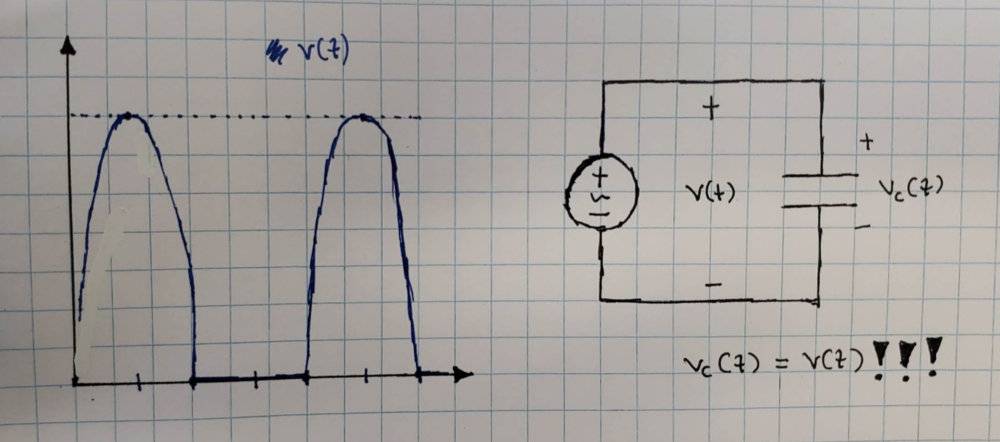
Snapchat-1848085985.jpg


You wouldn't expect the voltage across the capacitor to be that rippling DC of a half-wave rectifier. You would just expect it to follow the voltage source. It would be a contradiction violating KVL if the capacitor's voltage and the source's voltage differed! And also violate the idea that the capacitor is a passive component!

Of course, I know that the capacitor voltage will be that rippling DC, but my question is why? What analysis can show this? Where's the math or the model to show this, say to someone who wouldn't know that the output would be rippled DC?
 

Attachments

  • Half-Wave Rectifier Circuit with Reservoir Capacitor.png
    Half-Wave Rectifier Circuit with Reservoir Capacitor.png
    17 KB · Views: 921
  • Half-Wave Rectifier With 10uF Reservoir Capacitor.png
    Half-Wave Rectifier With 10uF Reservoir Capacitor.png
    12.1 KB · Views: 541
  • Half-Wave Rectifier Circuit without Reservoir Capacitor.png
    Half-Wave Rectifier Circuit without Reservoir Capacitor.png
    13.5 KB · Views: 597
  • Output on Half-Wave Rectifier Without Reservoir Capacitor.png
    Output on Half-Wave Rectifier Without Reservoir Capacitor.png
    15.2 KB · Views: 447
  • Snapchat-1848085985.jpg
    Snapchat-1848085985.jpg
    40.7 KB · Views: 450
Engineering news on Phys.org
What is a diode? A diode conduct current in one direction, from Anode to Cathode. In order for the diode to conduct, the Anode has to be about 0.7V higher than the Cathode. If Anode is less than 0.7V higher or Anode is more negative, the diode turns off and no current will flow.

What is a capacitor? It's to hold charge! So when the voltage goes up D1 will conduct and charge up the cap. The voltage on the cap follows ( with a diode drop of cause). But then when the voltage of the driving source goes do, you know that the diode D1 will be reverse biased and turn off. What is the path that discharge the cap? The answer is R1 only as D1 is off.

The charge of the cap holds the voltage, after D1 turns off, the only path of discharge the cap is R1. So the voltage drops in the cap is ONLY depend on the value of R1. If R1 is high and the charge is discharged slowly, the voltage across the cap will drop slowly like you showed as saw tooth wave.

Remember, when the input drops below the voltage on the cap, D1 is off, no charge will be discharged through D1. Why should the voltage on the cap follow the input? You forgot the function of D1 all together.
 
Last edited:
yungman said:
What is a capacitor? It's to hold charge! So when the voltage goes up D1 will conduct and charge up the cap. The voltage on the cap follows ( with a diode drop of cause). But then when the voltage of the driving source goes do, you know that the diode D1 will be reverse biased and turn off. What is the path that discharge the cap? The answer is R1 only as D1 is off.

Yes. This is what I mentioned in my question. When the voltage source drops from peak, at some point the voltage source minus the voltage across the capacitor will be less than the forward voltage needed to keep the diode conducting when forward biased. But this is assuming that the voltage of the capacitor stays constant, waiting for the voltage source to drop below it. I'm asking why would the capacitor do that?
 
I just got the answer after asking an EE professor. I swear this should be taught more clearly and put in textbooks. The reason is the current running through the capacitor is given by the defining equation ## i_c = C * \frac {dv} {dt} ##, and so if the capacitor was following the half-rectified wave after the peaks, we see that ## \frac {dv} {dt} ## is negative, which would mean that the current running through the capacitor was moving backwards into the source's positive terminal, but the diode would not allow this, and so ##i_c## must equal to 0, which means ## \frac {dv} {dt} ## must also equal to 0, and hence the capacitor will maintain it's voltage at constant until the voltage source drops enough so that the diode becomes reverse biased. Holy moly freaken finally. I've been going crazy with this. Seems so obvious though now that I know. Ayaaa.
 
Last edited:
We have to train our brain to think in that derivative-integral relationship between voltage and current and it's unnatural at first.

Practice it - you're going to really need it for inductance !.
 
  • Like
Likes   Reactions: berkeman and Abdullah Almosalami
jim hardy said:
We have to train our brain to think in that derivative-integral relationship between voltage and current and it's unnatural at first.

Practice it - you're going to really need it for inductance !.
Absolutely! The more you know :D.
 
  • Like
Likes   Reactions: berkeman

Similar threads

  • · Replies 32 ·
2
Replies
32
Views
3K
  • · Replies 10 ·
Replies
10
Views
5K
  • · Replies 7 ·
Replies
7
Views
2K
  • · Replies 22 ·
Replies
22
Views
5K
  • · Replies 63 ·
3
Replies
63
Views
8K
  • · Replies 5 ·
Replies
5
Views
2K
Replies
12
Views
3K
  • · Replies 7 ·
Replies
7
Views
4K
  • · Replies 8 ·
Replies
8
Views
3K
  • · Replies 9 ·
Replies
9
Views
2K