Understanding Fraunhofer Diffraction Patterns of Circles and Slots

  • Context: Undergrad 
  • Thread starter Thread starter Nick.
  • Start date Start date
  • Tags Tags
    Diffraction Fraunhofer
Click For Summary

Discussion Overview

The discussion centers on the differences in diffraction patterns produced by circular apertures versus linear slits. Participants explore the theoretical underpinnings of these patterns, their mathematical descriptions, and the implications of aperture shape on the resulting diffraction effects.

Discussion Character

  • Exploratory
  • Technical explanation
  • Debate/contested
  • Mathematical reasoning

Main Points Raised

  • One participant notes that a circular aperture produces a circular diffraction pattern, while a linear slot yields a linear pattern, questioning why the slot's pattern does not exhibit radial symmetry like the circle's.
  • Another participant agrees that smaller apertures lead to larger diffraction patterns, explaining that the slot's width affects the spread of the pattern along the x-axis due to reduced destructive interference.
  • A different participant raises concerns about the absence of expected interference patterns above and below the slit, suggesting that the observed fringes should indicate more intense light in those areas.
  • One participant emphasizes the importance of mathematical approaches to understanding diffraction, suggesting that basic geometry can explain simple cases but that integration is necessary for finite apertures.
  • A participant challenges the idea that slot diffraction should be radial, arguing that circular apertures naturally yield circular symmetry, while linear slots produce Cartesian symmetry, and mentions the use of 2D Fourier transforms for calculations.
  • Another participant questions the concept of "apparent slit width" and its implications for the diffraction pattern, seeking clarification on how this width changes.
  • One participant reiterates the value of mathematical transformations in understanding diffraction, advocating for the use of mathematical tools to reveal deeper insights into the phenomena discussed.

Areas of Agreement / Disagreement

Participants express differing views on the nature of diffraction patterns produced by circular versus linear apertures, with some agreeing on the mathematical approaches while others contest the interpretations of observed patterns. The discussion remains unresolved regarding the specific characteristics of the diffraction patterns and the implications of aperture shape.

Contextual Notes

Participants highlight limitations in understanding the diffraction patterns, including assumptions about interference effects and the dependence on mathematical descriptions. The discussion reflects varying levels of comfort with mathematical concepts and their application to physical phenomena.

Nick.
Messages
15
Reaction score
0
Hi,
Why is that when a diffraction pattern is created through small circular opening you achieve a diffraction pattern like this;
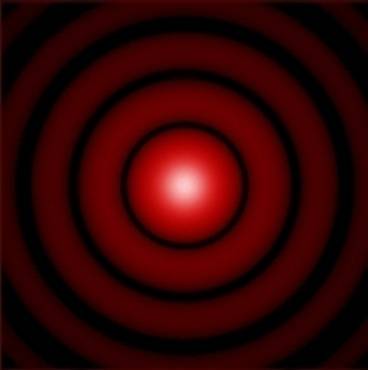
image.jpg


But when we see images of a slot we see this;
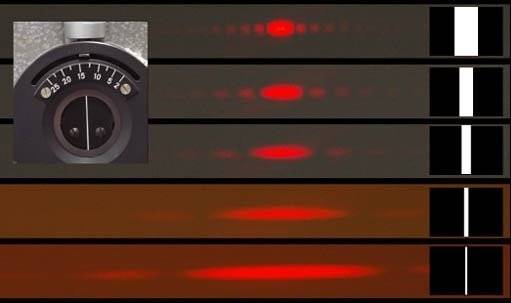
image.jpg

From; http://hyperphysics.phy-astr.gsu.edu/hbase/phyopt/fraungeo.html#c1

Notice how the diffraction is linear - not vertical or circular. If the same method is used in calculating the slot diffraction as you use in the circle then then slot diffraction should also be radial (but stretched to account for the slot height),

At first I thought this was because of the laser polarisation but since a laser also creates the circular image then this must not be the case??
 
Science news on Phys.org
Yes, the smaller the width of the slot, the larger the diffraction pattern. A circular pattern behaves the same way. The smaller the circle, the larger the pattern. The slot gives a increased x-axis spread when the x-axis of the slot (width) is smaller because there is less destructive interference along that axis. The Y-axis remains the same size because the height of the slot remains unchanged. A circular aperture changes size in both axes, so the diffraction pattern does so too.
 
Yes - I agree but...

In the slot images of my first post the slit is either short or the width of the laser beam is visible - we can tell this from the fuzzy fringes in the y-axis. Note there is no interference indicated above and below the slit - but there should be given the width of the fringes in the x-axis and y-axis are comparable - so there should be intense light above and below that is missing...?

Also, as you say, as the width of the slot increases the interference pattern should become closer together. Consider now rotating the x - axis distribution function incrementally around to the y-axis position. If the aperture is a circle, we can see how this x-axis rotation of the probability distribution would create a circular airy's style image. But if we make the opening a slit - as we rotate the prob distribution the apparent slit width increases, bringing the fringes closer together - so shouldn't we see some curving on the top and bottom of the interference pattern?
 

Attachments

  • image.jpg
    image.jpg
    5.8 KB · Views: 571
If you want to get a feel for the way that Diffraction works, there is no substitute for the mathematical approach. The two slits experiment is almost explained using very basic geometry, to account for the cancellation and enhancement of the waves in different places. Once you get to calculating and explaining diffraction of an aperture of finite size you cannot avoid Integration. The language of non-maths just cannot cope with what the language of maths can say, here. What you can do, however, is learn to recognise some of the patterns and basic rules - as written above. The list of threads that also discuss this subject are at the bottom of this page.
 
  • Like
Likes   Reactions: M Quack
"If the same method is used in calculating the slot diffraction as you use in the circle then then slot diffraction should also be radial (but stretched to account for the slot height)"

Not so. It makes sense for a circular aperture to have a diffraction pattern with circular symmetry and a linear slot to have one with cartesian symmetry. Diffraction patterns in the far field can be calculated by taking the 2D Fourier transform of the aperture function (transmission as a function of position).

Claude.
 
Nick. said:
In the slot images of my first post the slit is either short or the width of the laser beam is visible - we can tell this from the fuzzy fringes in the y-axis. Note there is no interference indicated above and below the slit - but there should be given the width of the fringes in the x-axis and y-axis are comparable - so there should be intense light above and below that is missing...?

Looks to me like the height of the slit is larger than the diameter of the laser beam. (Isn't the picture that's inset on the top left a picture of the slit?)

Nick. said:
But if we make the opening a slit - as we rotate the prob distribution the apparent slit width increases, bringing the fringes closer together - so shouldn't we see some curving on the top and bottom of the interference pattern?

I don't know what you're trying to say here. What is "apparent slit width" and how is it increasing?
 
What I am reading in this thread just confirms what I wrote in Post 4. The way a Mathematical Transform deals with all this is so elegant, and complete I really can't see why people are trying to supplant it with arm waving. Doing the Maths also gives you a huge bonus because it applies all over the place. Save time and learn about this bit of Higher Maths. You don't have to be very good at it - just appreciate what it's doing and it will reveal many truths about the world. Avoiding symbolic maths is like avoiding drawing and using graphs - it makes no sense to do so.
 

Similar threads

  • · Replies 7 ·
Replies
7
Views
2K
  • · Replies 5 ·
Replies
5
Views
2K
  • · Replies 1 ·
Replies
1
Views
3K
  • · Replies 11 ·
Replies
11
Views
3K
  • · Replies 17 ·
Replies
17
Views
3K
  • · Replies 6 ·
Replies
6
Views
8K
  • · Replies 1 ·
Replies
1
Views
5K
  • · Replies 6 ·
Replies
6
Views
3K
  • · Replies 12 ·
Replies
12
Views
3K
  • · Replies 2 ·
Replies
2
Views
2K