Understanding Karnaugh Maps: Two Ways of Representation

  • Thread starter Thread starter DiamondV
  • Start date Start date
  • Tags Tags
    Representation
Click For Summary

Discussion Overview

The discussion revolves around the representation of Karnaugh maps, focusing on the different notations used and the implications of assuming variable states. Participants explore the meaning of various labels and how they relate to the values of the variables in the context of logic design.

Discussion Character

  • Exploratory, Technical explanation, Debate/contested

Main Points Raised

  • Some participants express confusion regarding whether to assume variables are initially 1 when interpreting Karnaugh maps, noting that without an initial state, the question may not make sense.
  • Others argue that the different tables are merely notational variations representing the same underlying logic, with some tables corresponding to different input variables.
  • A participant clarifies that "1" and "0" can represent the same logical states as "##Z##" and "##\overline Z##", respectively.
  • There is a discussion about the implications of the labels "##Z##" and "##\overline Z##", with some participants asserting that if one is true, the other must be false, indicating a symmetric relationship.
  • One participant questions the assumption that if "Z bar" is 1, then "Z" must be 0, seeking clarity on the implications of these labels.

Areas of Agreement / Disagreement

Participants generally agree that the different representations of Karnaugh maps are notational variations, but there is disagreement on the implications of assuming variable states and the meaning of specific labels.

Contextual Notes

Some limitations include the lack of clarity on initial states and the dependence on specific definitions of the variables involved, which may affect interpretations of the maps.

DiamondV
Messages
103
Reaction score
0
Well, I've recently been studying karnaugh maps and I've noticed there's two sorts of ways to represent them. In my learning materials, sometimes they are expressed in one way,sometimes in another way.
For example:

http://puu.sh/luJBp/4b2c878122.png

Now, what I don't understand is with this method is that do I assume the variables to be initially 1? Otherwise the contents/minterms of the map itself don't really make sense. Also for this example no boolean expression was given.
I understand the other way of expressing karnaugh maps
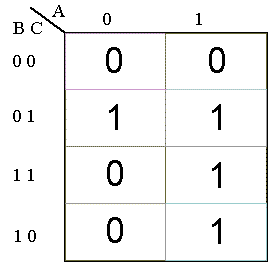
filled_8_cell_karnaugh_map.gif

In this method, the numbers above the cells indicate the value of the variables whereas in the first method they don't? So do I assume the variables to initially be at 1? I've read several websites and watched videos and I can't seem to figure it out.
 
Last edited by a moderator:
Engineering news on Phys.org
DiamondV said:
Now, what I don't understand is with this method is that do I assume the variables to be initially 1?
There is no initial state where such a question would make sense.
All three tables are just different notations for the same thing (well, the third table corresponds to a different logic with different input variables).
"1" or "0", and "##Z##" or"##\overline Z##", represent the same thing.
 
  • Like
Likes   Reactions: DiamondV
mfb said:
There is no initial state where such a question would make sense.
All three tables are just different notations for the same thing (well, the third table corresponds to a different logic with different input variables).
"1" or "0", and "##Z##" or"##\overline Z##", represent the same thing.
So z =1, and z bar = 0. Is that what I assume for the second table
 
The label "##Z##" means "if ##Z## is 1".
The label "##\overline Z##" means "if ##\overline Z## is 1".
Perfectly symmetric.
 
  • Like
Likes   Reactions: DiamondV
mfb said:
The label "##Z##" means "if ##Z## is 1".
The label "##\overline Z##" means "if ##\overline Z## is 1".
Perfectly symmetric.
if Z bar is 1 doesn't that mean z=0
 
Sure.

And Z is 1 means Zbar is 0.
 
  • Like
Likes   Reactions: DiamondV

Similar threads

  • · Replies 3 ·
Replies
3
Views
4K
Replies
2
Views
7K
  • · Replies 11 ·
Replies
11
Views
2K
  • · Replies 3 ·
Replies
3
Views
2K
  • · Replies 22 ·
Replies
22
Views
4K
  • · Replies 9 ·
Replies
9
Views
2K
Replies
4
Views
6K
Replies
3
Views
4K
  • · Replies 3 ·
Replies
3
Views
3K
Replies
2
Views
2K