Discussion Overview
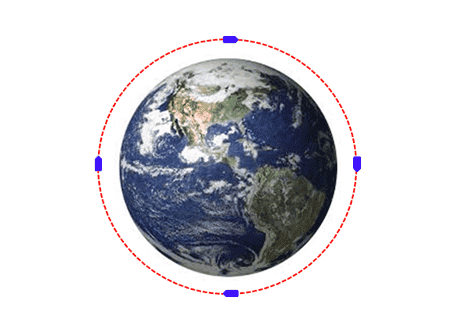
The discussion revolves around the concept of orbital geodesics in general relativity (GR) and how they relate to the motion of a missile orbiting the Earth. Participants explore the implications of geodesics in curved spacetime and how they manifest in different orbital scenarios, including the orientation of the missile during its flight.
Discussion Character
- Exploratory
- Debate/contested
- Technical explanation
Main Points Raised
- Some participants assert that the path of a missile orbiting the Earth can be described as a projection of a geodesic in curved spacetime onto 3D space.
- Others argue that the orientation of the missile (whether it rotates or not) does not affect the geodesic path of its center of mass.
- A participant suggests that the missile's trajectory can be visualized in different ways depending on initial conditions, leading to different interpretations of its motion.
- Some participants emphasize that the rotation of the missile does not follow a geodesic, as geodesics pertain to point-like particles in the absence of non-gravitational forces.
- There is a discussion about how Newtonian mechanics views the orbit as a circle in 3D space, contrasting with GR's perspective on geodesics.
- Participants mention that the missile's motion is influenced by internal forces and initial conditions, which complicates the relationship between its orientation and geodesic path.
Areas of Agreement / Disagreement
Participants do not reach a consensus on whether the missile's orientation affects its geodesic path. Multiple competing views remain regarding the relationship between the missile's rotation and its trajectory in both Newtonian and relativistic frameworks.
Contextual Notes
Participants note that the missile's behavior can vary based on initial launch conditions and that the motion of its center of mass is distinct from the motion of its individual parts. The discussion highlights the complexity of applying GR concepts to real-world scenarios.