Understanding the Behavior of a Combination Clipper Circuit

  • Thread starter Thread starter waffle123
  • Start date Start date
  • Tags Tags
    Combination
Click For Summary

Discussion Overview

The discussion revolves around understanding the behavior of a combination clipper circuit, particularly focusing on the output voltage in response to a sine wave input. Participants explore the implications of diode biasing and current flow within the circuit, as well as the theoretical output voltage under various conditions.

Discussion Character

  • Exploratory
  • Technical explanation
  • Debate/contested
  • Homework-related

Main Points Raised

  • One participant outlines the expected behavior of the circuit based on different input voltage ranges, noting the conditions under which each diode is forward or reverse biased.
  • Another participant questions the real-world applicability of the circuit, suggesting that it may illustrate a lesson rather than represent a practical scenario.
  • There is a suggestion to apply Kirchhoff's Voltage Law (KVL) and Kirchhoff's Current Law (KCL) to analyze the circuit further.
  • A participant expresses uncertainty about the output voltage when both diodes are forward biased, proposing several possible values (-5v, -3v, or -7v) without reaching a conclusion.
  • Another participant encourages tracing current flow and voltage levels for various output voltages (-10V, -6V, -4V, 0V) to deepen understanding.
  • One participant proposes that the output voltage when both diodes are forward biased could be -3V, based on the assumption that the 5V cell would discharge onto the 2V cell.
  • A later reply questions whether both diodes can ever be forward biased simultaneously and suggests a method to visualize the output voltage as the input voltage is varied.

Areas of Agreement / Disagreement

Participants express differing views on the circuit's behavior and its practical implications. There is no consensus on the output voltage when both diodes are forward biased, and multiple hypotheses are presented without resolution.

Contextual Notes

Participants note potential limitations in the circuit's design and its representation of real-world behavior, indicating that assumptions about current flow and voltage levels may not hold in practical applications.

waffle123
Messages
3
Reaction score
0
Poster has been reminded to post schoolwork questions in the Homework Help forums
Ok so my teacher gave us this as an assignment:
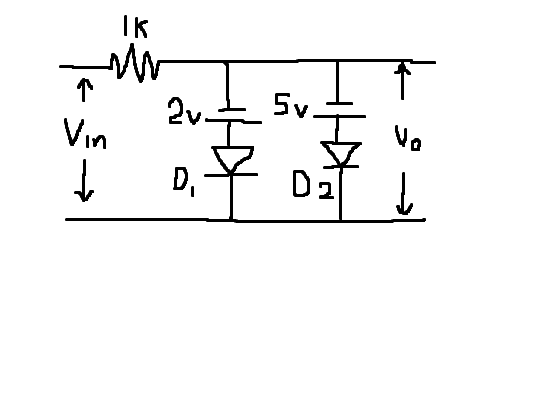
Untitled.png

and was tasked with drawing the output voltage. The input voltage is a sine wave with 10v and -10v as its peaks.

So I know that the positive cycle will have both diodes be forward biased and the negative cycle will have 3 parts. First is when Vin<2v, both diodes are forward biased; Second is when 2v<Vin<5, D1 is reverse biased and D2 is Forward biased so Vo=-5v; And the last part is when Vin>5v, both diodes are reverse biased so Vo=Vin.

Now what confuses me is when both diodes are forward biased so the diodes turn into a short, leaving 2 cells with different voltages in parallel which I don't think is good/posibble. If it is ppossible then I'm not sure what is Vo is. I'm thinking it's -5v, -3v or -7v.

Anyways, can someone help me out here?
 
Physics news on Phys.org
You are correct. This is a poorly drawn pedantic circuit. There are obvious real world problems with it.

So what is it trying to teach? Reworded, what are you studying?

Think about the current flow. Where does it go?

If there is no current flow (since there's no current path) what happens?

Of course real circuits have both current and voltage, which makes this an odd duck. I'm sure it's supposed to illustrate a lesson, but without knowing your coursework, I can't guess what that is.

In any case, you can't go wrong with KVL and KCL. Apply them. Find numbers.
 
Sorry about the drawing. I did it with a mouse.

Right now we just started with learning about clippers. We've talked about the different types of clippers(positive, negative, combination, etc) and illustrated the output wave of each if the input wave was a sine wave.

I do believe the resistor is unimportant right now since it wasn't used in the examples he gave us.

I don't exactly know what the purpose of this is. I think he's trying to see if we can apply what we learned to an unfamiliar case.

I'm sorry if this post isn't of any help. I'm rather tired right now and need to sleep so I can't really think well.
 
So what happens if the output voltage is -10V? What about -6V? What about -4V? What about 0V?

Give it some thought. Trace out the current flow and voltage levels.
 
I believe the 5v cell would discharge onto the 2v cell so that they'd be at the same voltage which would be 3v. If that is the case then that would mean that the output voltage for when the diodes are forward biased would be -3v.
Am I right?
 
I don't see a problem with the circuit :-) Can both diodes ever be forward bias?

Set the input to -10v and redraw it with +ve nodes at the top of the page. Then gradually increase vin to -5v. Plot vout vs vin. Can Vout ever get much higher than say -5v + vbe ?
 

Similar threads

  • · Replies 7 ·
Replies
7
Views
1K
  • · Replies 8 ·
Replies
8
Views
2K
  • · Replies 11 ·
Replies
11
Views
2K
  • · Replies 19 ·
Replies
19
Views
5K
  • · Replies 2 ·
Replies
2
Views
4K
  • · Replies 9 ·
Replies
9
Views
6K
  • · Replies 7 ·
Replies
7
Views
3K
Replies
7
Views
2K
  • · Replies 6 ·
Replies
6
Views
6K
  • · Replies 3 ·
Replies
3
Views
2K