Understanding the Bouncing and Rolling Motion of a Cube (Die) on a Slope

  • Thread starter Thread starter Mins
  • Start date Start date
Click For Summary

Homework Help Overview

The discussion revolves around the dynamics of a cube (specifically a die) as it bounces and rolls down a slope inclined at 45 degrees. Participants are exploring the concepts of rolling motion, elasticity, and the forces involved in the motion of the die.

Discussion Character

  • Exploratory, Conceptual clarification, Assumption checking

Approaches and Questions Raised

  • The original poster attempts to understand the conditions under which the die bounces and rolls, questioning the role of elasticity and the nature of rolling motion when airborne. They also inquire about the axis of the die and conservation principles involved.
  • Some participants describe the asymmetrical interaction of the die with the surface and the resulting rotational motion due to forces acting at a distance from the center of mass.
  • Further inquiries arise regarding the formulation of equations to describe these dynamics, with participants seeking clarification on the concepts presented.

Discussion Status

The conversation is ongoing, with participants actively questioning and clarifying concepts related to the motion of the die. While some guidance has been offered regarding the forces and moments involved, there is no explicit consensus or resolution yet.

Contextual Notes

Participants are operating under the assumption that air resistance is negligible, which may influence their understanding of the bouncing and rolling dynamics. The discussion also touches on the complexities of three-dimensional motion and the nature of collisions involving the die.

Mins
Messages
16
Reaction score
0
How a cube(a die) rolls(rolling motion help)

I want to show how a cube bounces and rolls when dropped from a slope(45 degrees).
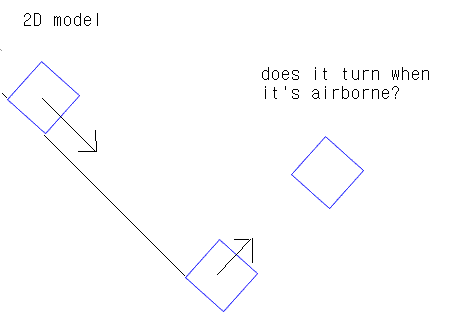
die rolls.GIF

I'm trying to make this problem as easy as possible, so I've ruled out air current.
How will it bounce? Think I need to use 'e'(elasticity)(which is roughly 0.3)...
Then, I don't understand why it rolls when it's airborne... Does it roll at all? Did I miss something?

Another thing that bothers me is it's rolling motion when it's not bouncing up and down...
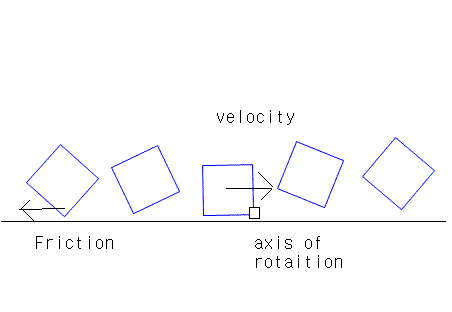
die rolls 1.GIF
(Not sure of it and don't know what determines rolling friction)
Where does the axis of the die lie?
and what is conserved, and what isn't?

extra)http://director-online.com/buildArticle.php?id=1075#dice
 
Last edited:
Physics news on Phys.org
Die are three dimensional objects. The interaction with a surface is asymmetric (striking a surface on one corner, edge or face), and the force acting in opposition to forward motion acts at a distance to its center of mass, which produces a 'moment' about the center of mass, and hence the development of rotational motion.

The collision is largely elastic since there is little deformation of the surface or die.
 
I think I understand but

Astronuc said:
the force acting in opposition to forward motion acts at a distance to its center of mass, which produces a 'moment' about the center of mass, and hence the development of rotational motion.
QUOTE]

I'm sorry if I'm asking too much, but can you make a formula out of this?
 
...

or suggest a formula to calculate?
 

Similar threads

  • · Replies 9 ·
Replies
9
Views
2K
  • · Replies 32 ·
2
Replies
32
Views
4K
Replies
2
Views
3K
  • · Replies 4 ·
Replies
4
Views
5K
  • · Replies 5 ·
Replies
5
Views
3K
  • · Replies 2 ·
Replies
2
Views
2K
  • · Replies 3 ·
Replies
3
Views
4K
  • · Replies 6 ·
Replies
6
Views
2K
  • · Replies 9 ·
Replies
9
Views
3K
  • · Replies 6 ·
Replies
6
Views
6K