Understanding the Concept of Sea Level in Relation to Mountain Height

  • Thread starter Thread starter Julian Solos
  • Start date Start date
  • Tags Tags
    Sea level
Click For Summary
SUMMARY

The discussion centers on the definition and implications of sea level in relation to mountain height, specifically addressing Mount Everest's elevation of 8,848 meters above sea level as defined by the US Geological Survey. Sea level is established as an arbitrary zero point, averaged out for tidal variations, and is determined through geodesy using modern GPS technology. The conversation highlights that while Everest is the highest mountain above sea level, Mauna Kea in Hawaii is taller when measured from its base on the ocean floor. The complexities of measuring sea level across different locations, including local variations and the influence of gravitational forces from the moon and sun, are also discussed.

PREREQUISITES
  • Understanding of geodesy and its role in defining sea level.
  • Familiarity with GPS technology and its application in surveying.
  • Knowledge of tidal forces and their impact on sea level measurements.
  • Basic principles of trigonometry for altitude calculations.
NEXT STEPS
  • Research the methods used in geodesy for determining the geoid and sea level.
  • Explore the role of GPS in modern surveying techniques.
  • Investigate tidal forces and their effects on local sea level variations.
  • Learn about the use of barometric altimeters in measuring altitude.
USEFUL FOR

Geographers, geologists, surveyors, and anyone interested in understanding the relationship between sea level and mountain height, as well as the methodologies used in measuring these phenomena.

  • #31
Amazing GRACE

Nereid

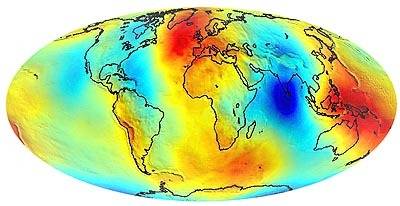
Amazing GRACE :wink: and GOZE and breath taking results:

GOCE_S_C2_geoid_bg_L.jpg


Notice that the deep red areas are more or less -very roughly- antipode. That reminds me of another World map in relation to sea levels:

http://home.wanadoo.nl/bijkerk/palaeogeography.GIF

With a little imagination you could draw an oblique geographic world from that, the poles being in the centre of the blue spots, the equator following the big orange wave. Aint it curious?

This is the origine of that second pic: http://www.sciencemag.org/cgi/content/full/295/5564/2438
 
Last edited by a moderator:
Earth sciences news on Phys.org
  • #32
Andre said:
some usefull links for Dutch sea level history:

http://www.ncg.knaw.nl/SubBZ/BeginSubBZ.htm
http://hanserren.cwhoutwijk.nl/co2/denhelder.html
That second link is very interesting. Actually I just remember now.. a few weeks ago there was a very stormy western wind. I was at the west of the IJsselmeer (a lake) and the water level was SO low! that you could actually go down and walk on the bottom of the lake for a considerable length from the bank.. reminded me of that tale where the water parted and Jesus walked across a lake.. sounds very possible in such a scenario :biggrin:
 
Last edited by a moderator:

Similar threads

  • · Replies 23 ·
Replies
23
Views
5K
Replies
1
Views
2K
  • · Replies 6 ·
Replies
6
Views
2K
  • · Replies 2 ·
Replies
2
Views
2K
  • · Replies 42 ·
2
Replies
42
Views
9K
  • · Replies 14 ·
Replies
14
Views
1K
  • · Replies 2 ·
Replies
2
Views
2K
  • · Replies 4 ·
Replies
4
Views
4K
Replies
31
Views
4K
Replies
2
Views
2K