Understanding the concept of voltage

Click For Summary
SUMMARY

The discussion centers on the concept of voltage, defined as the difference in electric potential between two points, denoted as ##V_{ab}## or ##\Delta{V}##. It clarifies that ##V_{ab} = V_a - V_b## and emphasizes that the selection of points ##a## and ##b## is crucial for understanding the integration path in electrostatics. The voltage is calculated using the formula $$\Delta V = V(\vec{x}_b) - V(\vec{x}_a)$$, and the direction of integration can be interpreted based on the configuration of measurement tools like voltmeters.

PREREQUISITES
  • Understanding of electric potential and voltage concepts
  • Familiarity with line integrals in vector calculus
  • Knowledge of electrostatics and electric fields
  • Basic understanding of measurement tools like voltmeters
NEXT STEPS
  • Study the mathematical definition of electric potential in electrostatics
  • Learn about line integrals and their applications in physics
  • Explore the relationship between electric fields and voltage using Maxwell's equations
  • Investigate practical applications of voltmeters and their measurement techniques
USEFUL FOR

Students of physics, electrical engineers, and anyone interested in understanding the principles of voltage and electric potential in electrostatics.

luca54
Messages
4
Reaction score
0
Hi everyone!

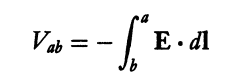
I ask some help in understanding better the concept of voltage. The voltage is a difference in electric potential between two points ##a## and ##b##. It is defined as
1579042968372.png


However, I'm a bit confused with the use of notation:

- Is ##V_{ab}## the same as ##\Delta{V}##, or rather ##-\Delta{V}##? In fact, ##V_{ab}## is also written as ##V_a-V_b##, while ##\Delta{V}## should be a difference between a final and an initial position.
- What do ##a## and ##b## represent? They are extrema of integration, but how do we select them in a problem, one as the starting position and the other as the arrival? What does the integration from one to the other (and not vice versa) mean?

Eventually, I would like to add another question, this one about the integrand:

- What is concretely ##dl##, and what is its direction?

Thanks very much!
 

Attachments

  • 1579043121536.png
    1579043121536.png
    13.9 KB · Views: 294
Last edited by a moderator:
Physics news on Phys.org
Looks like you are copy-pasting from stack exchange. For inline LaTeX you have to replace the SE $ with the PF ##

I reverted and updated for you
 
Ah thanks a lot!
Yes, I've posted the question also there, but it hasn't been directly answered, and my doubts are still there :confused::frown:
 
This is only true for electrostatics, because only then the electric field has a potential, independent of the integration path in your formula, i.e., you can use any path connecting the points with the position vectors ##\vec{x}_a## and ##\vec{x}_b##. The potential is defined as
$$V(\vec{x})=-\int_{C(\vec{x}_0,\vec{x})} \mathrm{d} \vec{r} \cdot \vec{E}(\vec{r}),$$
where ##C(\vec{x}_0,\vec{x})## is an arbitrary curve connecting an arbitrary fixed point ##\vec{x}_0## with the variable point ##\vec{x}##. Then you have
$$\vec{E}(\vec{x})=-\vec{\nabla} V(\vec{x}).$$
The voltage is simply the difference of the potentials between the two points in question,
$$\Delta V=V(\vec{x}_b)-V(\vec{x}_a).$$
Since the line integral defining ##V## only depends on the initial an final points of the path, you get
$$\Delta V=-\int_{C'(\vec{x}_a,\vec{x}_b)} \mathrm{d} \vec{r} \cdot \vec{E}(\vec{r}),$$
where ##C'(\vec{x}_a,\vec{x}_b)## is an arbitrary path connecting the points at ##\vec{x}_a## and ##\vec{x}_b##.
 
  • Like
Likes luca54
vanhees71 said:
This is only true for electrostatics, because only then the electric field has a potential, independent of the integration path in your formula, i.e., you can use any path connecting the points with the position vectors ##\vec{x}_a## and ##\vec{x}_b##. The potential is defined as
$$V(\vec{x})=-\int_{C(\vec{x}_0,\vec{x})} \mathrm{d} \vec{r} \cdot \vec{E}(\vec{r}),$$
where ##C(\vec{x}_0,\vec{x})## is an arbitrary curve connecting an arbitrary fixed point ##\vec{x}_0## with the variable point ##\vec{x}##. Then you have
$$\vec{E}(\vec{x})=-\vec{\nabla} V(\vec{x}).$$
The voltage is simply the difference of the potentials between the two points in question,
$$\Delta V=V(\vec{x}_b)-V(\vec{x}_a).$$
Since the line integral defining ##V## only depends on the initial an final points of the path, you get
$$\Delta V=-\int_{C'(\vec{x}_a,\vec{x}_b)} \mathrm{d} \vec{r} \cdot \vec{E}(\vec{r}),$$
where ##C'(\vec{x}_a,\vec{x}_b)## is an arbitrary path connecting the points at ##\vec{x}_a## and ##\vec{x}_b##.

Thanks very much for the answer!
 
luca54 said:
What does the integration from one to the other (and not vice versa) mean?
Since you have responses about the other portions, I thought I would address this. If you have a typical voltmeter then A will be your red lead wire and B will be your black lead wire. So integrating from A to B or from B to A is just a matter of switching your lead wires.
 
  • Like
Likes etotheipi, vanhees71 and sophiecentaur

Similar threads

  • · Replies 10 ·
Replies
10
Views
2K
  • · Replies 4 ·
Replies
4
Views
10K
  • · Replies 1 ·
Replies
1
Views
2K
  • · Replies 17 ·
Replies
17
Views
3K
  • · Replies 4 ·
Replies
4
Views
1K
  • · Replies 3 ·
Replies
3
Views
2K
Replies
8
Views
3K
  • · Replies 1 ·
Replies
1
Views
1K
  • · Replies 18 ·
Replies
18
Views
3K
Replies
0
Views
2K