Understanding the Derivation of Reciprocal Lattice Basis from Equations 5 and 6

Click For Summary

Discussion Overview

The discussion focuses on the derivation of the reciprocal lattice basis vectors from specific equations, particularly equations 5 and 6. Participants seek clarification on the steps involved in determining these vectors, which are relevant to the study of crystallography and solid-state physics.

Discussion Character

  • Technical explanation
  • Mathematical reasoning

Main Points Raised

  • One participant requests a detailed explanation of how the formulas for the reciprocal lattice vectors ##b_i## are derived from equations 5 and 6.
  • Another participant asserts that the formulas for ##b_i## satisfy the necessary equations and provides a verification method involving the dot product and linear independence of the vectors ##a_i##.
  • A participant suggests a method for deriving ##b_1## by expressing it in terms of the cross product of other lattice vectors and solving for a constant using a specific equation.
  • Further clarification is provided by reiterating the method to find ##b_1##, emphasizing its orthogonality to other vectors and the use of a specific equation to determine a constant.

Areas of Agreement / Disagreement

Participants appear to have differing levels of understanding regarding the derivation process, with some seeking more detailed steps while others provide explanations. The discussion does not reach a consensus on the clarity of the derivation steps.

Contextual Notes

The discussion lacks explicit details on the assumptions made during the derivation process and does not fully resolve the steps involved in deriving the reciprocal lattice vectors.

sam45
Messages
3
Reaction score
0
TL;DR
I am trying to understand how to determine the reciprocal lattice basis from the lattice basis vectors
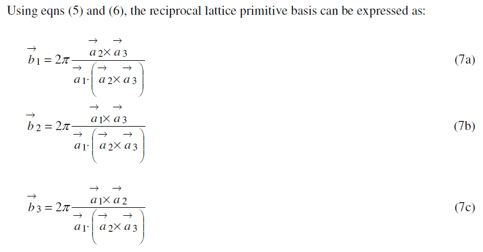
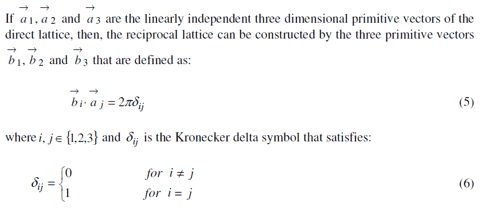
may someone explain to me or show me the steps of how equations 7a, 7b, 7c were determined from equations 5 and 6
1578337028016.png

1578337041041.png
 
Physics news on Phys.org
You can check directly that those formulas for the ##b_i## satisfy the equations that you want. For example, ##b_1\cdot a_1=2\pi\frac{a_1\cdot (a_2\times a_3)}{a_1\cdot (a_2\times a_3)}=2\pi##.

Since the vectors ##a_i## are linearly independent, the equations ##b_i\cdot a_j=2\pi\delta_{ij}## can be uniquely solved for the ##b_i##, and hence the above are the unique solutions.

If you wanted to figure out these formulas from scratch, you could argue like this: since ##b_1## is orthogonal to both ##a_2## and ##a_3##, you know that ##b_1=c_1 (a_2\times a_3)## for some constant ##c_1##. Then the equation ##a_1\cdot b_1=2\pi## let's you solve for ##c_1##, etc.
 
hello,

thank you. yes, but my question is how are they solved for bi i.e. what are the steps to find b1 for example

thank you
 
See the last paragraph of my post
Infrared said:
If you wanted to figure out these formulas from scratch, you could argue like this: since ##b_1## is orthogonal to both ##a_2## and ##a_3##, you know that ##b_1=c_1 (a_2\times a_3)## for some constant ##c_1##. Then the equation ##a_1\cdot b_1=2\pi## let's you solve for ##c_1##, etc.
 
  • Like
Likes   Reactions: sam45
thank you for your help!
 

Similar threads

  • · Replies 20 ·
Replies
20
Views
3K
  • · Replies 3 ·
Replies
3
Views
3K
  • · Replies 3 ·
Replies
3
Views
2K
  • · Replies 3 ·
Replies
3
Views
6K
  • · Replies 2 ·
Replies
2
Views
3K
  • · Replies 4 ·
Replies
4
Views
3K
  • · Replies 43 ·
2
Replies
43
Views
8K
  • · Replies 1 ·
Replies
1
Views
4K
Replies
2
Views
2K
  • · Replies 6 ·
Replies
6
Views
1K