Understanding the heat equation solution derived in this article

  • Thread starter Thread starter Makadamij
  • Start date Start date
Click For Summary
SUMMARY

This discussion focuses on solving the heat equations related to the photoacoustic effect in a photoacoustic cell, specifically analyzing the temperature distribution within the cell. The equations include two homogeneous heat equations for the backing material and gas, and a non-homogeneous heat equation for the solid material. The participants discuss the challenges of solving these equations without boundary conditions and suggest using numerical methods like the finite difference method for the non-homogeneous equation. The conversation highlights the importance of oscillatory steady state solutions and the use of real variables over complex variables in the analysis.

PREREQUISITES
  • Understanding of partial differential equations (PDEs)
  • Familiarity with the photoacoustic effect and its applications
  • Knowledge of numerical methods, particularly the finite difference method
  • Experience with variable separation techniques in solving PDEs
NEXT STEPS
  • Research the finite difference method for solving non-homogeneous PDEs
  • Study the derivation of oscillatory steady state solutions in heat equations
  • Explore the application of boundary conditions in heat transfer problems
  • Investigate the phase delay in photoacoustic signals for quantitative spectroscopy
USEFUL FOR

Researchers, physicists, and engineers working in the fields of thermodynamics, photoacoustic imaging, and heat transfer analysis will benefit from this discussion.

Makadamij
Messages
7
Reaction score
2
Homework Statement
Try to understand the solving method of the three heat equations given in the following article.
Relevant Equations
1-dimensional heat equations - see the pictures below, please:
Hello everyone!

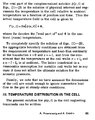
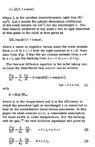
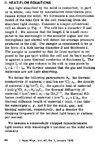
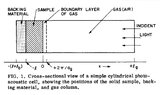
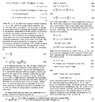
I'm analysing a scientific paper regarding the theory of the photoacoustic effect. The subject of investigation is a so called photoacoustic cell, in which a higly light-absorbing solid material is placed on a backing material and the rest of the cell is filled with gas (see picture below). Only the solid material is capable of absorbing light and converting it into heat. The cell is illuminated by sinosoidal chopped monochromatic light flux. The goal is to find the settled temperature distribution inside the cell. Therefore, three heat equations have been set up in picture pg65_2, two homogenous ones for the backing material and the gas and a non homogeneous heat equation for the solid, because heat is being created inside of it because of light absorption. The general solutions to these three equations are in picture pg66_1, not taking into account the boundary conditions of heat flux continuity.

I wanted to understand how they came up with these solution without using the boundary conditions, therefore I tried to solve the two homogenous ones via variable separation. Although no initial conditions are given, I assumed they are zero, because the backing material and gas do not absorb any light and therefore their temperature at t=0 is equal to the ambient temperature. However, then I didn't know how to calculate the b_n variables, since they would all became zero, hence the solution would be zero.

I would be very thankful I you could give me some advice on how to solve those equations or at least get some insight of the methods the researchers have used.
 

Attachments

  • pg66_1.jpg
    pg66_1.jpg
    85.6 KB · Views: 131
  • pg65_3.jpg
    pg65_3.jpg
    55.3 KB · Views: 131
  • pg65_2.jpg
    pg65_2.jpg
    50.8 KB · Views: 147
  • pg65_1.jpg
    pg65_1.jpg
    79.8 KB · Views: 126
  • cell.jpg
    cell.jpg
    18.4 KB · Views: 133
Physics news on Phys.org
What is the publication you are quoting (I don't see a citation)?? I co-authored a paper about using the phase delay of the photoacoustic signal to do quantitative spectroscopy (1978 maybe) This looks vaguely familiar.
 
  • Like
Likes   Reactions: berkeman
hutchphd said:
What is the publication you are quoting (I don't see a citation)??
Hello,

it can be found here: http://www.edcc.com.cn/en/upload/newsfile/202008/1596532988i77e2ebw.pdf

I have thought a bit and given that my problem actually consists of a system of differential equations rather than individual ones, I probably won't be able to solve any of those two homogenous ones without solving the non-homogenous one? But the latter can probably only be solved using numerical methods, like the finite difference method.
 
My recollection is that the solution is obtained for the 6 useful limiting cases in that cited paper for a continuous sinusoidal excitation. Not knowing your setup I do not know what you will produce.. The paper is pretty straightforward I think, and I am not enthusiastic about immediately jumping to some more complicated numerical solution .
 
What they are trying to solve for here is the long time solution, when the system has reached "oscillatory steady state." This is where the temperature at each x value oscillates with a constant amplitude ##\phi^*(x)##, with the angular frequency ##\omega##, and with a phase angle that also depends on x. In this oscillatory steady state, the temperature variation is independent of the initial conditions.

If I were solving this, I would not use complex variables. Instead, I would solve the equation ##\frac{\partial ^2\phi}{\partial x^2}=\frac{1}{\alpha}\frac{\partial \phi}{\partial t}-Ae^{\beta x}(1+\cos{\omega t})## using real variables (and with the equations for the other media unchanged).

You can represent the solution at oscillatory steady state as $$\phi=\phi_0(x)+\phi_1(x)\cos{\omega t}+\phi_2(x)\sin{\omega t}\tag{1}$$where ##\phi_0## satisfies $$\frac{\partial ^2\phi_0}{\partial x^2}=-Ae^{\beta x}$$and ##\phi_1## and ##\phi_2## correspond to $$\frac{\partial ^2\phi}{\partial x^2}=\frac{1}{\alpha}\frac{\partial \phi}{\partial t}-Ae^{\beta x}\cos{\omega t}$$Substituting Eqn. 1 intro the differentail equation leads to two coupled 2nd order ODEs in x involving ##\phi_1## and ##\phi_2## (the terms involving time factor out).
 
  • Like
Likes   Reactions: vanhees71, hutchphd and SammyS
Hello,

thank you very much for your detailed answer. The steps you've written seem very intuitive and make physical sense to me.

If I understand it correctly, the authors solved the three heat equations in the article for the dc-steady state separately, where they tried to find such a temperature function, where ##\frac{\partial ^2\phi}{\partial x^2}## would be equal to zero for the backing material/gas and equal to ##-Ae^{\beta x}## for the solid sample.

I have now tried to solve the heat equation for the gas, which is a homogenous PDE ##\frac{\partial ^2\phi}{\partial x^2}=\frac{1}{\alpha_g}\frac{\partial \phi}{\partial t}##, using variable separation. For the time dependent function I get ##F(t) = Ae^{-\alpha_g^{2}k^{2}t}## and for the ##x## dependent function I get ##G(x) = B\cos{kx}+C\sin{kx}##, where k is some negative constant I have used during the variable separation part. I have set the boundary conditions such that at ##x=l## the temperature ##\phi(t, l) = 0## and at ##x=0## it has some arbitrary value ##\phi(t, 0) = T##, depending on the temperature of the solid sample. Putting those boundary conditions into the function F(t) and G(x), I get: ##F(t)G(0) = F(t)B = T## and ##F(t)G(l) = F(t)(B\cos{kl}+C\sin{kl}) = 0##. When substituting ##T/F(t)## instead of B into the latter equation, I get a transcedental function, because the F(t) is an exponential function. I suppose the component with the exponential function is the component the authors have omitted in the solution, as can be read in the picture pg66_1. So that would mean, that I'll have to take into account only the cosine component and use it to calculate the constant k, so ##T\cos(kl) = 0##. However, then I get ##T\cos{\frac{\pi nx}{2l}}##, which is nowhere near the solution the authors would get: ##Te^{\sigma_gx + j\omega t}##, where ##\sigma_g = (1+j)a_g## and ##a_g = (\omega/(2\alpha_g))^{1/2}## .
 
Last edited:
Makadamij said:
Hello,

thank you very much for your detailed answer. The steps you've written seem very intuitive and make physical sense to me.

If I understand it correctly, the authors solved the three heat equations in the article for the dc-steady state separately, where they tried to find such a temperature function, where ##\frac{\partial ^2\phi}{\partial x^2}## would be equal to zero for the backing material/gas and equal to ##-Ae^{\beta x}## for the solid sample.

I have now tried to solve the heat equation for the gas, which is a homogenous PDE ##\frac{\partial ^2\phi}{\partial x^2}=\frac{1}{\alpha_g}\frac{\partial \phi}{\partial t}##, using variable separation. For the time dependent function I get ##F(t) = Ae^{-\alpha_g^{2}k^{2}t}## and for the ##x## dependent function I get ##G(x) = B\cos{kx}+C\sin{kx}##, where k is some negative constant I have used during the variable separation part. I have set the boundary conditions such that at ##x=l## the temperature ##\phi(t, l) = 0## and at ##x=0## it has some arbitrary value ##\phi(t, 0) = T##, depending on the temperature of the solid sample. Putting those boundary conditions into the function F(t) and G(x), I get: ##F(t)G(0) = F(t)B = T## and ##F(t)G(l) = F(t)(B\cos{kl}+C\sin{kl}) = 0##. When substituting ##T/F(t)## instead of B into the latter equation, I get a transcedental function, because the F(t) is an exponential function. I suppose the component with the exponential function is the component the authors have omitted in the solution, as can be read in the picture pg66_1. So that would mean, that I'll have to take into account only the cosine component and use it to calculate the constant k, so ##T\cos(kl) = 0##. However, then I get ##T\cos{\frac{\pi nx}{2l}}##, which is nowhere near the solution the authors would get: ##Te^{\sigma_gx + j\omega t}##, where ##\sigma_g = (1+j)a_g## and ##a_g = (\omega/(2\alpha_g))^{1/2}## .
Like I said, you should be using $$\phi=B(x)\cos{\omega t}+C(x)\sin{\omega t}$$Then the differential equation becomes $$B^"\cos{\omega t}+C^"\sin{\omega t}=\frac{\omega}{\alpha}[-B\sin{\omega t}+C\cos{\omega t}]$$This then gives:
$$B^"=\frac{\omega}{\alpha}C$$and$$C^"=-\frac{\omega}{\alpha}B$$Then $$B^{iv}=-\left(\frac{\omega}{\alpha}\right)^2B$$and$$C^{iv}=-\left(\frac{\omega}{\alpha}\right)^2C$$
 
The solution for the function B in the gas and in the substrate is $$B(x)=D\cosh{\left(\sqrt{\frac{\omega}{2\alpha}}x\right)}\cos{\left(\sqrt{\frac{\omega}{2\alpha}}x\right)}$$$$+E\cosh{\left(\sqrt{\frac{\omega}{2\alpha}}x\right)}\sin{\left(\sqrt{\frac{\omega}{2\alpha}}x\right)}$$$$+F\sinh{\left(\sqrt{\frac{\omega}{2\alpha}}x\right)}\cos{\left(\sqrt{\frac{\omega}{2\alpha}}x\right)}$$$$+G\sinh{\left(\sqrt{\frac{\omega}{2\alpha}}x\right)}\sin{\left(\sqrt{\frac{\omega}{2\alpha}}x\right)}$$
 

Similar threads

Replies
0
Views
1K
Replies
1
Views
2K
Replies
2
Views
2K
  • · Replies 6 ·
Replies
6
Views
2K
  • · Replies 2 ·
Replies
2
Views
2K
  • · Replies 4 ·
Replies
4
Views
4K
  • · Replies 7 ·
Replies
7
Views
935
  • · Replies 8 ·
Replies
8
Views
3K
  • · Replies 2 ·
Replies
2
Views
1K
  • · Replies 5 ·
Replies
5
Views
2K