Understanding Time Measurement in Physics: Uncertainty and Calculations

Click For Summary

Homework Help Overview

The discussion revolves around measuring time and estimating uncertainties in a physics experiment involving free fall. Participants are exploring how to calculate uncertainties in height and time based on experimental data collected using the phyphox application.

Discussion Character

  • Exploratory, Assumption checking, Conceptual clarification

Approaches and Questions Raised

  • Participants are questioning how to set the uncertainty in height (ΔH) and whether it should be zero or a small value based on measurement error. There are discussions about the meaning of the threshold value in the phyphox app and how it relates to time calculations (ΔT). Some are considering different methods for calculating uncertainties and whether they should remain constant across different heights.

Discussion Status

There is an active exploration of the concepts of uncertainty in measurements, with participants providing insights and suggestions for estimating uncertainties. Some guidance has been offered regarding the interpretation of the threshold in the phyphox app and how to approach the calculations, although there is no explicit consensus on the methods to be used.

Contextual Notes

Participants express confusion regarding the units used in the phyphox app and the implications of measurement techniques on uncertainty. There are references to the need for careful measurement and the potential variability in uncertainty based on the method of dropping the object.

srnixo
Messages
51
Reaction score
10
Homework Statement
I'm so confused how to calculate the uncertainties , i suggested a lot of methods i thought about, so please help me! i need a clear answers
Relevant Equations
.
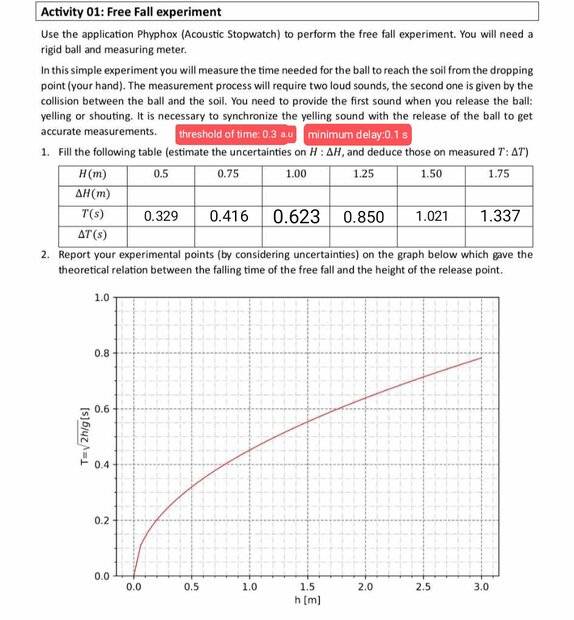
So as you can see in the image, I have noted the time in the [time column (s) ] on the table after conducting the experiment at home using the application phyphox.
1000004603.jpg

And now, I have some questions to fill in the remaining gaps:

The first question: about ΔH (m) :
  • Should I set it equal to zero [ΔH=0] because I didn't calculate it, the values were directly given from the exercise?
  • Or at least 0.1 [ΔH=0.1] due to the potential small error in the measurements of the used meter tool!

  • Or nevertheless, I must calculate it, and let that be in that way :[I don't know if it's correct or not, this is the only method i know]:
    1000004708.jpg


    ----------------------------------------------------------------------------------------------------------------------------
    The second question: about ΔT(s) :
    First of all, in the app phyphox of calculating the T , there were a choice of threshold and minimum delay, and as i mentioned:
    The threshold: 0.3 a.u ( i don't know what does a.u means! i don't even know which unit is that so i can't finish the calculations)
    The minimum delay: 0.1 s
  • So, do i assume that the threshold corresponds to a time interval and i convert it to seconds so it becomes 0.003 seconds and then calculate it using [ Minimum delay + time interval ] which means [0.1+0.003= 0.103 seconds for all of them! ]
  • Or i use the formula ΔT= threshold x measured time + minimum delay so that i keep threshold 0.3
  • Or i calculate it in the same way previously , and i write the same result in all the gaps!
    1000004713.jpg
  • Or there is another correct way? please help!

 
Last edited by a moderator:
Physics news on Phys.org
This is likely the intention:
You need to estimate the uncertainty in height with a reasonable judgement call. How close do you think you were to each precise height you were supposed to drop the object from? I bet you were more careful than 0.1 meter for each height! Use a ruler to help you gauge your likely range if necessary.

With each height you need to calculate the time of fall. This is the prediction of how long it should take according to the free fall 'theory.' You'll compare this against the actual data you recorded for each time.

The formula you use to calculate each time is on the y axis of your graph. To get the uncertainty in time you propagate the uncertainty you estimated in height through the calculation. Hopefully you've been given resources on how to do this. But, if not, you can read about it readily online. If it is new to you, expect to spend a few hours reading and practicing before you feel confident in it.

Now that you have the experimental values of time (assumed to have negligible uncertainty compared to your uncertainty in height) and the theoretical values of time (based on the uncertainty in your measurement of height) you can make a meaningful comparison between the prediction and outcome.
 
  • Like
Likes   Reactions: srnixo and MatinSAR
I largely agree with @brainpushups , but some things worry me.
The wording "uncertainties … in measured T" seems wrong if these are deduced from the intended h and the formula. They may be discrepancies or errors but not uncertainties. An uncertainty in a measurement of T would reflect differences between measured T and the actual time.
What are you expected to plot on the graph? The obvious way is to plot horizontal error bars ##(T_i,[h_i-\Delta h, h_i+\Delta h])##. I don't see what the calculated ##\Delta T## adds.

From reading https://phyphox.org/wiki/index.php/Experiment:_Acoustic_Stopwatch, it seems the "threshold" is the minimum noise level (in some audio units) to register as a trigger and the minimum delay is the minimum time between the two sounds for the app to consider them as two triggers. You do not need to worry about these if it seems to be working.
 
  • Like
Likes   Reactions: brainpushups, srnixo and MatinSAR
srnixo said:
Homework Statement: I'm so confused how to calculate the uncertainties , i suggested a lot of methods i thought about, so please help me! i need a clear answers
Relevant Equations: .

The threshold: 0.3 a.u ( i don't know what does a.u means! i don't even know which unit is that so i can't finish the calculations)
A.U. is "Arbitrary Units".
It seems to apply to the "gain" setting for the sound detector, with highest gain being 1.0. It just has to be high enough to get reliable sound triggering. It would not be involved in, or appear in, the required calculations.

Cheers,
Tom

irrelevant p.s. The A.U. abbreviation also shows up in Astronomy, but is defined there as "Astronomical Unit", the mean distance between the Earth and Sun.
 
  • Like
Likes   Reactions: srnixo and MatinSAR
brainpushups said:
This is likely the intention:
You need to estimate the uncertainty in height with a reasonable judgement call. How close do you think you were to each precise height you were supposed to drop the object from? I bet you were more careful than 0.1 meter for each height! Use a ruler to help you gauge your likely range if necessary.
"But I didn't understand a simple thing, do all the values remain the same or do they change depending on each height?"
According to my knowledge, it depends on the meter tool used so normally the range is gonna be between 0.5 and 0.6 for all the heights isn't?
 
srnixo said:
"But I didn't understand a simple thing, do all the values remain the same or do they change depending on each height?"
According to my knowledge, it depends on the meter tool used so normally the range is gonna be between 0.5 and 0.6 for all the heights isn't?

By "the values" do you mean the values of the uncertainty? That is up to you. I expect them to be similar, and perhaps the same, but that doesn't have to be the case.

For example, when you measure 0.50 meters and try to drop the object from that height did you do something like support the object on something like a clipboard right next to the meter stick's 0.5 meter mark and have very little 'wiggle' in your arm before dropping it? In that case I'd imagine that ± 0.005 m (half a centimeter) is a plausible range. Or were you less careful than that? If you just dropped it by holding it with your hand and were less steady, then maybe 0.01 or 0.02 meters (1 or 2 cm) is a more honest assessment of your uncertainty.

If you dropped the thing the same way for each height then I'd imagine that having the same absolute uncertainty (measured in m or cm) stays the same. There could be other factors to consider, like if you had to move the meter stick to measure 1.75 m, but I'd guess any other sources of error are negligible compared to your ability to hold the object still (provided they were done with care). The extra millimeter or two of uncertainty that moving a meter stick may introduce is insignificant compared to the half centimeter or more of uncertainty you judge.

Though the absolute uncertainty may stay the same note that your relative uncertainty in height will decrease. Let's assume you go with ±1 cm for a reasonable uncertainty. For the 50 cm drop that is a 2% relative uncertainty, but in the 100 cm drop it is only 1%. You'll end up using these percentages as part of the error propagation.
 
  • Like
Likes   Reactions: srnixo
brainpushups said:
For example, when you measure 0.50 meters and try to drop the object from that height did you do something like support the object on something like a clipboard right next to the meter stick's 0.5 meter mark and have very little 'wiggle' in your arm before dropping it? In that case I'd imagine that ± 0.005 m (half a centimeter) is a plausible range. Or were you less careful than that? If you just dropped it by holding it with your hand and were less steady, then maybe 0.01 or 0.02 meters (1 or 2 cm) is a more honest assessment of your uncertainty.
I got it right now, Thank you so much.
 

Similar threads

  • · Replies 33 ·
2
Replies
33
Views
2K
  • · Replies 4 ·
Replies
4
Views
1K
Replies
15
Views
3K
  • · Replies 12 ·
Replies
12
Views
1K
  • · Replies 7 ·
Replies
7
Views
2K
  • · Replies 7 ·
Replies
7
Views
5K
  • · Replies 16 ·
Replies
16
Views
2K
  • · Replies 3 ·
Replies
3
Views
4K
  • · Replies 8 ·
Replies
8
Views
2K
  • · Replies 20 ·
Replies
20
Views
2K